
At WiseGEEK, we're committed to delivering accurate, trustworthy information. Our expert-authored content is rigorously fact-checked and sourced from credible authorities. Discover how we uphold the highest standards in providing you with reliable knowledge.
What Does It Mean If a Fetus Is in the Posterior Position?
 Nicole Madison
Nicole Madison
Nicole Madison
When a fetus is in the posterior position, this means he is head down but his face is positioned toward his mother's abdomen while the back of his head is facing the back of her pelvic region. This position doesn't usually mean much, as babies often change positions during labor and delivery, and most eventually end up in the face-down position that most doctors consider desirable. If the baby does not reposition himself, however, a woman can usually still have a vaginal birth, but she may feel more labor pain in her back than if the baby was in a face-down position, and in some cases, labor may progress more slowly or require intervention.
To a woman who has heard that her baby should be in a face-down position for delivery, learning that her baby is in a posterior position may lead to worry. Often, women wonder whether they can have a normal vaginal delivery when a baby is in this position. In most cases, this positioning will not interfere with a woman's ability to give birth vaginally. In fact, it usually doesn't cause any problems, since many babies change positions before and during labor. As such, a baby may begin in a posterior position in the womb and then change to a face-down position before delivery, but even if the position doesn't change, it won't usually interfere with delivery.

Though a baby who is in a posterior position can be delivered vaginally, his mother may sometimes endure additional discomfort because of this position. Some people believe that when a baby is face up, a woman is more likely to experience a great deal of lower back pain during labor. It is important to note, however, that scientific evidence doesn't necessarily back that up. Some studies show that the face-down position is just as likely to produce back pain during labor.

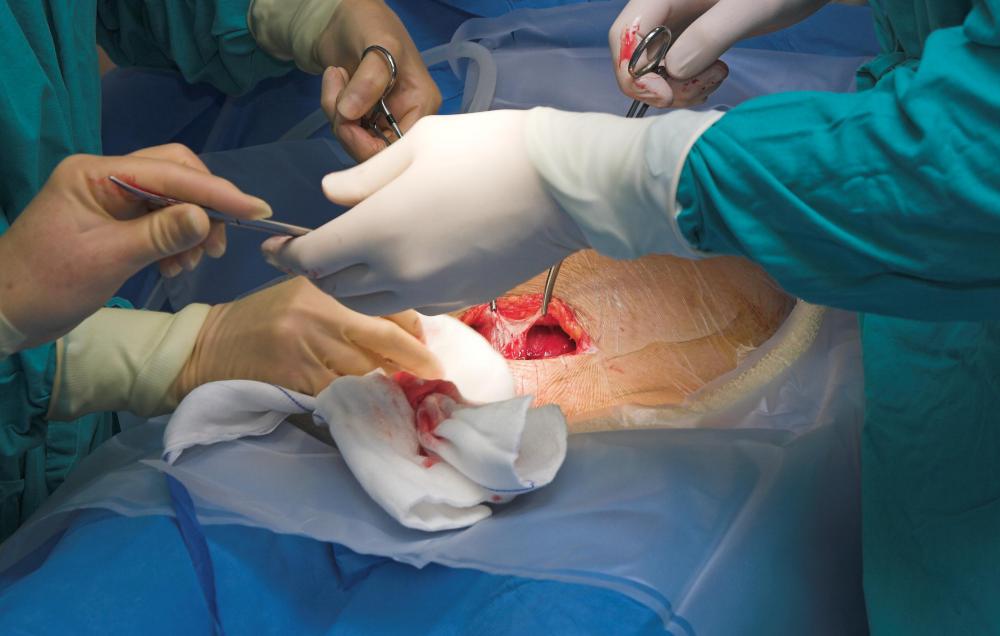
Back pain aside, there is some evidence that women with posterior babies are more likely to share certain labor experiences. For example, this type of labor may not proceed as quickly or as steadily as others, and a woman may need to push for a longer period of time. Likewise, these mothers often are more likely to require assistance with their vaginal births, such as a doctor using forceps to help pull the baby out or administering medication to stimulate stronger contractions. Additionally, the posterior position may slightly increase a woman's risk of needing a Cesarean section.
Nicole Madison
Nicole’s thirst for knowledge inspired her to become a WiseGEEK writer, and she focuses primarily on topics such as homeschooling, parenting, health, science, and business. When not writing or spending time with her four children, Nicole enjoys reading, camping, and going to the beach.
Learn more...
Nicole Madison
Nicole’s thirst for knowledge inspired her to become a WiseGEEK writer, and she focuses primarily on topics such as homeschooling, parenting, health, science, and business. When not writing or spending time with her four children, Nicole enjoys reading, camping, and going to the beach.
Learn more...AS FEATURED ON:
AS FEATURED ON:









-
![Babies often change position during labor and delivery.]() By: Monkey BusinessBabies often change position during labor and delivery.
By: Monkey BusinessBabies often change position during labor and delivery. -
![A fetus in a posterior position may increase a woman's need for a C-section.]() By: Anton BooysenA fetus in a posterior position may increase a woman's need for a C-section.
By: Anton BooysenA fetus in a posterior position may increase a woman's need for a C-section. -
![Labor may progress more slowly when the fetus is in the posterior position.]() By: Tyler OlsonLabor may progress more slowly when the fetus is in the posterior position.
By: Tyler OlsonLabor may progress more slowly when the fetus is in the posterior position. -
![In most cases, a baby who is in posterior position can still be delivered vaginally, although the woman may experience more pain in her back.]() By: LangstrupIn most cases, a baby who is in posterior position can still be delivered vaginally, although the woman may experience more pain in her back.
By: LangstrupIn most cases, a baby who is in posterior position can still be delivered vaginally, although the woman may experience more pain in her back. -
![Some women believe that a woman is more likely to experience lower back pain during labor when a baby is face up.]() By: nastia1983Some women believe that a woman is more likely to experience lower back pain during labor when a baby is face up.
By: nastia1983Some women believe that a woman is more likely to experience lower back pain during labor when a baby is face up. -
![The position of a fetus is typically noted during prenatal visits.]() By: HalfpointThe position of a fetus is typically noted during prenatal visits.
By: HalfpointThe position of a fetus is typically noted during prenatal visits.



Discussion Comments
@Grivusangel -- Wow. How sad. I wasn't sure what the common protocol was for breech births, except I knew they always tried to turn the baby in the womb, if it didn't turn by itself. After that, I didn't know if the doctor would allow the birth to proceed vaginally, or if they would automatically do a C-section.
I know some doctors are more hesitant to do a C-section than others are. I have a friend who had one and it really kind of messed her up. It was absolutely necessary to save her baby's life, and he's fine, but she somehow felt she was less of a mom or less of a woman because she didn't deliver vaginally. I felt really sorry for her.
My sister-in-law was a breech birth, and the doctor opted to do a C-section. Good thing, since they found my mother-in-law had ovarian cancer. It had not spread at that time, so they went ahead and did a full hysterectomy, including removing the affected ovary.
In that case, a C-section was definitely the best way to go, since they might not have discovered the cancer, otherwise. It apparently did spread eventually, though, since she died of pancreatic cancer about 12 years later. She was only 39. She left three children. My husband was only 19 and had been her primary caregiver.
Post your comments