
At DelightedCooking, we're committed to delivering accurate, trustworthy information. Our expert-authored content is rigorously fact-checked and sourced from credible authorities. Discover how we uphold the highest standards in providing you with reliable knowledge.
What does "Halal" on a Food Label Mean?
 Mary McMahon
Mary McMahon
Mary McMahon
A food label is stamped halal if the contents of the food conform with Muslim dietary laws. This certification is analogous to a kosher certification, in that it is provided by a certified third party agency, but kosher food is not necessarily halal, and halal food is not always kosher. For Muslims who are concerned about obeying the Sharia, or Islamic law, this label acts as an assurance that the contents of the food are not haram, or forbidden.
In Arabic speaking nations, the word is used to refer generically to anything that is permitted by the rules of Islam, as the word in Arabic means “lawful” or “permitted.” In the rest of the world, it applies specifically to foods. Most nations have food labeling laws to protect both halal and kosher certification, to ensure that food labels are accurate.

Under Muslim law, Muslims are forbidden to eat pork, blood, land-based carnivores, omnivores, carrion, and intoxicants. The prohibition against pork is one of the most difficult aspects of a Muslim diet, because of the inclusion of pork byproducts in many foods. A long ingredient list may conceal a pork-derived product, so devout Muslims look for a label that indicates that the food is acceptable. In addition, there are restrictions on seafood; many Muslims believe that only fish with scales are halal, excluding shellfish and crustaceans as haram.

The important distinguishing feature of meat with this label is that the animal must be slaughtered in the name of Allah. Any Muslim can slaughter an animal for food, as long as he or she slaughters the animal by quickly severing the major arteries of the neck, and utters the name of God as the animal is killed. Animals killed in other ways are haram, as are those slaughtered in the name of false Gods, or animals that are not dedicated to any deity when they are slaughtered.

In Muslim countries, finding halal food is relatively easy, as stores and restaurants are often run by Muslims who obey the Sharia. Outside of Muslim countries, however, adhering to the law can be very difficult, especially with processed foods. Some Muslim organizations have published lists of ingredients that contain pork and those companies that make food that is safe to eat. In Muslim communities within non-Muslim nations, there is often a plethora of restaurants that are certified, and there may also be a halal butcher.
Mary McMahon
Ever since she began contributing to the site several years ago, Mary has embraced the exciting challenge of being a DelightedCooking researcher and writer. Mary has a liberal arts degree from Goddard College and spends her free time reading, cooking, and exploring the great outdoors.
Learn more...
Mary McMahon
Ever since she began contributing to the site several years ago, Mary has embraced the exciting challenge of being a DelightedCooking researcher and writer. Mary has a liberal arts degree from Goddard College and spends her free time reading, cooking, and exploring the great outdoors.
Learn more...AS FEATURED ON:
AS FEATURED ON:


-
![Muslims concerned with obeying Islamic Law must avoid foods that are forbidden.]() By: Orhan ÇamMuslims concerned with obeying Islamic Law must avoid foods that are forbidden.
By: Orhan ÇamMuslims concerned with obeying Islamic Law must avoid foods that are forbidden. -
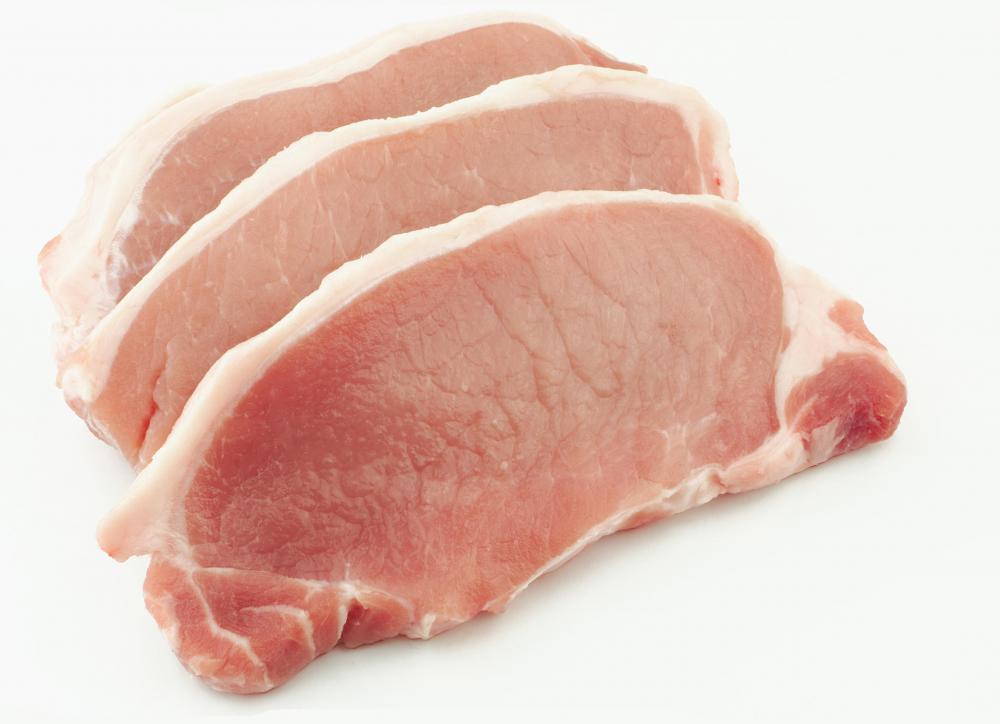
![Pork is especially hard for Muslims to avoid as many foods include pork by-products.]() By: mini444Pork is especially hard for Muslims to avoid as many foods include pork by-products.
By: mini444Pork is especially hard for Muslims to avoid as many foods include pork by-products. -
![In Muslim countries, finding halal food is relatively easy.]() By: MikeyIn Muslim countries, finding halal food is relatively easy.
By: MikeyIn Muslim countries, finding halal food is relatively easy. -
![In a general sense, "halal" means "lawful" in Arabic, and refers to anything allowed under the rules of Islam.]() By: Aleksandar TodorovicIn a general sense, "halal" means "lawful" in Arabic, and refers to anything allowed under the rules of Islam.
By: Aleksandar TodorovicIn a general sense, "halal" means "lawful" in Arabic, and refers to anything allowed under the rules of Islam. -
![Halal butchers may make sausage out of beef, turkey or other lawful meats instead of pork.]() By: aboikisHalal butchers may make sausage out of beef, turkey or other lawful meats instead of pork.
By: aboikisHalal butchers may make sausage out of beef, turkey or other lawful meats instead of pork.



Discussion Comments
This whole issue is just another example of a simple truth. Religion of any kind is a mental illness stemming from fear, delusions, and narcissism. More hate, violence, rape, murder, and all out war has been committed throughout history because of this mental illness. Hopefully one day man kind will find a cure for religion.
Replies to Post 30, 27, and 22.
@tinatina Post 27: Yes, the Halal stamp only confirms that all ingredients are allowed under Islam guidelines. The product may contain plant or animal products that are allowed.
@anon233781 Post 30: Contrary to what you are saying, Allah and the God mentioned in the bible are one and the same. The bible was revealed upon Prophet Isa (Jesus) in Aramaic. The Word for God in that version is Ellah, Ellohim (the "im" at the end being a grammatical plural of respect, like when the queen addressing herself says "We shall do this"). In Arabic it's Allah and the A and E difference is simply due to the difference in language and pronunciation. So please do some background checks before making such claims.
@anon180258 Post 22: I respect your views but do not agree as there is a problem with the reasoning. 1. If killing living beings (you mean animals)for human consumption is not correct, then plants are also living beings.
2. As a student of botany, I can assure you that it's proven now that many plants do have advanced sensory systems and as,such feel pain. Besides, if screaming was a "reason," would you accept slaughtering a human being that is in vegetative form? (no pun intended just trying to provide alternative reasoning). I am sure none of us would. 3. Yes there is pain associated with animal slaughter, but some methods less than others and usually the methods used in Kosher and Halal slaughter seem to be the least painful and most healthy. I can explain how but the post will get too long. You may search mercy Halal Islamic slaughter online.
Allah and the Christian God of the Bible are not the same. Christians should not eat halal food. It is food sacrificed to idols.
who inspects the meat processing plants that process halal meat for consumption.
I will be extremely grateful if someone will answer this question for me. If a product is labeled halal on the supermarket shelves, does this mean that although that particular food product does not contain the haram ingredients such as pork, alcohol, etc, there is every possibility that that particular food product does contain animal derived ingredients from other sources which Muslims are allowed to eat, such as chicken, beef, etc? I do hope you understand what I mean in my above question.
What I am trying to find out is, when a product is labeled halal, does this mean that it is strictly vegetarian/vegan or does it mean that it can contain animal derived ingredients too?
I am going on the understanding that when a product is labeled halal, this label does not confirm that that particular product is completely vegetarian/vegan. I am going on the understanding that when a product is labeled halal, there is every possibility that it contains animal derived ingredients from animals which are allowed for consumption by the Muslims but these animals have been slaughtered under the Muslim law to make it lawful (permitted by Allah).
Please, I will be most thankful if anyone can give me a clear answer to the above query. Thank you very much.
halal meat is that the animal must be slaughtered in the name of God if you know God with another name besides Allah, it's halal too. So the slaughtered kosher food is halal too, although they know God with the name YHWH.
This is what I think: (no offense to anyone):
Every living being in this world has the equal rights to reproduce and live (like we humans do), which means we are restricting them from their rights.
I do eat plants and vegetables and it's because when i pick a fruit from a tree or pluck some vegetables, i don't see them scream out of pain. I have seen animals been killed in several ways and in all the cases they do cry for their life. So, however we kill, I personally feel that we are not doing justice for those poor animals. As I said earlier this is what i think and and offense to anyone.
Halal is a lot like how the Africans commonly known as "pygmies" kill and dispatch animals. They kill as quickly as possible, and then say a prayer to reassure the animal that it is dying only so we can live.
Halal means it's suitable for Muslims to consume.
We Muslims are forbidden to eat things that are not halal or animals that have not been slaughter
e.g., "shot in the head, been killed by hammer and not been prayed on-prayers ). The slaughter process is focused on getting rid of the blood in the animal's body because we are forbidden of consuming blood.
Other halal stuff doesn't mean saying prayers or anything, it just means it's suitable for Muslims like "pork-free products" or "alcohol-free." It's also not just food. It may also be some other products like "pork fat-free soap" for example.
disgusting! i think its disgraceful that a poor animal has to suffer in order to differentiate between haram and halal! the poor animals feel every inch of pain as their throats are slit and they suffer for nearly an hour before they actually die!
If it doesn't contain animal products or alcohol, then it is automatically Halal (i.e. fruits, vegetables).
Sheep, goats, cows, rabbits, chickens, etc., are Halal when slaughtered properly by a Muslim, Jew, or Christian.
Kosher = Halal for Muslims
Halal is not necessarily Kosher for Jews.
Allah = God Almighty the creator of the universe. Read the second verse of the first chapter of the Quoran: "All praise is due to Allah: the lord of the worlds."
Finally, no, when you buy halal food, the store does not send money to an Islamic organization. Halal food may cost more because it is not produced in massive quantities. By all means, don't buy it if you are not comfortable with it. (if you can actually find it in the supermarket).
I would like to know if there is a payment made to the Islamic organization with every product marked halaal and sold in our supermarkets?
Just for the record: halal killing is barbaric and goes against any any killing of livestock standards in the developed world. There is no prior electrolysis so the animal feels the pain and is conscious, despite the killers trying to 'aim' for the main artery.
I wouldn't touch any meat that goes against the humane slaughter of an animal. It's barbaric and stupid.
I want to clarify a huge point to Anon106082's post #11. Moses is not considered a god to Christians. He served God, just like I do now.
In English, there is a difference in 'a' god and 'the' God. Anyone can call their deity a god (like the god of thunder), but it is not capitalized and is not considered the creator of the universe.
When speaking of God (the creator of the universe), it is always capitalized - unless the person typing is disrespectful or ignorant.
Also, in response to Anon91970's comment #10, God, Jesus and the Holy Spirit are one and the same. Jesus was (and is) 100 percent God and 100 percent man. It is called the Holy Trinity. It is difficult for many to grasp, especially children. There are many names for God: Immanuel, Lord, God the Father, The Light, King of Kings, Savior, Lord of Lords, Shepherd, Alpha and Omega, Messiah, Redeemer, Yeshua Of Nazareth, Exalted One, the Almighty, Power, Only Begotten Son, The Bread of Life, Judge, Prince of Peace, Mighty One, King of Israel, The Eternal Spirit, and The Head Of The Body are just some of the names the Bible calls God. (Notice the Bible is also capitalized.)
I hope that gave some clarification on Christian beliefs.
Any views on halal water filtration system?
Allah is the Arabic word for God it is derived from 'Ilah-Ma'louh' which means worshipped. Arab jews and Arab Christians use the word Allah as well.
Sources: lived in Egypt for 15 years-Christian minority
lived in yemen for 8 years -Jew minority
In Response to q 9 anon72673: Any animal slaughtered in anyone's name beside god is haram be it jesus or moses or Mohamed pbuh. yes Allah is the same god that jews and christians serve. the difference is that the english word god is nonspecific while Allah is the personal name of god.
anon36687: According to some Muslim fiqah only fish with scales are halal. The remaining seafood is haram. But the remaining Muslim considers all seafood Halal.
anon72676: According to Muslim belief if an animal is slaughtered with the name of God, then it is Halal.
Allah or God is sole creator of the universe and is considered as God of Adam, Ibrahim, Ishmael, Moses, Jesus and Muhammad. In other words, beside God, Adam, Ibrahim, Moses, Jesus and Muhammad are accepted as messengers of God only.
Very interesting and informative topic. I have a question though: If animals slaughtered in Allah's name are Halal, would animals slaughtered in Jesus' name be haram? Another quick question; do Muslims see Allah as being the God christians serve? Onmyway
is halal meat also organic?
All seafood is Halal, including shellfish.
This may look awkward. but if something is not Halal, this does not necessary make it Haram. For example stores beef, (the one that is not labeled as Halal), is not haram, especially if it has been slaughtered by Jewish or Christian, but Halal is always preferred.
Pork and alcohol are Haram, no matter what.
P.S.
Anything that contains blood or alcohol is also 'haram'. This is a layman's reply not an expert's.
This is in response to Suzan's question: What are 'halal' products? Broadly speaking there are two categories of animals; Clean(permissible to eat) and Unclean (Not permissible to eat). Anything that contains a product or by-product of Unclean animals is 'Haram' or NOT halal. Everything else is Halal. Typical examples of 'Haram' or Unclean animals include Pig, Dog, Cat, Donkey, Horse, most reptiles, Humans, etc. Typical examples of 'Halal' animals are Chickens, Fish, Cows, most birds etc. Muslims' concept of 'Halal' is similar to that of 'Kosher' of Jews.
As for her question about muslims prayers being said on halal products; if something comes from non-animal source no prayers are needed. But if it comes from animal source then prayers are said. Prayers are only necessary to take a clean animal's life for eating purposes alone. I hope it helps, Suzan.
I think the list of consumer products that are NOT halal or kosher is far too long to list. In general, it's easiest to assume that something isn't halal or kosher, unless the label indicates otherwise. Don't know anything about prayers for halal...
Can you tell me the products that are not halal and kosher? Are muslim prayers said on products in supermarkets that have the halal certification logo?
Post your comments