
At PracticalAdultInsights, we're committed to delivering accurate, trustworthy information. Our expert-authored content is rigorously fact-checked and sourced from credible authorities. Discover how we uphold the highest standards in providing you with reliable knowledge.
What does a Criminal Psychologist do?
A criminal psychologist is a professional who studies the personality of convicted criminals or people undergoing prosecution, sometimes with the aim of rehabilitating them but often also as a way to help courts and law enforcement personnel understand criminal tendencies and influences. It's often the case that these experts work with suspects, and in these cases the analysis is sometimes ordered by a court — often when there is a question as to whether the suspect has diminished mental ability or some other hindrance that could make him or her incompetent to stand trial. No matter their specialty, people with this sort of training typically work directly with the accused, and often have a therapist-patient relationship with them. The psychologist will usually spend a lot of time observing and analyzing criminal actions, thoughts, reactions, and intentions. The field is quite broad and people can do a lot with this sort of training.
Understanding the Field Generally

The field of psychology is a big one, and the options for those with an interest in criminal minds and tendencies is similarly wide-reaching. The most basic way to think about this sort of work is as a scientific approach to understanding why people turn to crime, and what things in either society or the home can either promote or discourage this tendency. People with criminal psychology training usually start out studying psychology generally, which can be described as the way the human mind works and allows people to function in complex sociological scenarios.

From here, professionals can focus their attention on those who have committed crimes. The goal is usually to understand not only why people break the law, but also what, if any, difference exists in the brains of criminals versus the brains of normal, law-abiding people. There are many different ways to approach this question, and accordingly many different possibilities for people working in this field.
Patient Evaluations

In addition to studying the basic actions involved in criminal behavior, a criminal psychologist tries to dig deep into a person’s subconscious to figure out what caused him to commit the crime in the first place. This usually involves a series of personal, one-on-one meetings. Sometimes these are ordered by courts, usually when criminals are preparing for trial; they can also happen post-conviction, often in prisons or detention facilities. Psychologists frequently also evaluate suspects, or observe interrogations in order to pick up signs of either guilt or innocence.
Work Settings

There are a number of things psychologists do with the information they glean from evaluations. They are often asked to provide expert testimony about the person in court, for instance. This can gives the judge or jury insight into the mind of the accused, and can also help them make sense of why the crime happened or what motivated the accused person to act.

There is also an important role for this sort of work in law enforcement. Professionals are often called on to profile murderers, sexual predators, and other hardened criminals. A criminal psychologist’s knowledge can be really important when it comes to anticipating crimes or identifying possible suspects in unsolved matters, too. The trend of criminal psychology profiling began in the 1940s when psychiatrists were enlisted to help profile Adolf Hitler. Since that time, these psychologists have remained instrumental in the modern criminology innovations that help define emerging investigative sciences.

There are also opportunities for a criminal psychologist to work outside of courtrooms and active law enforcement. Many psychologists opt to set up a private practices or go on to teach criminal justice and forensic psychology for government agencies or at universities. Private practice typically produces more income, especially if the person chooses to provide expert court testimony on the side. In many places, expert witnesses can charge a lot for their services, though much of this depends on the market as well as the person’s experience and credibility in the field.
Relationship to Anthropology
Criminal anthropology is a related branch of criminal psychology. A person with more anthropological training may be asked to examine a victim’s bones to help do things like determine the murderers’ mindset at the time of the killing. With specialized training, the psychologist learns how to use the forensic clues left behind in the bones or other material to define the pattern, or modus operandi (MO), of individual criminals. This sort of information is often really important to both law enforcement and justice system personnel.
Getting Started in the Field
Education requirements for a career in criminal psychology vary across the world. Most areas require at least a bachelor’s degree in criminal justice, psychology, or criminal psychology. People with this level of basic training can usually do simple analysis work and can often participate in evaluations, but they can’t usually be lead investigators. More advanced work usually requires a master's degree or Ph.D. There is often a lot of upward mobility in the field, but just the same, it’s usually true that the more education a person has the more likely he or she will be when it comes to commanding responsibility and being influential.
AS FEATURED ON:
AS FEATURED ON:


-
![A criminal psychologist profiles criminals to assist law enforcement efforts.]() By: dmitrimarutaA criminal psychologist profiles criminals to assist law enforcement efforts.
By: dmitrimarutaA criminal psychologist profiles criminals to assist law enforcement efforts. -
![A criminal psychologist may be called upon to provide court testimony.]() By: qingwaA criminal psychologist may be called upon to provide court testimony.
By: qingwaA criminal psychologist may be called upon to provide court testimony. -
![Criminal psychologists look how crimes impact victims.]() By: Astrid GastCriminal psychologists look how crimes impact victims.
By: Astrid GastCriminal psychologists look how crimes impact victims. -
![Criminal psychologists may examine a crime scene to determine possible motives.]() By: Yali ShiCriminal psychologists may examine a crime scene to determine possible motives.
By: Yali ShiCriminal psychologists may examine a crime scene to determine possible motives. -
![Criminal psychologists may look at how external factors contribute to criminal tendencies.]() By: Roman BodnarchukCriminal psychologists may look at how external factors contribute to criminal tendencies.
By: Roman BodnarchukCriminal psychologists may look at how external factors contribute to criminal tendencies. -
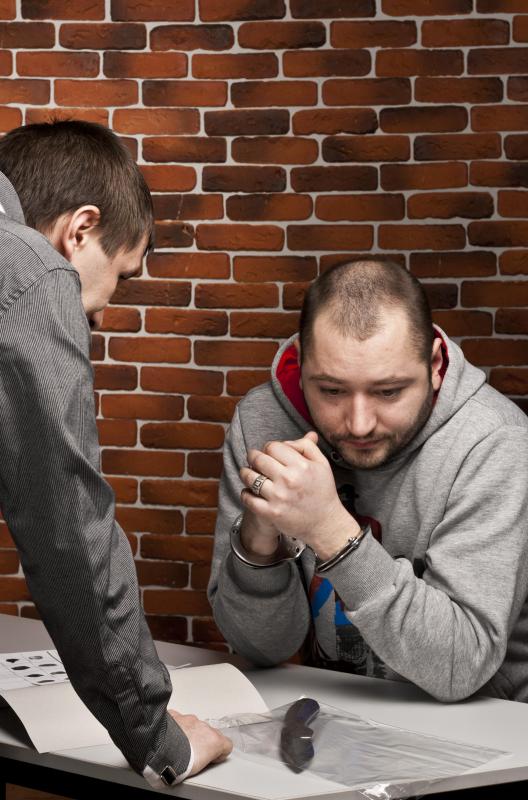
![Criminal psychologists examine the treatment of suspects by law enforcement agents.]() By: donserhioCriminal psychologists examine the treatment of suspects by law enforcement agents.
By: donserhioCriminal psychologists examine the treatment of suspects by law enforcement agents.


Discussion Comments
I'm very interested in forensics and police work. Is there any job that allows me to be a psychologist and a cop at the same time? I want to help solve crimes like a criminal psychologist, but I also want to be in the action, make arrests and use a gun like a cop.
I am a high school student who is very interested in criminal psychology. I want to work for an investigation department as a profiler. What kind of college and courses should I attend? And can you names some great colleges at this major?
Criminal psychologist salaries can range from $49,000 in a locale like Houston to $65,000 in Miami.
Criminal psychologist that provides expert witness testimony can make a six figure salary easily. These criminal psychologist jobs are available in police departments and government entities like the F.B.I.
Sunshine31-I think that a criminal psychologist career would be fascinating. Usually in order to become a criminal psychologist you have to have a PhD.
In order to treat those afflicted with criminal tendencies you would need a PsyD or a doctorate in clinical psychology with an emphasis on criminal and deviant behavior.
It you are seeking to perform research in the field, and then a PhD in criminology or psychology with research on criminal behavior is sufficient.
Some schools are starting to offer criminal psychologist degrees directly, but you have to make sure the school is accredited.
Moldova- Criminal justice psychologists study criminal behavior and why it occurs in some people and not others.
They often take a holistic approach and include information on the criminal’s childhood. Many famous criminal psychologists like Alice Miller always denote how a criminal's level of crime escalates from childhood.
Often noting that first, they are cruel to animals because they have no remorse and later progress to people.
A criminal profiler links information pertaining to a crime to a possible suspect.
The profiler who researched crimes at length will out together psychological as well as potential physical characteristics of what the suspect may be like for a given crime.
For example, criminal justice psychologists may determine that based on the crime and how it was committed, the profile of the person falls into a specific category. Based on previous case studies, the forensic psychologist can compile a threat risk assessment on where the suspect will strike next.
Post your comments