
At TheHealthBoard, we're committed to delivering accurate, trustworthy information. Our expert-authored content is rigorously fact-checked and sourced from credible authorities. Discover how we uphold the highest standards in providing you with reliable knowledge.
What Determines what Blood Type a Person Has?
 Michael Pollick
Michael Pollick
Michael Pollick
Under the common ABO blood typing process, a person's blood type could be A, B, AB or O. It is very important for people to know their own blood type, as well as that of their spouse and children. Important decisions concerning emergency blood transfusions may have to made quickly, so having this information on hand for medical professionals can shave precious minutes off the initial triage process following a trauma. A person's blood type is determined largely by genetics, and it does not change through his or her lifetime. A simple blood typing test can be performed literally anywhere by anyone through the use of specially-treated testing cards.
One of the main factors that determines blood type is family genetics. A child receives separate sources of genetic code, called alleles, from each parent at the time of conception. One of the alleles located on chromosome 9 contains the precise type of the donor parent, and is classified as A, B, AB or O. An additional factor is called the Rhesus factor, which could be positive or negative. The actual blood type of a child is determined by the dominant type between the two parents. A and B are both dominant over O, which means a child that receives an A from the father and an O from the mother will have a type A blood.

Subsequently, A and B are considered to be codominant, which means a child inheriting an A from the mother and a B from the father will most likely have an AB blood type. Only two recessive O genes from both parents will result in a child having type O. An O negative blood type is considered to be a universal donor, since it contains nothing that would appear foreign to someone else's blood. Those with type A or B positive must not receive blood infusions of the opposite type, since the body's natural defenses will attack the incoming blood cells as they would any other infection.

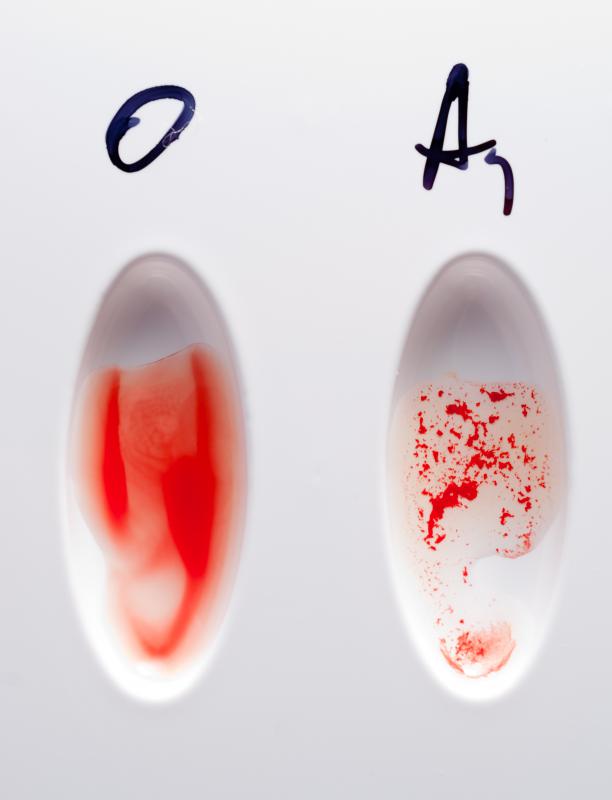
A person's blood type is determined through a simple ABO test available at a doctor's office, blood donation center, or even through pharmacies. A drop of blood is placed on two separate testing circles marked A and B. The card has already been prepared with dried serum containing anti-A and anti-B chemicals. If the blood reacts to the A circle but not the B circle, then the tester's blood type is considered to be A. A reaction to both circles indicates type AB, while a complete non-reaction to either circle indicates type O blood. The reaction is caused by the chemicals on the card coming in contact with type A or type B antigens on the surface of the red blood cells.
Michael Pollick
A regular TheHealthBoard contributor, Michael enjoys doing research in order to satisfy his wide-ranging curiosity about a variety of arcane topics. Before becoming a professional writer, Michael worked as an English tutor, poet, voice-over artist, and DJ.
Learn more...
Michael Pollick
A regular TheHealthBoard contributor, Michael enjoys doing research in order to satisfy his wide-ranging curiosity about a variety of arcane topics. Before becoming a professional writer, Michael worked as an English tutor, poet, voice-over artist, and DJ.
Learn more...AS FEATURED ON:
AS FEATURED ON:


-
![Two types of blood on a blood typing test card.]() By: lkordelaTwo types of blood on a blood typing test card.
By: lkordelaTwo types of blood on a blood typing test card. -
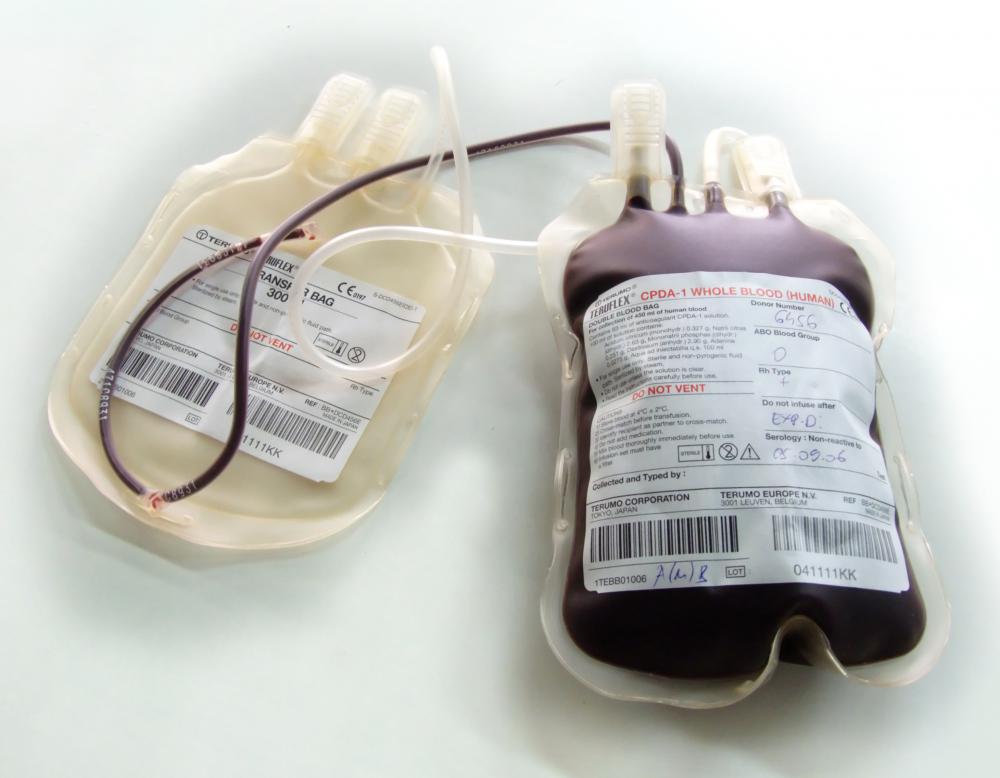
![One empty and one full pint-sized blood bag.]() By: .shockOne empty and one full pint-sized blood bag.
By: .shockOne empty and one full pint-sized blood bag. -
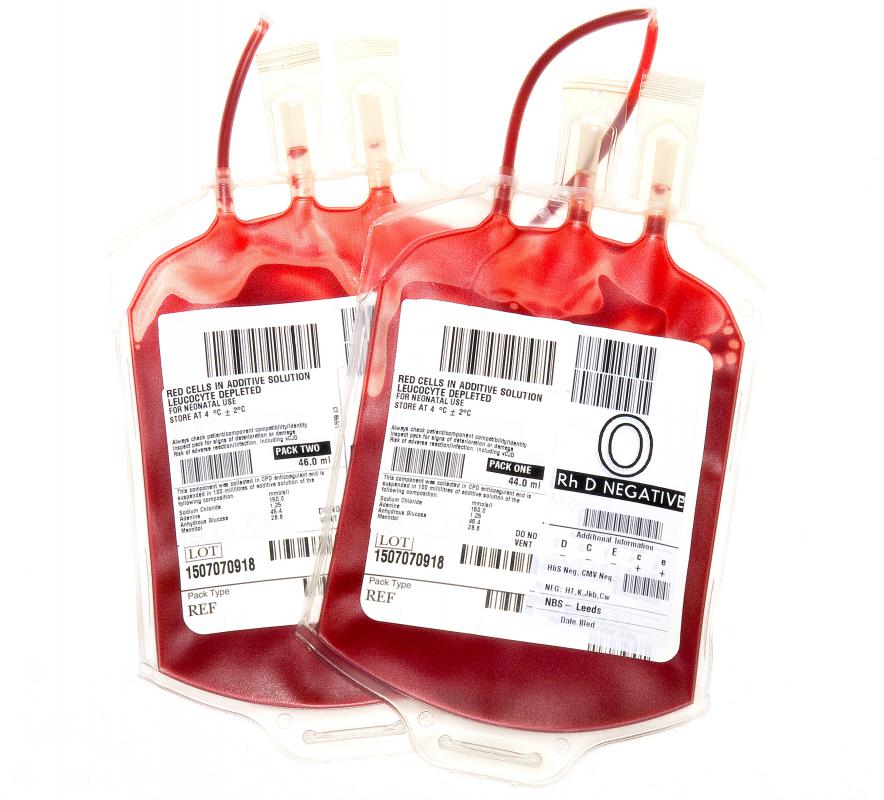
![Two packs of O- blood.]() By: dazzi-bTwo packs of O- blood.
By: dazzi-bTwo packs of O- blood. -
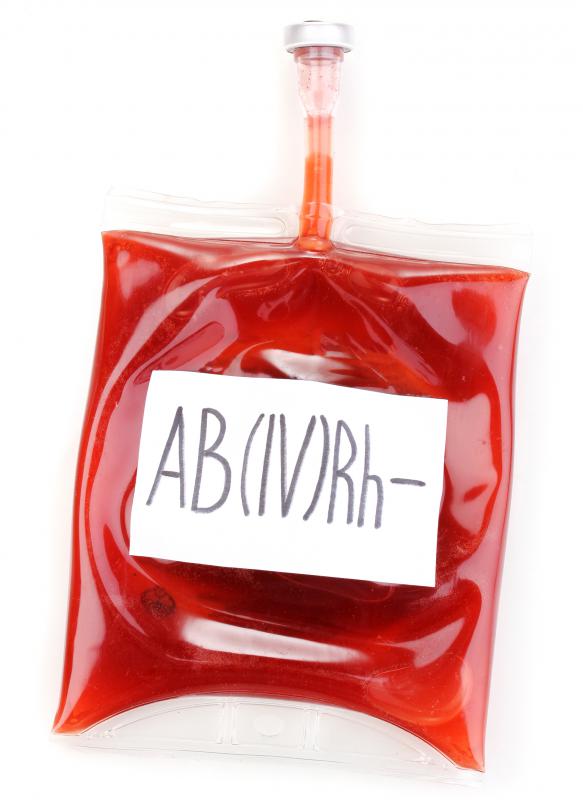
![A pouch of AB- blood.]() By: Africa StudioA pouch of AB- blood.
By: Africa StudioA pouch of AB- blood. -
![The Rhesus Factor set of blood types.]() By: Maxim PavlovThe Rhesus Factor set of blood types.
By: Maxim PavlovThe Rhesus Factor set of blood types. -
![Red blood cells contain type A or type B antigens that distinguish a person's blood type.]() By: Alexandr MitiucRed blood cells contain type A or type B antigens that distinguish a person's blood type.
By: Alexandr MitiucRed blood cells contain type A or type B antigens that distinguish a person's blood type.


Discussion Comments
Is there any possibility to change our type of blood?
My mum's blood group is O+; dad A+.. son is O+. Is this possible? From what I read and understand, it's the norm to have the same type bloop group as the dad.
can a baby's blood tell who the father and mother are without the father's and mother's blood?
when explaining blood groups, + and - is used for rhesus factor, but sometimes 1 or 2 is used. why?
For all you people wondering about your own or a child's blood type: In a nutshell, a child with parents who both have dominant blood types (A, B, or AB) could inherit the recessive O. It's hidden in the parents, but it's still there. But a child with parents who are both type O cannot (in theory) have a child with a dominant blood type.
I am A positive and Hubby is A negative. Two of my children are A positive and the other is A negative. Up until he went to donate blood and they have said he is AB negative (he is over 40). How can it change? He has been retested and it still comes back AB negative!
Over the years of playing football he has had many test and they were always A negative.
Thanks for your help.
Using a Punnet Square is good, but what percentage would you guess at it being totally wrong?
Answering #96: Yes, this is possible.
Going back to genetics the blood groups of your parents would look like this, using a Punnet Square:
A O
B AB BO
O AO OO
What this means is your parents carry the genes for both A and O type blood. There is a 25 percent chance these will give AB blood (like your brothers) and a 25 percent chance they will give O blood (like yours).
My father is type A and my mother is type B. My four brothers are type AB. why is it that my blood type is O. Is this possible?
If everyone is really so concerned about how their family members' blood types match up, just draw a good ol' Punnett Square. Basically, you have to know what two blood type genes are being carried by each parent. The possibilities are A, B, and O, and each parent will have 2 of those in combination: A parent: A/A or A/O (I'd assume A/O, just to make it easier.) B parent: B/B or B/O (I'd assume B/O, just to make it easier.) AB parent: A/B O parent: O/O Once you've decided what blood type genes the parents carry, draw a 2x2 square. Put one parent's two letters along the top of the square, and those of the other parent down the left side. I'll use my own parents (B father, O mother) as an example: __O__O_ B|__|__| O|__|__| Then, just go row-by-row and match up the letters: __O__O_ B|BO|BO| O|OO|OO| The combinations inside the square are the possible combinations for the blood type of any children they may have. O is always recessive, so BO or AO means the child will have B or A blood, respectively. OO naturally means O blood, and AB obviously means AB blood. Thus, for the example of my parents, the possible blood types of their offspring are either B (the BO combination) or O (the OO combination). And sure enough, my blood type is B.
@83: It's a very odd way of phrasing it, but I assume this woman means that she inherited a positive Rh factor from one parent, and a negative from the other. Assuming that is the case, she has both positive and negative *genes*, but her blood is positive.
The most important part (in summary): ~2 Type-A parents...can produce A or O children. ~1 Type-A parent, 1 Type B parent...can produce AB, A, B, or O children. ~1 Type-A parent, 1 Type AB parent...can produce AB, A, or B children. ~1 Type-A parent, 1 Type O parent...can produce A or O children. ~2 Type-B parents...can produce B or O children. ~1 Type-B parent, 1 Type-AB parent...can produce AB, A, or B children. ~1 Type-B parent, 1 Type-O parent...can produce B or O children. ~2 Type-AB parents...can produce AB, A, or B children. ~1 Type-AB parent, 1 Type-O parent...can produce A or B children. ~2 Type-O parents...can only produce O children. @79: I think you're the one who needs to work on their knowledge of genetics. Go read post no. 28. It specifically states that your example is impossible. We don't just magically carry every blood type that has ever been expressed in our family. We've all got two - and only two - blood type alleles, one from each parent. (Rh factor is determined at a separate spot in our genes.) Since there are three possible allele types (A, B, and O), we're all missing at least one of them. Type A people can have: 2 As; 1 A, 1 O Type B people can have: 2 Bs; 1 B, 1 O Type AB people can only have: 1 A, 1 B Type O people can only have: 2 Os We each pass on *one* of our two alleles (selected essentially at random) to our offspring: AB people can pass on A or B. A people with 2 A alleles can only pass on A. A people with 1 A and 1 O can pass on either. B people with 2 B alleles can only pass on B. B people with 1 B and 1 O can pass on either. O people can only pass on O. The combination of that allele with the allele passed on by our partner determines the baby's blood type. The theoretical combinations work like this: 1 A, 1 B gives the child AB. 1 A, 1 O gives the child A. 1 B, 1 O gives the child B. 2 As gives the child A. 2 Bs gives the child B. 2 Os gives the child O. Therefore, a type B mother can pass on B, and theoretically O if she has a B/O combination herself. A type O father can *only* pass on O. So, your example of a B mother and O father only has two possibilities: type B children (B from the mother, O from the father) or type O children (O from the mother, O from the father). That couple cannot ever produce type A children. Take me, for example. My mother is O, my father is B. I all three of my siblings are also type B, either because my father had a B/B combination or because he had B/O and just happened to always pass on his B allele.
do all blood brothers and sisters have the same blood type or can one have a different blood type?
I know a woman that says that she has positive and negative blood. Is that possible?
The gene that determines your blood type expresses itself as all of the options (A,O,B, etc) in your sperm/eggs. Mother with B, and Father with O can certainly have a child with type A! For example a grandparent on each side could have A!
I have been typed 4 times in my life. Twice it came up as O+ and twice it came up as O-.
It is not one of those things I really worry about, but it is something I would like an answer too.
There are numerous factors in calculating blood types and unfortunately we cannot provide that specific service here at wiseGEEK. We are, however, committed to providing general information about the topic which should help answer your questions. But, you can type "blood type calculator" into your search engine and you should get several easy-to-use options to calculate specific blood type possibilities!
Here are some general points though. There are two main categorizations of blood type to consider when you're talking about how it is passed on: (1) the blood type (i.e., A, B, AB, and O), and (2) the Rhesus (Rh) factor (i.e., positive (+) or negative (-).
Blood Type
People with type A blood can pass on either A or O.
People with type B blood can pass on either B or O.
People with type O blood can pass on only O.
People with type AB blood can pass on either A or B.
Once you've determined the parental blood types you can see the possibilities for the children. (You can also work it backward if you know the child's blood type and one of the parent's to discover the other parent's blood type.) A parent with O type and a parent with A type blood can have O or A children. The only way to get AB blood is if (i) both parents are AB or (ii) one parent is A and the other is B or (iii) if one parent is AB and the other is A or B. When one parent is AB, then the child cannot be O. You cannot get a blood type that the parents do not have (i.e., a parent with type O blood and a parent with type B blood cannot have a child with type A blood).
While these general rules apply most of the time, the body is very complex and there are things like recessive anomalies that can occur. The best way to know anything for sure is to get some answers from a qualified medical professional.
Rh Factor
People with Rh+ can pass on Rh+ or Rh-.
People with Rh- can only pass on Rh-.
Two people with Rh- can only have a child with Rh-. But two Rh+ people or, a Rh+ and a Rh- person, can have Rh+ or Rh- children.
Can an O+ Father and an O+ Mother have an O- child?
A person only has type O blood if they got one O from each parent. If you get an O from one parent and a B from the other, you'll have type B blood. So an O parent and a B parent with B kids will have received one O and one B, making them have type B.
Negative Rh works like type O, so that the only way to have negative blood type is to receive the negative gene from both parents.
This means that even though your blood type looks like O+, what you actually got from your parents (and have the ability to pass to your kids) is OO+-. That is, a positive blood type can actually pass on a positive or negative blood type. A negative blood type, however, only can pass on negative.
So, someone with a B+ blood type can pass on B or O blood that is positive or negative.
Hi eyes, You're right to ask — it's not possible. If you have type O blood, the only possibilities for your child are O, A, or B, depending on the blood type of the father.
If I have an O blood type and my baby has an AB blood type does that mean the dad is AB also or is that even possible?