
At AllThingsNature, we're committed to delivering accurate, trustworthy information. Our expert-authored content is rigorously fact-checked and sourced from credible authorities. Discover how we uphold the highest standards in providing you with reliable knowledge.
What Causes Thunder?
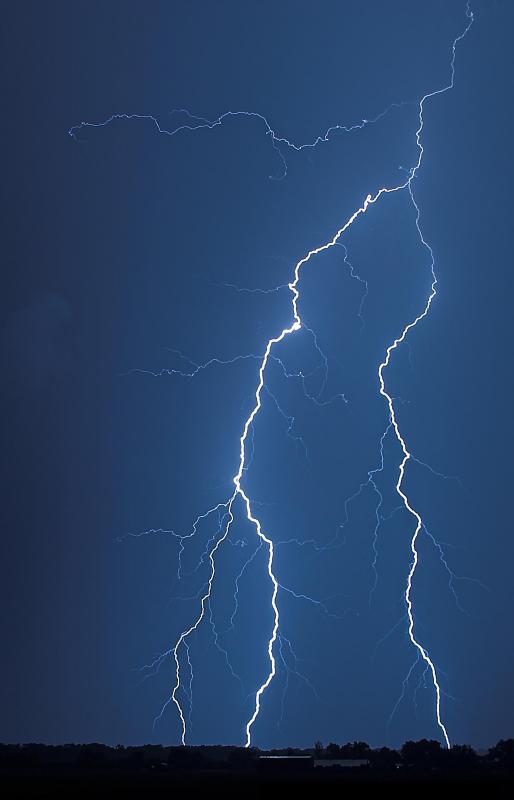
Thunder is caused by the sudden expansion of the air around a lightning bolt's path. The deep rumbling and sharp cracks of thunder are produced as the air around the lightning bolt is superheated — up to about 54,000° Fahrenheit (about 33,000° Celsius) — and rapidly expands. This rapid expansion creates an acoustic shock wave that manifests itself as thunder. The closer the lightning is, the louder the clap of thunder will seem to be.
Lightning is a discharge of electricity in the atmosphere. A lightning strike takes just a few thousandths of a second to go from the clouds to the ground or an object that is raised off the ground, then to go back up to the clouds along the same pathway. The electrostatic discharge raises the air surrounding this pathway to a temperature that is roughly five times hotter than the surface of the sun. This happens so quickly that the heated air doesn't have enough time to expand and becomes compressed to many times the normal atmospheric pressure. As the compressed air expands outward, it creates an acoustic shock wave that is heard as thunder.
What Affects the Sound

The location and shape of a lightning bolt will affect how the thunder sounds to a listener, as will the ambient temperature of the air. A nearby lightning strike will sound like a loud crack or snap, and lightning that is rather away will sound like more of a long rumble as the shock waves bounce off the clouds and hills. A forked lightning bolt also can sound like a rumble as the sound waves bounce off each other.

In addition, thunder will sound louder when the air near the ground is colder and the air higher in the atmosphere is warmer. This is because the acoustic shock waves get "trapped" in the cold air. Such a temperature difference, called an inversion, tends to happen at night, which is why thunder often sounds louder at night.
Early Explanations
Before the 20th century, science could not explain the sounds of thunder, so the cause was a matter of much dispute. Early Greeks believed that it was caused by clouds colliding. Other theories included vacuums, exploding gases and steam. Thor, a god of Norse mythology who is named for the Old Norse word for thunder, usually is portrayed as wielding a thunder-clapping hammer.
Frequently Asked Questions
What is the primary cause of thunder?

Thunder is primarily caused by the rapid expansion and contraction of air surrounding a lightning bolt. When lightning heats the air to around 30,000 degrees Celsius (54,000 degrees Fahrenheit), the air expands explosively, then contracts as it cools, creating a sonic shock wave we hear as thunder.
How does lightning relate to the sound of thunder?
Lightning is the precursor to thunder. The intense heat from a lightning bolt—five times hotter than the surface of the sun—causes the surrounding air to expand rapidly. This expansion results in a shock wave that travels through the air and manifests as the rumbling sound of thunder.
Can thunder occur without lightning?
No, thunder cannot occur without lightning. Thunder is a direct result of the thermal shock wave caused by the intense heating of the air by a lightning strike. According to the National Severe Storms Laboratory, every instance of thunder is accompanied by lightning, although you may not always see the lightning.
Why is there a delay between seeing lightning and hearing thunder?
The delay between seeing lightning and hearing thunder is due to the difference in the speed of light and sound. Light travels at 299,792 kilometers per second, almost instantaneously reaching our eyes, while sound travels at about 343 meters per second, taking longer to reach our ears. This time difference allows us to estimate the distance of the storm.
Is it possible to have thunder during a snowstorm?
Yes, it is possible to have thunder during a snowstorm, an event often referred to as 'thundersnow.' While less common than thunder during rainstorms, thundersnow occurs when there is strong enough instability and moisture in the atmosphere, typically near a strong low-pressure system, according to meteorological research.
How far away can thunder be heard?
Thunder can typically be heard up to 10 miles (16 kilometers) from the lightning strike under ideal conditions. However, terrain, humidity, wind, and ambient noise can affect this range. The sound of thunder can indicate how far away a storm is, with every five seconds between the flash and the bang representing approximately one mile.
AS FEATURED ON:
AS FEATURED ON:









-
![Thunder is the sound of the air expanding around a lightning bolt.]() By: mackflixThunder is the sound of the air expanding around a lightning bolt.
By: mackflixThunder is the sound of the air expanding around a lightning bolt. -
![Hail can accompany thunderstorms.]() By: Gavin AndersonHail can accompany thunderstorms.
By: Gavin AndersonHail can accompany thunderstorms. -
![Air rapidly expands around a lightning bolt's path, creating an acoustic shock wave that is heard as thunder.]() By: El GauchoAir rapidly expands around a lightning bolt's path, creating an acoustic shock wave that is heard as thunder.
By: El GauchoAir rapidly expands around a lightning bolt's path, creating an acoustic shock wave that is heard as thunder.


Discussion Comments
Is it bad that the thunder hasn't stopped for about 30 minutes? There's no lightning or anything.
I am doing a science fair project. Any suggestions for a safe mini experiment I could do?
Does thunder cause death?
TO - anon115084, what was it like to experience lightning because I think I might be astraphobic.
I used to live in a place where thunderstorms occur almost every day. The thunder would sometimes be so severe that my whole house would rattle and sometimes we would get cracks in my husbands tool shed windows, and some of the windows even completely broke. My dog would always go on barking rampages when the thunder rolled.
you don't necessarily die if you get hit by lightning. trust me; I'm a survivor
I also live in the caribbean. thunder rolls but there's no lightning. why is this?
when lightning will strike a person, will that person die? I'm just curious.
"if the thunder don't get you then then lightning will." Robert Hunter
we are having heavy rain and it's thundering but it's not lightning.
Anon75154: I live in an area of the United States where thunderstorms are very common. Most of the time, they are all noise and lightning. The main thing to remember is to stay away from windows, in case the wind is blowing hard. Also, as the article says, stay inside until it's over. Most storms last between 10 and 30 minutes, depending on how fast that individual storm cell or storm line is moving.
As long as the storm isn't rated severe, they are usually just very noisy. Try not to be afraid of them. They will pass pretty quickly.
I live in the Old Capital of Fiji which is Levuka. There was a thunderstorm that struck levuka that I have come across in my life and was really scary.
As we celebrate easter on Friday the weather was cloudy and you can't see any sky and I was telling my husband, see even everything around us respects that today we are remembering the death of our saviour and every living things respect. And on sunday the resurrection of Jesus. Everything is like what the bible says but not that strong. This the first time for me to see and experience a thunderstorm, because most of the time we experience hurricanes.
I was really scared and started reading the bible and everything was like the end of the world.
Makes me search for things that can be done in this kind of situation.
This thunder is like an earthquake again. It was so close and I see people running around and enjoying the weather.
No such thing as heat lightning. Sound does not travel as far as light. A far away lightning storm will create what people call heat lightning (could be 50 miles away). Common misconception. You see lightning flashes but you don't hear thunder. Happens all the time. Usually happens during clear nights where the light can travel far, and the distant thunderstorm cloud cannot be seen.
just five minutes ago in my town, there were small chunks of hail falling. then afterward, there was thunder.
we have thunder rain and lighting right now.
why does lighting hit the trees on so many occasions?
we had thunder but no lightning, why is that? No rain either.
the lightning just shot out in different directions and didn't happen to pass by where you were.
we had thunder today --all day-- and not one time did we have lightning! Explain that one please!
its heat lightning
It's because the thunder is too far away too be heard. Thunder always follows lighting
I live in the Caribbean and sometime lightening flashes but no sound of thunder why is this?
Post your comments