
At TheHealthBoard, we're committed to delivering accurate, trustworthy information. Our expert-authored content is rigorously fact-checked and sourced from credible authorities. Discover how we uphold the highest standards in providing you with reliable knowledge.
What Causes Lymphocytosis?
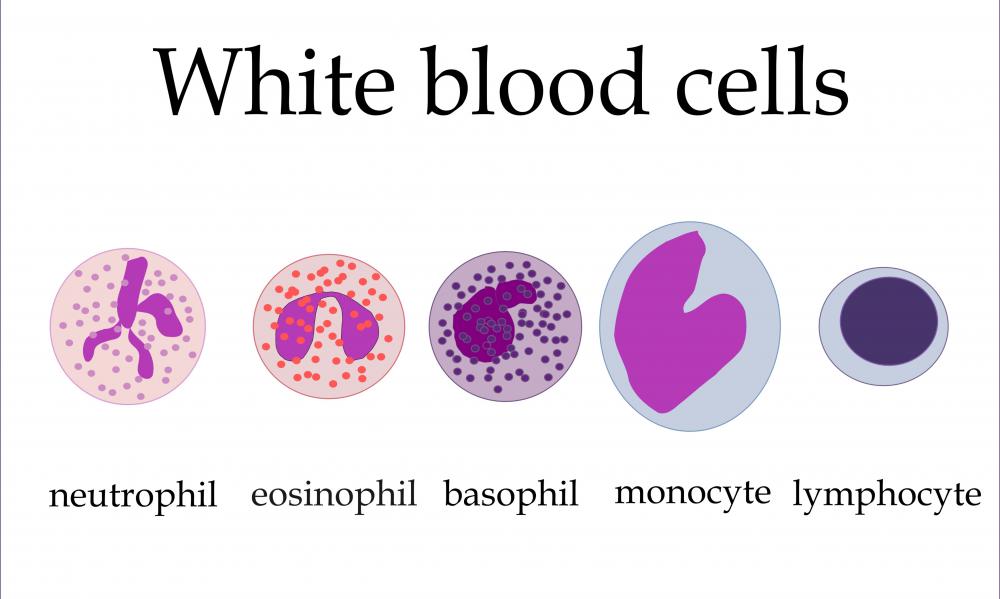
Lymphocytosis is a medical condition characterized by elevated amounts of lymphocytes, a type of white blood cell, in the body. There are three main types of lymphocytes: natural killer cells, T cells, and B cells. Each is important when it comes to defending the body from illness and disease. Lymphocytosis itself is not an illness, but is rather a condition caused by an illness or other problem.
In order to be diagnosed with lymphocytosis, an adult must have a lymphocyte count over 4,000 per microliter. Typically, this condition does not have any symptoms, which means the only way to diagnosis it is to perform a blood test.

A variety of infections and diseases can cause elevated lymphocytes. Viral infections are the most common cause, with glandular fever being one of the main ones. Infectious mononucleosis, also known simply as mono or glandular fever, generally affects adolescents and young adults and is spread through blood and saliva. Common symptoms include sore throat, fever, and fatigue.

Bacterial infections such as tuberculosis can also cause lymphocytosis. Tuberculosis is one of the most deadly modern day infectious diseases. It usually effects the lungs, though it may also effect the circulatory system, central nervous system, genitourinary system, lymphatic system, genitourinary system, and the bones and joints.
Blood diseases such as chronic lymphocytic leukemia and other forms of leukemia are also possible causes of lymphocytosis. All forms of leukemia are a type of cancer, though the cancer may be located either in the blood or in the bone marrow. These types of cancer are often identified after the high levels of lymphocytes are found.

In order to cure lymphocytosis, it is necessary to address the underlying health issue that has caused it to develop in the first place. Curing or treating the underlying cause will decrease the body’s need to produce more white blood cells in order to protect the body from the illness, disease, or infection. Treating the problem to the point where the lymphocyte count is lowered to more normal levels does not, however, necessarily mean the underlying cause is completely eradicated from the body.
AS FEATURED ON:
AS FEATURED ON:


-
![Samples of blood from a healthy person and one with leukemia. Some types of leukemia can cause lymphocytosis.]() By: AlilaSamples of blood from a healthy person and one with leukemia. Some types of leukemia can cause lymphocytosis.
By: AlilaSamples of blood from a healthy person and one with leukemia. Some types of leukemia can cause lymphocytosis. -
![Virus infections may cause a high number of lymphocytes in the blood.]() By: kmiragayaVirus infections may cause a high number of lymphocytes in the blood.
By: kmiragayaVirus infections may cause a high number of lymphocytes in the blood. -
![Tuberculosis is a common cause of lymphocytosis.]() By: stockdevilTuberculosis is a common cause of lymphocytosis.
By: stockdevilTuberculosis is a common cause of lymphocytosis. -
![A sore throat, fever, and fatigue are common symptoms of lymphocytosis.]() By: MarcoBagnoli ElflacoA sore throat, fever, and fatigue are common symptoms of lymphocytosis.
By: MarcoBagnoli ElflacoA sore throat, fever, and fatigue are common symptoms of lymphocytosis. -
![Lymphocytosis is characterized by elevated amounts of lymphocytes, a type of white blood cell, in the body.]() By: apple1Lymphocytosis is characterized by elevated amounts of lymphocytes, a type of white blood cell, in the body.
By: apple1Lymphocytosis is characterized by elevated amounts of lymphocytes, a type of white blood cell, in the body. -
![Infectious mononucleosis can easily be spread by sharing drinks or other close contact.]() By: bokanInfectious mononucleosis can easily be spread by sharing drinks or other close contact.
By: bokanInfectious mononucleosis can easily be spread by sharing drinks or other close contact. -
![Leukemia may be diagnosed by analyzing blood samples.]() By: mario beauregardLeukemia may be diagnosed by analyzing blood samples.
By: mario beauregardLeukemia may be diagnosed by analyzing blood samples.




Discussion Comments
My lymphocytosis is 70 percent. Is it dangerous?
You are all complaining. I'm 17 and have a 20 percent in viral fighting white blood cells to 80 percent bacterial fighting white blood cells. Now what could be wrong with me?
My wbc is 5600 and and my lymphocytes are 72 percent, and neutrophils are 24 percent. Is this normal?
I am 40 years old and have a white blood cell count of 32,500 and lymphocytes count of 72 percent. My doctor thinks it may be CLL, after doing all the required tests. What is the the solution for me?
To all you folks with lymphocytosis: sit tight, and always go back for your follow-ups as your doctor recommends. Most lymphoproliferative disorders are slow to cause issues, and if you are getting regularly monitored, then you are a step ahead. Some lymphocytosis really don't ever cause you any issues.
Don't worry about acute (scary) leukemias. Those are diagnosed by finding blasts, not lymphocytes. You will usually have other more dramatic symptoms that your docs will see and move on.
Good luck to all of you and always keep asking questions of your doctors until you get an answer that makes sense to you. If they don't want to talk to you, find one that will. It's their job! I am a health care professional and work to help diagnose these disorders.
I recently did a differential WBC test and my lymphocytes were 60 percent and my neutrophil was 32 percent. Others were within normal range. Do you think I should be scared of being infected with HIV? Please let me know.
Can someone help me figure out why my white blood count is elevated?
I was told by the doctor in September of 2011 that my white blood count was elevated after doing a complete blood count. He thought that it was from my gallstones so I had my gallbladder removed at the first of this month (October) and had to do a repeat CBC.
My white blood count is still elevated. I am very concerned because I have some itching under my right armpits and about two boils (risings) under my left armpit. Can this be the cause of my elevated white blood count? Can anyone help me figure out the problem?
I had a visit with my Hematologist after a white blood cell count of 13.3 and absolute lymphocytes at 7415. The lab pathologist recommended
immunophenotyping of lymphocytes by flow cytometry evaluation. More blood drawn for this f/u. Does
this sound like the right path for a full diagnosis? C. Plummer
my lymphocytes is 59 percent. is that dangerous? please if anyone can help.
My 9 month old son got a WBC count of 29,000 and report says "neutrophilia with lymphocytosis". The doctor has given an antibiotic (Rifaximin) for seven days to have and then to have another test (CBC). do i have any fear of leukemia at this stage with this WBC count? I'm extremely worried.
All my reports are normal such as LFT, CBC, HBSAG, HCV, kidney blood test, but the only think out of level is my lymphocytes which are 47 percent and for the last nine months, no increase no decrease since then. What am i to do.
i have 59.0 percent of lymphocytes in blood. is there anything happening to me?
My wife has been diagnosed with 'early hypochromic anemia with relative lymphocytosis.' what does this mean, what is the cause of it and what is the remedy?
i have 57.0 percent of lymphocytes in blood. i have swelling in my leg. what do I need to do?
Lymphocytes can be elevated due to chronic infection and a wait and see approach is acceptable, as in many cases they return to normal by themselves.
When it is chronically elevated then further tests are indicated to look at the cells themselves to rule out leukemia.
The leukemias cover a spectrum of disorders of lymphocyte replication. A hematologist is generally involved at some stage. They can explain the implications of your results and you may be followed up by your primary care physician.
If lymphocytes are elevated due to a disease, then medication is usually needed to control their levels. Not everyone needs to be on medication, monitoring is sufficient and even then, high levels can be tolerated if you don't have symptoms.
Not knowing is frightening, so ask your doctor; Is this something I need to worry about? If the answer is no, relax and just get followed up, its probably nothing. Minor symptoms don't always add up to anything.
My grandma's old medical book says with lymphocytosis, the doctor knows that the tempo can increase later but with no clear-cut evidence of leukemia it's important not to label it as "Leukemia."
It's usually noticed in the fifth decade of life with no symptoms through the sixth and seventh decade and that something else will probably kill them before that.
Naturally, with all the pesticides, gmo and msg in our foods we are having health problems hit us at earlier ages. My daughter was diagnosed with lymphocytosis when she was one. They'd been spraying pesticides in our apartment. The doctor didn't even tell me about it.
I found out later when I pulled her records from the clinic because I didn't like the way the doctor was treating us. Antibiotics knock down the immune system when given out for viruses. It is very dangerous.
Our cows and chickens are treated inhumanely and are fed crappy diets and antibiotic and hormones because it makes them rich, while most of us are getting sick and dying. I pay $6.00 for 12 oz. of grass fed organic free range ground beef and I buy organic free range eggs and chickens that are grass fed.
I buy organic fruits and veggies unless they're in season. It's expensive and I'm on food stamps but if you budget right you can buy the food your body needs. I don't buy anything unless it's organic or a natural whole food.
If more people did this then they'd be forced to do things right and prices would eventually be better.
I have had poly b-cell lymphocytosis for about 13 years or more, normal range 4.6 when first found was 24.1. For several years it sat at 10.8, this last year it's gone up and the latest is an 18.5 with new blood done last week because of an insufficient amount and they had to redo in one week.
I've had night sweats, fatigue, headache every day for last month. I'm 37 and i have lived with this for years. i had the marrow test at the beginning. nothing to it. will it change? has it changed? who knows? my hemo guy said go home and live your life all those years back and i am taking care.
i am a 42 year old male, who two years ago, had a splenectomy and also had my gall bladder and spleen removed due to a tumor growing in my pancreas. i am an insulin dependent diabetic as a result of this operation and just recently went to the doctor for my blood test result.
I was advised that my white cell count is getting increasingly higher. i also have persisting lymphocytosis that i know have to go for a bone marrow biopsy. just what is the doctor telling me? that the cancer is back again? any suggestions?
i am a man of 42 years. my lymphocytes count was diagnosed to be 64. Please what danger lies ahead for me and what can i do to bring it to normal. thanks
i have recently been told i suffer with mild lymphocytosis, caused by a prolonged viral infection. i've suffered a sore throat since i was a child, and upset stomach. i also get fatigued when i try to do anything physical for more than 15 minutes and i get night sweats.
yet still i don't know what's causing this health problem as my doctor has told me it's nothing to worry about. can any one help me? what blood tests i should have? this might show my GP how concerned i am for my health, and should i go on incapacity benefits as the benefits agency is threatening to stop my JSA as i can't work at the momment.
I'm a cll patient diagnosed since 2004. i had brief chemotherapy for four months in 2006 due to health. white cell count + lymphocytes. have been in remission since and feeling good all the time before and after. but now my blood test shows again elevated wbc 21.5 and 7l percent lymphocytes. how can i decrease the level of lymphocytes? i exercise a lot every days (yoga for 30 years) eat a good, balanced diet, do meditation two times a day for one hour. age 55. i work two days a week and love my job. as stated i feel good, except for these concerns about the results of the blood test. if that is my only symptom shall i stop?
denis. thanks for any suggestion
my wife has a 4200 cell in WBC count with 57 percent lymphocytes from two years ago. she has no symptoms. she has no anemia or decrease in platelets. lab says lymphocytes are atypical. what should I do and what's the diagnosis? is doing a BMA necessary?
I am thinking that Lymphocytosis is the body creating more of the white blood cells to fight off the infection or cancer rather than the body doing something wrong. Am I correct? I have in mind Hodgkin's lymphoma and non-Hodgkin's lymphoma.
I am responding to ANON17130 about your 13month old. I don't know how old that post is, but if the last white count is 15,000, that is within normal range for a 13month old child. Also, WBC can increase due to stress and anxiety which your child was probably feeling during all of the doctor visits, I have a 14mnth old, I know. Also, it is very typical for the lymphs to be elevated until after the age of 2, the normal range for this age is 37-73% Lymphs are made of T & B cells which mount an immune response against any unknown allergen that invades the body. So for a child, this happens a lot until their immune system is built up. Good luck!
i have fatty liver infiltration and my lymphocytes are 49%. my liver function test shows a very little increase in bilirubin. i also have a very mild back and abdominal pain
can anybody here tells me from what i am suffering from?
hello i just had a check and result of blood test came back doctor advised my lymphocytes where 66 percent can someone tell me what could it mean he advised me to also take a hiv test im curious i always and use safe sex .
I haven't seen much medical feedback on this post, but my 13 month old daughter has been back and forth to the Dr. for blood tests over the last 3 weeks. She shows no sign of infection, we were in for a check-up and the Dr. did a CBC and her WBC came back at 16,800, so she did some tests and put her on aggressive antibiotics, but three days later her WBC was 21,000 and her lymphocytes were 90%. They sent us to a pediatric hematologist, and by the time we got admitted to the hospital her WBC was 24,000, but he said it wasn't leukemia....still no symptoms...is there a chance he could be wrong? I don't want to wait too long. Can someone give me advice on what it could be. All of the virus panels came back negative...no bacteria or leukocytes in urine or stool, no TB, EBV, or cytomegalovirus, no parvo...nothing. As of yesterday her lymphocytes were still above 80% of her WBC of 15,000+. What is going on?
i too have been diagnosed with lymphocytosis as well as monophyctosis and one other that he named what does this all mean? they told me something about a high white blood count like im trying to fight off an infection. well each time i go to get blood work i always am fighting off a bladder infection or throat infection could this be the problem that's causing this ?
Bordetella pertussis (whooping cough) can cause the promotion of lymphocytosis.
To anon 623 --
I also was just diagnosed. My doctor had been noticing a "trend" and just told me since it seemed to be going up more quickly. First thing I mentioned and first thing he told me -- see a hematologist. Better safe than sorry. My understanding of it from the doctor is it can go on without really doing much for years -- or possibly not? I know they have to keep testing your blood. I will find out more when I go to the hematologist in a couple of weeks. I believe they will want a bone marrow biopsy and for that reason I am petrified to go! But at least let me tell you that the doctor's "version" was not nearly as bad as what you (we) are reading on the computer. According to him the chance of leukemia from this is about 10%. But again, I will be asking the hematologist.
I don't know how long ago you wrote this...just came across it reading about this condition.
im 18 and was recently told i had lymphocytosis. i don't know what it is or how i got it. i get sick all the time an recently have been having lots of blood tests for my kidneys, and that's how it was found. i had a little look about it and now am really scared i have some thing really serious. and my doctor is a bit hard to understand. am i going to be OK ??
does anyone know what a lymphocytosis TVR blood test determines?
i was just diagnosed today with lymphoproliferative disorder. i'm adopted so i know no medical family history, i'm 45 years old (female) and i'm a bit freaked about this. i'm going to a hematologist/oncologist in three weeks for a consult. common examples of lpd is cll, all, hairy cell leukemia, lymphomas, multiple myeloma. if anyone knows anything about this please respond. thanks, my wbc for at least one year has been between 11-15 (normal high is 10) and i have lymphocytosis as well.
After doing my cbc, i found out that my lymphocytes are 62 %..way over the 20-40 range. However four doctors told me it isn't anything to worry about. Is that true? I have been having burning of the skin, fatigue, etc but they think it is due to depression. Do you think I have something to worry abut. Please help
My husband, last year had a cancer scare, when blood tests were taken for his yearly checkup. Tumors and/or nodules were found in the throat area.When the tests came back there were no cold spots and everything seemed OK.Yesterday he had a fall at work where he twisted his back severely enough for him to go to the hospital. He has never gone to the hospital before except to have his tonsils removed at the age of three, he is now in his 60th year. While a the hospital several tests were done showing everything OK but he would have a sore back for a while. Then the dr. said one of the separate tests, lymphocytic, for the WBC was a little high. Normal was 4 and my husband's was 4.9. She said not to be overly alarmed but should see his own family dr. She was very busy and I couldn't inform her of last years episode. Some my 2 questions are: What is classified as high and when should we be concerned?
Lady Willow
I have been diagnosed with lymphocytosis. My count is 4,500 and the doctor said not to be concerned and that it can stay that way for quite some time. She also said that it has been this high for about ten years, but she just told me last year. I am 61 years old and this is bothering me tremendously. All I read indicates that it can develop into some kind of cancer. I asked her if I should see a specialist and she said it wouldn't help. I have been in excellent health for all my life (with the exception of the last two years - having quite a bit of sinus infections and colds). Should I see a blood specialist or someone else? Or just wait to see if the count goes up (is it then too late)
Post your comments