
At TheHealthBoard, we're committed to delivering accurate, trustworthy information. Our expert-authored content is rigorously fact-checked and sourced from credible authorities. Discover how we uphold the highest standards in providing you with reliable knowledge.
What Causes Enteritis?
 Tricia Christensen
Tricia Christensen
Tricia Christensen
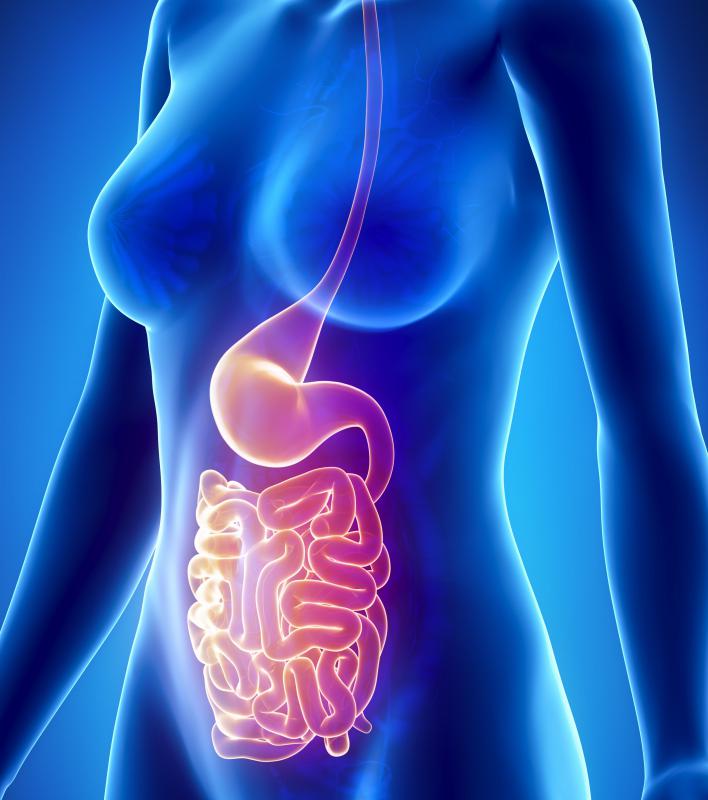
Enteritis refers to swelling and irritation of the small intestine. This part of the intestine connects the colon or large intestine to the stomach and is split into three sections, called the duodenum, jejunum and ileum. Irritation may occur in any or all of the sections and is most frequently caused by bacterial or viral illness. Long-term swelling that is not caused by infection is called chronic enteritis, and it may result from conditions affecting the intestinal tract, like Crohn's or celiac disease.
A medical professional may suspect enteritis when a patient experiences discomfort in the abdomen, diarrhea, and bloating of the abdomen due to excess gas. Occasionally, bowel movements are black, signifying internal bleeding. This fourth symptom, called hematochezia, may be misdiagnosed if the patient is taking medications that naturally dye the stools black for several days.

Surprisingly, this condition is not associated with nausea or vomiting. When stomach upset is present, along with the four main symptoms, the condition is referred to as gastroenteritis. Gastroenteritis may have exactly the same causes but results in slightly different symptoms.
Most cases are caused by viral illnesses. These cases tend to also have symptoms like minor fever and are usually over within a few days. Viral illnesses tend to require rest and proper intake of fluids to restore a patient to health. Any illness that causes diarrhea needs to be treated by increasing the patient's intake of water and other fluids to prevent dehydration.

Bacteria responsible for enteritis usually enter the body through improperly prepared food. Common bacteria responsible for this condition are salmonella, listeria, and E. coli. When more than one person gets sick after eating the same food from the same source, bacteria is usually suspected. When symptoms last for longer than two days, the patients should see a healthcare professional, since E. coli and listeria can both result in serious complications. Treatment is usually antibiotics and careful checks to rule out complications.

Chronic enteritis may be caused by various conditions affecting the intestinal tract, and the treatment varies depending upon the cause. Some forms may result from exposure to parasites, for example, and extended cases of travelers' diarrhea and/or drinking water from streams are usually considered possible causes. These are diagnosed by evaluating stool samples and can only be cured by taking anti-parasitic medications.

Other causes of chronic intestinal irritation are conditions that may require complex treatments. Crohn's disease, for example, can affect the entire intestinal tract and may require surgeries to reduce inflammation. Celiac disease, on the other hand, is a persistent inability to digest gluten found in wheat flours. Usually, dietary modification can control this condition.
Tricia Christensen
Tricia has a Literature degree from Sonoma State University and has been a frequent TheHealthBoard contributor for many years. She is especially passionate about reading and writing, although her other interests include medicine, art, film, history, politics, ethics, and religion. Tricia lives in Northern California and is currently working on her first novel.
Learn more...
Tricia Christensen
Tricia has a Literature degree from Sonoma State University and has been a frequent TheHealthBoard contributor for many years. She is especially passionate about reading and writing, although her other interests include medicine, art, film, history, politics, ethics, and religion. Tricia lives in Northern California and is currently working on her first novel.
Learn more...AS FEATURED ON:
AS FEATURED ON:


-
![Enteritis refers to the swelling and irritation of the small intestine.]() By: CLIPAREA.comEnteritis refers to the swelling and irritation of the small intestine.
By: CLIPAREA.comEnteritis refers to the swelling and irritation of the small intestine. -
![Microorganisms that cause enteritis can be spread through contaminated drinking water.]() By: ElenathewiseMicroorganisms that cause enteritis can be spread through contaminated drinking water.
By: ElenathewiseMicroorganisms that cause enteritis can be spread through contaminated drinking water. -
![Enteritis can be caused by bacteria, like Salmonella.]() By: Lyuba BunakovaEnteritis can be caused by bacteria, like Salmonella.
By: Lyuba BunakovaEnteritis can be caused by bacteria, like Salmonella. -
![Stool samples that are collected at home are usually placed into plastic containers.]() By: luchschen_shutterStool samples that are collected at home are usually placed into plastic containers.
By: luchschen_shutterStool samples that are collected at home are usually placed into plastic containers. -
![Bloating and excessive gas are symptoms of enteritis.]() By: michaeljungBloating and excessive gas are symptoms of enteritis.
By: michaeljungBloating and excessive gas are symptoms of enteritis.




Discussion Comments
My dad has being diagnosed with chronic enteritis. About seven months ago he had a terrible cramp and we took him to the doctor and he ended up cutting 30 cms of his intestine. At this point, he was complaining of so much pain and went to see many doctors, and got scans done. They said there were no tumors, no cancer signs or anything. The doctor said that his intestine got clogged and therefore, he had to cut the intestine.
The pain came back and they changed his diet once more with baby's food and ensure since they said they didn't want him to work his intestines for now until they find the problem. At the end, this is what they decided he has, but he can't have any normal food or life. The doctor said that his intestine gets swollen with anything he takes, drinks or eats, and as I said before, this is the conclusion he made, but I read your article and it doesn't really make much more sense since he never had diarrhea, vomiting or any of those symptoms.
sorry you don't mention post-cancer treatment which is how I developed mine - and landed in the hospital for almost a month, just when I expected to be celebrating "coming back" from cancer. Go figure.
@dinoleash: Thanks for that information. I had always heard that taking too much ibuprofen could mess up your stomach, but I didn't know how.
@anon44433: One of the causes of enteritis is eating or drinking something that is contaminated with a virus or bacteria. Those germs settle in the small intestine and causes inflammation that can lead to abdominal pain, diarrhea, dehydration, and fever.
Other causes of enteritis can be Crohn’s disease, damage from radiation therapy, and certain drugs such as ibuprofen and naproxen sodium.
what causes the disease 'enteritis'?
Post your comments