
At WiseGEEK, we're committed to delivering accurate, trustworthy information. Our expert-authored content is rigorously fact-checked and sourced from credible authorities. Discover how we uphold the highest standards in providing you with reliable knowledge.
What are X-Rays?
 Michael Anissimov
Michael Anissimov
Michael Anissimov
X-rays are a form of invisible, high-frequency electromagnetic radiation. Their wavelength is between 10 and 0.01 nanometers, corresponding to a frequency of 30 PHz to 30 EHz. X-rays are very small and energetic. They are produced by accelerating electrons at a metal target. They are used in various medical applications, especially for imaging.
X-rays were a hot topic for research in the late 19th century, and various famous inventors worked on them, including Thomas Edison and Nikola Tesla. Tesla was the first to inform the scientific community of the biological hazards of x-rays. The biggest contributor to x-ray research was Wilhelm Röntgen, who won the first Nobel Prize in Physics for his work. Although the term "x-rays" was only meant to be a placeholder, the name stuck, much to Röntgen's chagrin. In some languages, these rays are actually referred to as Röntgen rays. His landmark paper in the field was titled "On a New Kind of Radiation."

Because of the tiny wavelength of x-rays, they are useful for imaging small structures, such as individual molecules. This research field is known as x-ray crystallography, which was responsible for uncovering the physical structure of DNA, among other achievements. Today it is frequently used to image the molecular structure of complex proteins.
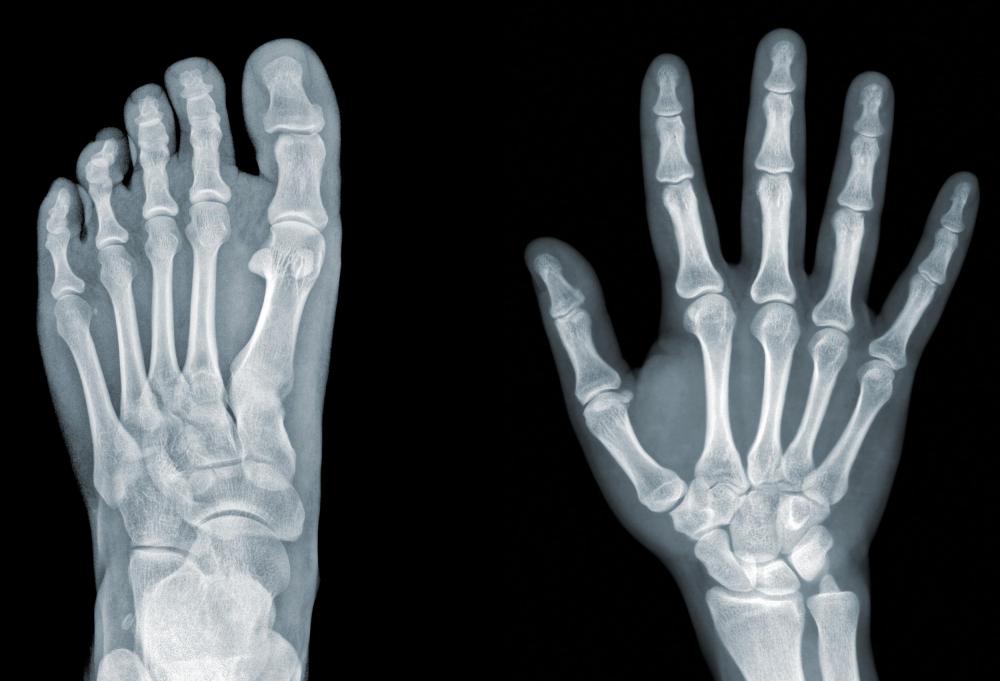
Sometimes x-ray imaging is used to investigate paintings which have been painted over. Their most prominent use is probably to image bones to discover whether they are actually broken or not. X-rays are a carcinogen, so use of them for medical purposes should be kept brief.

Under special circumstances, such as in a dark room and looking directly down a cathode ray tube, x-rays are visible to the human eye. It is not known whether this is the eye directly perceiving the rays, or from a secondary effect such as the creation of luminescent sparks in the eyeball. In any case, this is not widely publicized, likely because it would be dangerous to test it very extensively.
Michael Anissimov
Michael is a longtime WiseGEEK contributor who specializes in topics relating to paleontology, physics, biology, astronomy, chemistry, and futurism. In addition to being an avid blogger, Michael is particularly passionate about stem cell research, regenerative medicine, and life extension therapies. He has also worked for the Methuselah Foundation, the Singularity Institute for Artificial Intelligence, and the Lifeboat Foundation.
Learn more...
Michael Anissimov
Michael is a longtime WiseGEEK contributor who specializes in topics relating to paleontology, physics, biology, astronomy, chemistry, and futurism. In addition to being an avid blogger, Michael is particularly passionate about stem cell research, regenerative medicine, and life extension therapies. He has also worked for the Methuselah Foundation, the Singularity Institute for Artificial Intelligence, and the Lifeboat Foundation.
Learn more...AS FEATURED ON:
AS FEATURED ON:









-
![Neck X-ray.]()
Neck X-ray. -
![Dental X-ray.]()
Dental X-ray. -
![An X-ray machine.]() By: Konstantin ShevtsovAn X-ray machine.
By: Konstantin ShevtsovAn X-ray machine. -
![A healthcare professional reviewing an X-ray.]() By: Leah-Anne ThompsonA healthcare professional reviewing an X-ray.
By: Leah-Anne ThompsonA healthcare professional reviewing an X-ray. -
![Using a cathode ray tube, x-rays may be visible to the human eye in some circumstances, although the process is not well-understood.]() By: Vasiliy TimofeevUsing a cathode ray tube, x-rays may be visible to the human eye in some circumstances, although the process is not well-understood.
By: Vasiliy TimofeevUsing a cathode ray tube, x-rays may be visible to the human eye in some circumstances, although the process is not well-understood. -
![X-rays, which are a form of high-frequency electromagnetic radiation, are used in X-ray machines to take images of bones, teeth and other internal body parts.]() By: eAlisaX-rays, which are a form of high-frequency electromagnetic radiation, are used in X-ray machines to take images of bones, teeth and other internal body parts.
By: eAlisaX-rays, which are a form of high-frequency electromagnetic radiation, are used in X-ray machines to take images of bones, teeth and other internal body parts.




Discussion Comments
The reason X-rays are not allowed for women who are pregnant is because it could cause birth defects
I hope you are not being serious, Anon 47798 and 68920! Just because a car can take us places does not mean it is not safe, and just because an X ray, or a doctor, has a useful side, they can still be dangerous.
Medical mistakes, especially pharmaceutical drug dosing errors, kill more people than car crashes do -- over 100,000 in the USA each year!
@Anon98753: Medical science does not yet have an answer to lung cancer, it does however manage the progress of the disease.
If you are brave enough, look around the web, and hope that one of the "answers" people say exist for this condition work for you. Most of them look like hard work/life changing stuff, though.
Try looking up Krebs B17 and see where that leads. I don't know what works, and I do know that there are a lot of fraudulent claims out there, (most of them I believe) but when my dad had the same and I did a crash course of research, B17 looked like it might have some credibility about it. Flaked or grated apricot seeds are OK on a sweet cereal.
Pregnant women cannot have X-rays due to the fact that the radiation in the X-ray's "rays" can harm the baby's brain or other beneficial cells/ body parts.
Lets start with x-ray radiation: x-ray radiation is energy of a small wavelength that it in simple terms interferes with a cells molecular structure sometimes irreparably. This transformation can alter a cell so that it when it reproduces or replicates itself it can lose control of its normal function(cancer).
The body has an amazing ability to be able to repair itself most of the time from mechanical, chemical or x-ray insult. However, sometimes this process becomes a runaway affair, leading to some of the different types of cancer we know of today.
It is important to note that all of us on the surface of the earth are receiving radiation as we read this. If we live at higher altitudes with less atmosphere above us, we are getting even more exposure. For example at 5000 ft(Denver, CO) we receive approximately twice the radiation as at sea level. Despite this, our body handles the situation well and this increased radiation exposure does not cause a significantly increased cancer rate.
Concerning dental radiation, things have changed tremendously over the last several decades. If you are receiving x rays today, digital sensors, collimation(a physical mechanism to direct and prevent radiation "scattering" to other parts of the body) and better technique have reduced the exposure by a factor of 100 or more. This means that even if you were to have a full mouth series or panoramic type x-ray, the dose is roughly equivalent to 30 minutes sun exposure at sea level.
Is this radiation exposure measurable and cumulative? Yes. How significant is that to you and I? That is a question you must answer for yourself. Many people used to bake themselves outside tanning all day and never gave it a second thought. Now we recognize the reality of such exposure dramatically increases our chances for skin cancer. Dental radiation is so low and controlled that it doesn't make much sense to forbid it when used judiciously. The clinical benefits of the information gathered far outweigh the risks in this person's opinion.
Hope this was helpful.
i have just been told i have early stages of lung cancer. the the doctor told me these are nodules in my left lung she also told me that it may lie dormant for years but it can start to grow any time if i lose weight or start bringing blood up to go back to him. why is she not offering treatment at this stage? i have to go back in three months.
why can't pregnant women have x-rays?
Which is one way in which you can test for the presence of x-rays without using the x-ray machines with radiation.
Are X-rays anywhere and can you test for the presence of x-rays? This is my project and I need help.
x-rays are not allowed for pregnant women because it can damage the baby or fetus causing deformity and cancer.
x-rays are not dangerous because if you take an x-ray you can see what is inside your body.
can x-rays kill you? i have a project!
Will x-rays harm reed relays?
x-rays cause cancer!
doctors aren't dangerous. they help you. they are my friends.
are doctors dangerous?
are x-rays dangerous?
how come x-rays are called x-rays but brain scans are called CT scans?
X-rays and Gamma rays are on the same side if the electromagnetic spectrum*. the side that can cause cancer, but it has a very little chance of causing cancer, the same chance as the sun's rays. babies are not as strong as us when unborn so this increases the cancer rate.
* the electromagnetic spectrum is all the rays that we use today. eg. the light we see, UV (ultraviolet)what we use in remote controles for the tv. x-rays and gamma-rays are the only on the side that causes cancer.
Additional info: mobile phones are believed to cause cancer. this is not certain yet. mobiles use microwaves that are not on the cancer side, but the theory is that it heats up the brain when you are talking to someone.
i am a tenth year student who has just learned this in class the other day.
why im here is i have an assignment and i am bored.
Are x-rays dangerous?
My son had his teeth cleaned at an office for the first time. He said they took 18 x-rays of his teeth. My question, is it safe to take that many x-rays at one time?
Why are x-rays not allowed for pregnant women?
Post your comments