
At TheHealthBoard, we're committed to delivering accurate, trustworthy information. Our expert-authored content is rigorously fact-checked and sourced from credible authorities. Discover how we uphold the highest standards in providing you with reliable knowledge.
What are White Matter Lesions?
What matter lesions are small groups of dead cells that clump together in the white matter of the brain. The human brain is made of both gray and white matter; information is typically stored and archived in the gray area, but the white parts play an important role when it comes to shuttling signals back and forth and retrieving information from one place and bringing it to the next. Lesions can slow or stop this process. Some experts believe that they form as a normal part of aging in most adults, but they can also be a sign of a more serious degenerative condition, particularly when they are large, when there are many, and when they seem to be growing. Alzheimer’s disease, Multiple Sclerosis, and dementia are three of the most common ailments connected with lesions, but the list is usually quite long.
White Matter Basics

The brain’s white matter occurs most often in the fibrous pathways and canals responsible for transmitting signals between the larger areas of the brain that process information, known as gray matter. It is very common for theses two distinct parts to work simultaneously to perform basic functions. When white matter dies, vital communication between two collaborating areas of gray matter slows and can even stop.

In most cases white matter brain cells are actually pink in color, but they get their name because they turn white when they’re put in formaldehyde, which is common in autopsies and other scientific experiments after death. The lesions, coincidentally, also appear as patches of white, or a very light gray, on magnetic resonance imaging (MRI) scans. They are almost always diagnosed and usually first seen on these sorts of scans.
What They Mean

Lesions are typically a sign of degeneration, which is in most cases somewhat negative. People don’t always have identifiable symptoms or outward problems, though, at least none that couldn’t also be attributed to normal aging. Age is not the only factor in their development, however. They also appear in some cases of migraine headaches, particularly acute cases, and in the brains of those who have suffered strokes or have progressive neurological diseases

While it is not clear that these lesions directly cause brain dysfunction, they are at least good indicators. There is a clear connection between them and a decrease in brain volume, loss of memory and vision, and the ability to understand concepts. Studies have found that Alzheimer’s patients with a greater area of white matter lesions are likely to advance in the disease more rapidly. Larger patches often result in slower walking as well.
Why Lesions Occur

Scientists are not certain about exactly why these sorts of lesions occur. Many believe that it’s a normal part of aging, and most people function just fine with a few lesions. It’s when they’re bigger and placed more frequently through the brain’s information passageways that they become the most troubling.
Medical experts generally say that high blood pressure can make the lesions more likely, or can at least cause them to grow faster once they’ve formed. Cerebral vasculitis, the inflammation of blood vessels in the brain, also appears to be a likely factor, as does hardening of the arteries, especially the aortic artery. When it comes to degenerative conditions like Multiple Sclerosis, there is some debate when it comes to determining whether the condition causes lesions or if the lesions lead a person to develop the condition.
Prevention and Treatment

There isn’t usually any way to reverse white matter lesions once they’ve formed, and they don’t usually heal on their own or go away. In most cases there is a wide variation in how much they advance in people’s brains once they are spotted, though, and it may be possible to stop them from growing. There is some evidence that prevention is possible, too, but results tend to vary. Many experts think that a person’s propensity to develop lesions is largely genetic, which can make prevention much less likely.
Even still, there are some things people can do to try to ward this sort of degeneration off. Controlling blood pressure appears to have an effect on limiting lesion development, for instance. Eating a diet rich in omega-3 fatty acids, which are found in many types of fish and some nuts, may also help with prevention, and many health care professionals recommend regular mental stimulation and “exercise,” to include logic puzzles and word games, in order to keep the brain as active as possible.
AS FEATURED ON:
AS FEATURED ON:


-
![An MRI of a human head, which can be used to check for white matter lesions.]() By: Marcin SadlowskiAn MRI of a human head, which can be used to check for white matter lesions.
By: Marcin SadlowskiAn MRI of a human head, which can be used to check for white matter lesions. -
![Acute migraine headaches may cause white matter lesions.]() By: fred goldsteinAcute migraine headaches may cause white matter lesions.
By: fred goldsteinAcute migraine headaches may cause white matter lesions. -
![White matter lesions may be symptomatic of Alzheimer's disease.]() By: riccardo bruniWhite matter lesions may be symptomatic of Alzheimer's disease.
By: riccardo bruniWhite matter lesions may be symptomatic of Alzheimer's disease. -
![Several brain imaging techniques are used to identify and measure white matter lesions in the brain.]() By: Mikhail BasovSeveral brain imaging techniques are used to identify and measure white matter lesions in the brain.
By: Mikhail BasovSeveral brain imaging techniques are used to identify and measure white matter lesions in the brain. -
![Inflammation of blood vessels in the brain may cause white matter lesions.]() By: CLIPAREA.comInflammation of blood vessels in the brain may cause white matter lesions.
By: CLIPAREA.comInflammation of blood vessels in the brain may cause white matter lesions. -
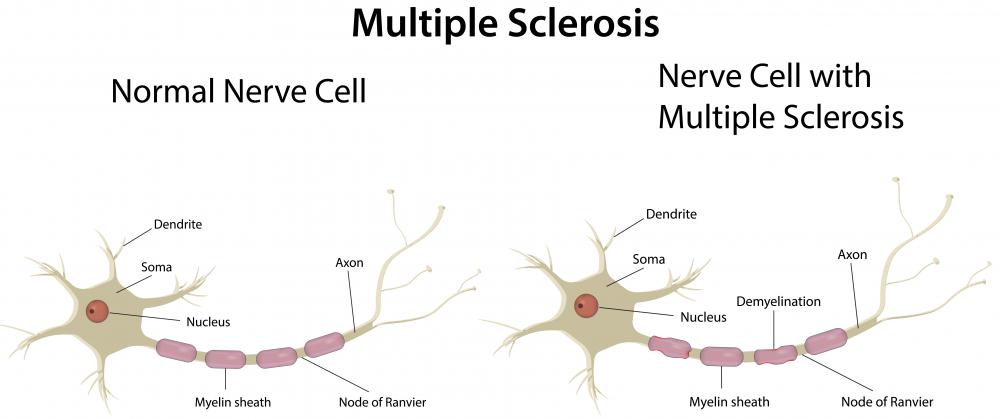
![Multiple sclerosis is one of the most common diseases associated with white matter lesions.]() By: joshyaMultiple sclerosis is one of the most common diseases associated with white matter lesions.
By: joshyaMultiple sclerosis is one of the most common diseases associated with white matter lesions.


Discussion Comments
A lot of information on WML is in the Rotterdam Scan study.
The only remedy so far, found by Prof.Chandan Sen (Ohio) works with Tocotrienols. Many people studied had the WML shrinking - or develop less rapidly.
Is the volumetric analysis helpful for the early diagnosis of dementia?
So, it appears that we folks with healthy and normal functioning brains have no white matter lesions, right?
Did I understand that correctly?
We have white matter, but lesions are not present until we reach a certain age or some outside white matter disease source causes this problem in brain tissue.
Is that correct? My grandfather has Alzheimer’s and I'm trying to get a grasp of normal brain function.
Is it also common to find that brain injured patients have white matter lesions develop?
My brother-in-law was in a motorcycle accident some years ago, and still has not regained the ability to speak or use the left side of his body. His vision was also affected. We are very blessed to still have him with us!
I was just wondering if perhaps these white matter lesions on the brain were part of the way that his doctors determined what was damaged, and how things are likely to improve for him in the future.
Post your comments