
At WiseGEEK, we're committed to delivering accurate, trustworthy information. Our expert-authored content is rigorously fact-checked and sourced from credible authorities. Discover how we uphold the highest standards in providing you with reliable knowledge.
What are Tin Snips?
 Mary McMahon
Mary McMahon
Mary McMahon
Tin snips are shears designed to cut through thin sheets of sheet metal. While their design resembles scissors, they are much stronger, with heavier blades that make metal cutting as easy as possible. Many hardware stores carry these cutting tools, and there are typically several options to choose from; many people have several sets in their toolbox for different tasks.
There are three basic types of tin snips: left cutting, straight cutting, and right cutting. As the names imply, the set of the blades on each type cuts in a slightly different way. Straight cutting snips will cut in a straight line, while left and right cutting ones create curved cuts. Because sheet metal is stiff and hard to maneuver, it is often necessary to use curved shears to create curved cuts like holes for ductwork.
Most companies color code their shears to make it easy to know what kind they are. Typically, straight cutting snips are yellow, right cutting snips are green, and left cutting snips are red. The color-coding makes it easy to grab the right pair without inspecting the blade, which can be handy for people in a hurry. As a general rule, these colors are standard across the industry for convenience, although it never hurts for shoppers to double check when purchasing a set.
The best tin snips have offset handles, which create an angle between the blade and the hands of the user. This means that the user's hands are not caught on the edges of the metal as he cuts, making cutting faster and safer. Even with offset shears, however, it is a good idea for users to wear heavy gloves when cutting sheet metal because the edges can be very sharp, and shards of metal can act like splinters, penetrating the hands and causing pain and discomfort.
Like other bladed tools, tin snips benefit from regular care. The blades should periodically be wiped down and oiled to minimize the risk of rusting. It is also a good idea to sharpen them occasionally to keep their cutting edges crisp, making cutting tasks easier and more comfortable. Many knife sharpening companies are happy to handle bladed tools like these, and the blades can also be sharpened at home, for people who have the tools to do so.
Mary McMahon
Ever since she began contributing to the site several years ago, Mary has embraced the exciting challenge of being a WiseGEEK researcher and writer. Mary has a liberal arts degree from Goddard College and spends her free time reading, cooking, and exploring the great outdoors.
Learn more...
Mary McMahon
Ever since she began contributing to the site several years ago, Mary has embraced the exciting challenge of being a WiseGEEK researcher and writer. Mary has a liberal arts degree from Goddard College and spends her free time reading, cooking, and exploring the great outdoors.
Learn more...AS FEATURED ON:
AS FEATURED ON:









-
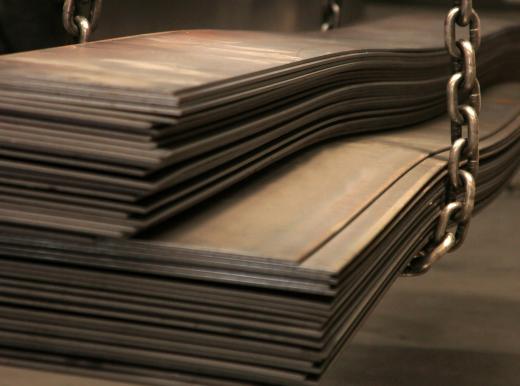
![Tin snips can be used to cut thin sheet metal.]() By: KybeleTin snips can be used to cut thin sheet metal.
By: KybeleTin snips can be used to cut thin sheet metal.

Discussion Comments
Sheet metal is an incredibly versatile material and easy to use. Once you learn the basics of working with sheet metal there are a number of things you can do. Just scanning the internet you can find all kinds of home repairs, art projects and little doodads you can build.
Sheet metal can be bent, cut and welded into shape so you can fit it almost anywhere. Sheet metal can be made out of aluminum, brass, copper, nickel, titanium and tin so you have plenty of metal types to match what you want to do.
For fancy decoration you can even get gold, silver and platinum sheet metal. Using different polishes and craft techniques and you can make a very nice display piece.
Sheet metal comes in various thicknesses. The measurement of the thickness is called the gauge. The larger the number of the gauge the thinner the metal. The gauge numbers between different metals are measured differently though.
Post your comments