
At WiseGEEK, we're committed to delivering accurate, trustworthy information. Our expert-authored content is rigorously fact-checked and sourced from credible authorities. Discover how we uphold the highest standards in providing you with reliable knowledge.
What are the Symptoms of Throat Cancer?
 Mary McMahon
Mary McMahon
Mary McMahon
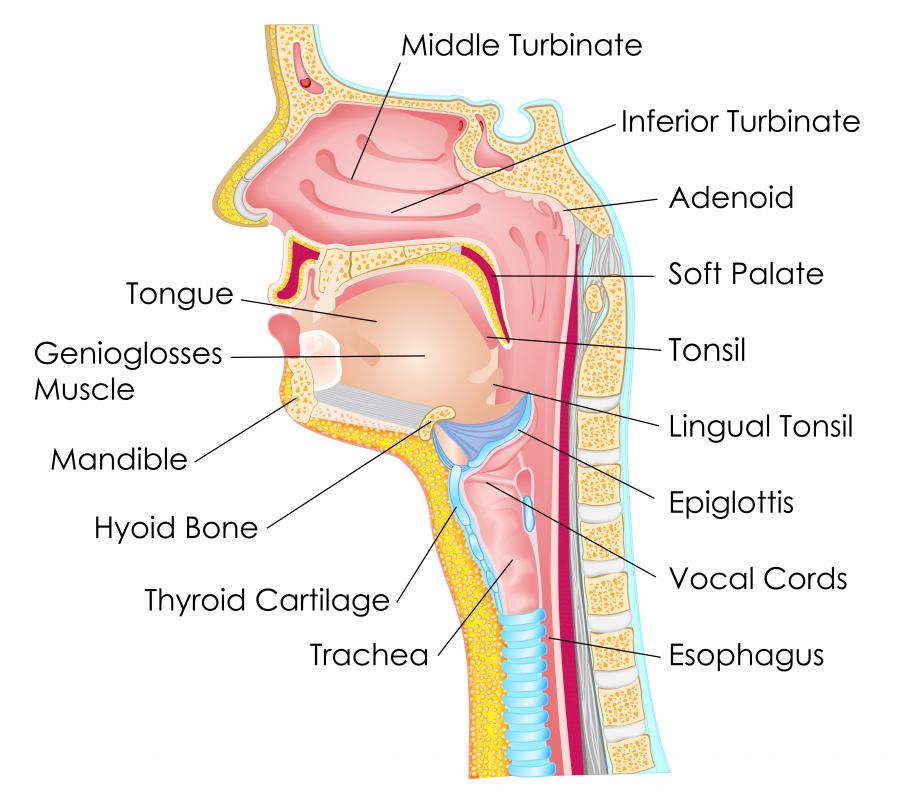
Throat cancer, which occurs when the cells in the throat begin to divide at an out of control rate, is accompanied with a number of symptoms, many of which are also associated with less serious conditions or other medical problems. Patients who identify the symptoms of throat cancer should make an appointment to see a medical professional in a timely fashion, and they should not worry about being wrong; a healthcare practitioner would much rather give a patient a clean bill of health or some antibiotics for a mild sore throat than see a patient with throat cancer after it is too late.
Many of the symptoms of this type of cancer involve breathing, swallowing, and eating. The patient may have difficulty breathing, develop high pitched breath sounds, have difficulty swallowing, or feel like he or she has a lump in the throat that makes it difficult to eat and drink. Voice changes, such as hoarseness or changes in pitch, can also accompany throat cancer, and the throat may feel painful, sore or tender. The lymph glands in the throat may also become swollen.

Other symptoms of throat cancer can include frequent headaches, recurrent sinus infections, a persistent sore throat or cough, pain or paralysis in the facial muscles, ear pain, and unexplained weight loss. The symptoms may be subtle at first and attributed to a more general malaise or a resilient sore throat. More serious symptoms can include bleeding from the nose or coughing up blood and the appearance of lumps in other areas of the body, suggesting that the cancer has begun to spread.

A patient who suspects that he or she has throat cancer will be examined by a medical professional who will physically examine the throat, interview the patient, and order medical tests, such as biopsies of the throat and imaging studies, to look for signs of abnormal growth. If a cancerous growth is detected, a pathologist will determine the type of cancer involved and the stage of the cancer, and the patient will see an oncologist to discuss treatment options.

Cancer of the throat can be treated with chemotherapy and radiation, and the prognosis varies, depending on the cancer, the patient, and when the cancer is caught. The earlier the symptoms are identified, the better the prognosis, as the patient will be able to benefit from early intervention. When discussing throat cancer treatment with a medical professional, patients may want to ask about all of the options, the prognosis with each option, the side effects associated with different treatments, and the amount of time that will be required for treatment.
Mary McMahon
Ever since she began contributing to the site several years ago, Mary has embraced the exciting challenge of being a WiseGEEK researcher and writer. Mary has a liberal arts degree from Goddard College and spends her free time reading, cooking, and exploring the great outdoors.
Learn more...
Mary McMahon
Ever since she began contributing to the site several years ago, Mary has embraced the exciting challenge of being a WiseGEEK researcher and writer. Mary has a liberal arts degree from Goddard College and spends her free time reading, cooking, and exploring the great outdoors.
Learn more...AS FEATURED ON:
AS FEATURED ON:









-
![Tenderness and pain are symptoms of throat cancer.]() By: Arman ZhenikeyevTenderness and pain are symptoms of throat cancer.
By: Arman ZhenikeyevTenderness and pain are symptoms of throat cancer. -
![A persistent cough or sore throat can be a symptom of throat cancer.]() By: Alexander RathsA persistent cough or sore throat can be a symptom of throat cancer.
By: Alexander RathsA persistent cough or sore throat can be a symptom of throat cancer. -
![Throat cancer can cause a patient to cough up blood.]() By: Lisa F. YoungThroat cancer can cause a patient to cough up blood.
By: Lisa F. YoungThroat cancer can cause a patient to cough up blood. -
![Pain or paralysis in the facial muscles could be a sign of throat cancer.]() By: snapgalleriaPain or paralysis in the facial muscles could be a sign of throat cancer.
By: snapgalleriaPain or paralysis in the facial muscles could be a sign of throat cancer. -
![Treatment for throat cancer depends on the location and type of tumor.]() By: edbockstockTreatment for throat cancer depends on the location and type of tumor.
By: edbockstockTreatment for throat cancer depends on the location and type of tumor. -
![The prognosis for throat cancer is more favorable if the cancer is detected early.]() By: Lisa F. YoungThe prognosis for throat cancer is more favorable if the cancer is detected early.
By: Lisa F. YoungThe prognosis for throat cancer is more favorable if the cancer is detected early.




Discussion Comments
@ Amphibious54- It is important to track what makes symptoms better or worse when preparing for a diagnostic appointment. Time is precious in the treatments of cancers. The doctor will able to make a quicker diagnosis when more information about symptoms is available. I believe that making a conscious effort to track symptoms will also help the patient address the issues that increased their risks for getting cancer.
My grandfather died of numerous cancers, but the main culprits were throat and prostate cancer. When doctors diagnosed my grandfather with cancer, the cancers had begun to metastasize. To summarize part of the article, early detection and aggressive treatment are important to surviving throat cancer.
If you are showing signs of throat cancer, making the decision to go see a doctor can be stressful. Preparing for a trip to the doctor to discuss throat cancer symptoms is important. These tips are good for both facing the possibility of cancer and gathering information for your doctor.
*Enlist the help of a friend or family member. The emotional support can be good for the patient, while the extra set of ears will be beneficial in soaking up all the information from the doctor.
*Stop any activities that can aggravate the symptoms. The doctor will likely prescribe lifestyle changes, and it is never too soon to start implementing these changes.
* write down all of your symptoms, questions, family history, and fears you may have. Going to a doctor appointment prepared will ensure that the appointment is comprehensive.
Cancers are tough physically and mentally, but they are survivable.
The National Cancer Institute estimates throat and mouth cancers account for three to five percent of yearly cancer cases. What causes cells in the throat to mutate is not known, but there are many factors that increase the risk for throat cancer.
Poor diet and nutrient deficiencies can increase the risk for cancer in the lower Pharynx. Plummer-Vinson Syndrome is a type of Hyperpharynx cancer that is often associated with severe anemia.
Poor oral hygiene is the number one risk factor for cancer of the soft palate, tongue, and tonsils, although, overuse of mouthwash containing alcohols is thought to increase risks. Certain STDs like HPV also increase risks for oropharynx cancers.
Diets heavy in preserved foods increase the risk for nasopharynx cancers. Upper throat cancer is also more prevalent in those with Asian ancestry, and those that work in woodworking and timber occupations.
Post your comments