
At Sports&Hobbies, we're committed to delivering accurate, trustworthy information. Our expert-authored content is rigorously fact-checked and sourced from credible authorities. Discover how we uphold the highest standards in providing you with reliable knowledge.
What are the Offensive Positions in Football?
The offensive team in football is the team that is in possession of the ball and usually is trying to score points against the opponent's defense. There can be 11 players at various positions on the field for the offense on each play. The offensive positions in football can be broken down into three general categories: backfield positions, offensive linemen and receivers. In the backfield, the main positions are the quarterback and the running backs. The offensive linemen include the center, guards and tackles, and the receivers typically include the wide receivers and tight ends.
Quarterback

Many people consider the quarterback to be the most important of the offensive positions in football. The quarterback has the ball on almost every offensive play and can either pass it through the air, run with it or hand it off to a teammate. It is the quarterback who typically tells the other offensive players on the field which play to run and, after the offense lines up, calls out signals to instruct his or her teammates and to indicate when the play should begin — and sometimes to deceive the defensive players. The quarterback typically lines up behind the center, who snaps the ball to the quarterback to begin a play.
Running Backs
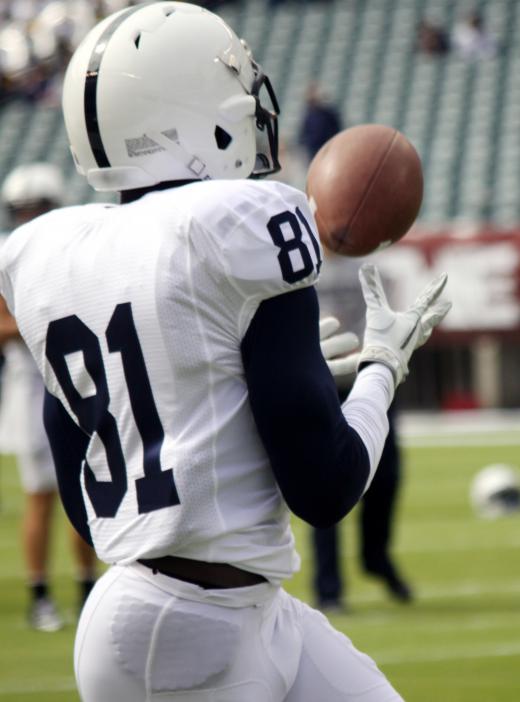
Also lining up behind the offensive line are the running backs, who usually stand farther behind the line than the quarterback and might also be a little to the quarterback's left or right. Most offensive formations include one or two running backs, but there might be more or fewer on the field for a particular play. A running backs often carries the ball, and sometimes will catch passes from the quarterback or even throw the ball to a teammate.
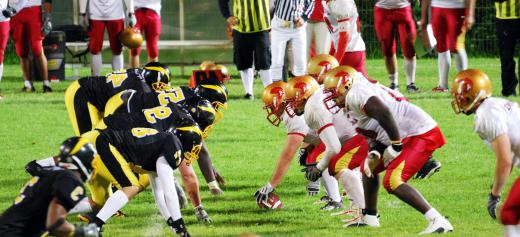
A running back who frequently carries the ball is often called a tailback or halfback, and one who is more often required to block for a ballcarrier is usually called a fullback. The fullback often lines up in front of the tailback in the backfield in order to lead the way when the tailback is handed the ball on running plays. Players who line up farther to the side of the backfield and closer to the line might be called wingbacks or H-backs.
Linemen

The foundation of the offense is the linemen. These five players — who usually are the largest offensive players on the field — are responsible for blocking defenders to keep them away from the quarterback and to create holes through which the running backs can run with the ball. The center lines up in the middle of the line, directly over the ball in order to snap it to the quarterback. There are two guards, one on each side of the center, and there are two tackles, one on each end of the line. The offensive linemen are positioned along the line of scrimmage, which is an imaginary line that extends from the ball to both sidelines.
Receivers
Next to the tackle is sometimes a tight end, who is eligible to receive passes from the quarterback but also might be asked to block like a lineman. Typical offensive formations include one tight end, but formations that include no tight ends, two tight ends or even three tight ends also are common. A tight end also might line up a little behind the line of scrimmage or out away from the linemen and closer to the sideline.
Wide receivers primarily line up to the outside of the offensive formation, often near one of the sidelines. Their main role is to catch passes from the quarterback although they also can be required to block and will sometimes carry the ball on running plays. The wide receiver positions might be known by various names — such as flankers, split ends, X receivers or Z receivers — that usually refer to where those players line up on the field. There typically are two or three wide receivers on the field at a time, although formations that include no wide receivers or as many as five wide receivers also might be used.
Different Skills Needed
At each of the offensive positions in football, certain skills and athletic abilities are ideal. Along with their large size, offensive linemen need enormous strength for blocking equally large defensive linemen. Wide receivers typically need good speed and the ability to catch well, and tight ends often have strength for blocking as well. Running backs use speed, elusiveness and strength to avoid being tackled. Quarterbacks typically need to be able to throw the ball well and have leadership skills, intelligence and the ability to make quick decisions.
Jersey Numbers
Under some sets of rules, players at each of the offensive positions in football must wear certain numbers on their jerseys. This helps fans and other people who are watching the game identify players more easily, and it helps the defense know which players are eligible to catch passes. Quarterbacks typically wear numbers 1 to 19, running backs 20 to 49, offensive linemen 50 to 79 and receivers 80 to 89 or sometimes 1 to 19.
Players sometimes change from one position to another, either on a long-term basis or from one play to the next. For example, an offensive lineman might switch from guard to tackle, or a running back might also play wide receiver. In some cases, an offensive player might be required by rule to let a game official know that he or she is switching positions, and the official will tell the defense in order to prevent unfair deception.
AS FEATURED ON:
AS FEATURED ON:


-
![Quarterbacks, running backs and wide receivers are some common offensive positions.]() By: Melinda NagyQuarterbacks, running backs and wide receivers are some common offensive positions.
By: Melinda NagyQuarterbacks, running backs and wide receivers are some common offensive positions. -
![Passes are typically thrown to tight ends and wide receivers.]() By: Richard KanePasses are typically thrown to tight ends and wide receivers.
By: Richard KanePasses are typically thrown to tight ends and wide receivers. -
![Defensive linemen are typically closest to the ball before it is hiked.]() By: JJphotoDefensive linemen are typically closest to the ball before it is hiked.
By: JJphotoDefensive linemen are typically closest to the ball before it is hiked. -
![A running back will often be handed or tossed the ball by the quarterback right after the snap.]() By: Melinda NagyA running back will often be handed or tossed the ball by the quarterback right after the snap.
By: Melinda NagyA running back will often be handed or tossed the ball by the quarterback right after the snap.


Discussion Comments
While there is normally 11 offensive players per play, it's certainly possible that more than 11 or less than 11 might be on the field if the substitutions weren't conducted properly. Having more than 11 offensive players on the field will result in a penalty.
Post your comments