
At WiseGEEK, we're committed to delivering accurate, trustworthy information. Our expert-authored content is rigorously fact-checked and sourced from credible authorities. Discover how we uphold the highest standards in providing you with reliable knowledge.
What are the Most Common Slipped Disc Symptoms?
Pain is by far the most common slipped disc symptom, though how this pain presents itself and how long it lasts can vary a lot from person to person. A lot depends on individual anatomy, as well as the precise location and severity of the injury. Most people with slipped discs start out feeling general pain on one side of their body. It’s often most acute in the arms, legs, or neck, and frequently comes paired with numbness or tingling. Pain tends to be worst when walking or otherwise moving, though people can experience it at any time. Sciatica, which is a type of nerve pressure pain, is also very common, as is overall muscle weakness and feelings of diminished strength. Slipped discs can usually be corrected with physical therapy and a certain amount of rest, though a lot does depend on the specific situation.
Why and How Spinal Discs Slip

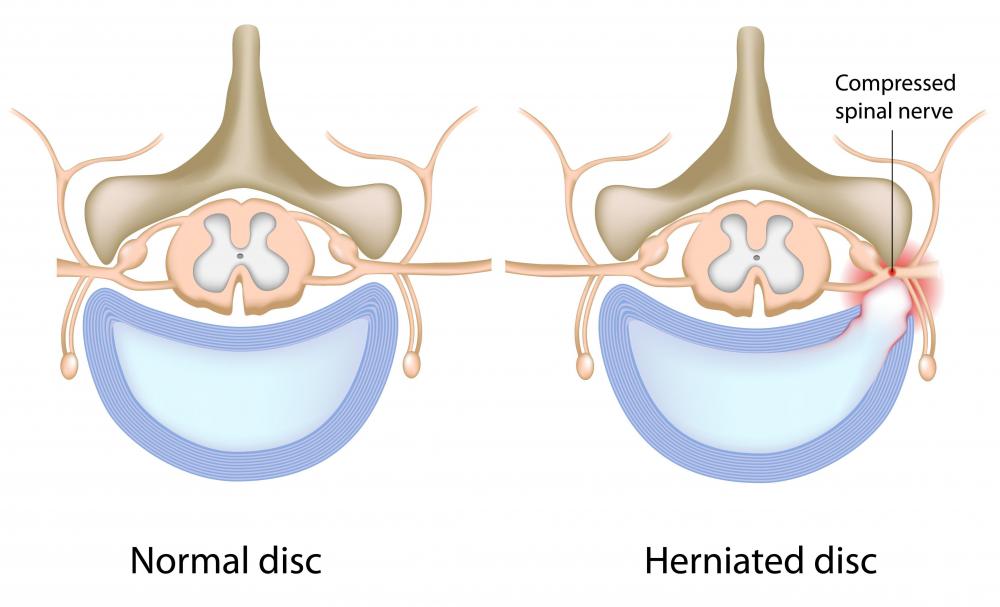
A slipped disc, also known as a herniated or ruptured disc, occurs when the substance from the nucleus of a disc leaks into the spinal column. The spine of the human body consists of 26 bones called vertebrae. Located between each vertebra are discs filled with a jellylike substance that acts as a cushion between the bones. Slipped discs most often occur in the lower back, but they can occur in any part of the spine.

Discs are round and flat, and have two main components: the annulus, which is the tough outer layer, and the nucleus, which is the soft inner layer. Slipped discs often occur when there is a rupture in the annulus and part of the nucleus pushes through. The displacement of the jellylike substance can put pressure on nerves in the spinal column, which can lead to a range of problems.
General and Specific Pain

Pain is one of the first things that people with slipped discs experience. Sometimes the discomfort is more or less general, usually in the back region but not really centralized anywhere, It’s also common for people to feel shooting pain sensations that come and go in their arms and legs.
A slipped disc on or near a nerve can also trigger very specific pain. People in these situations often feel a burning or pulsing sensation in a particular place, and it doesn’t usually move or change the way more general discomfort often does. In either case, people can often get some relief from over the counter medications and changes in things like sitting and sleeping positions. In more serious cases, though, prescription-strength drugs may be required.
Neck Issues

Sharp or dull pain in the neck, between the shoulder blades, or that radiates down into the arm and hands may indicate a slipped disc in the cervical spine or neck. The pain may be increased with certain positioning and decreased with others. Slipped disc symptoms can also include tingling and muscle spasms, and in some cases may not cause any symptoms at all.
Sciatica

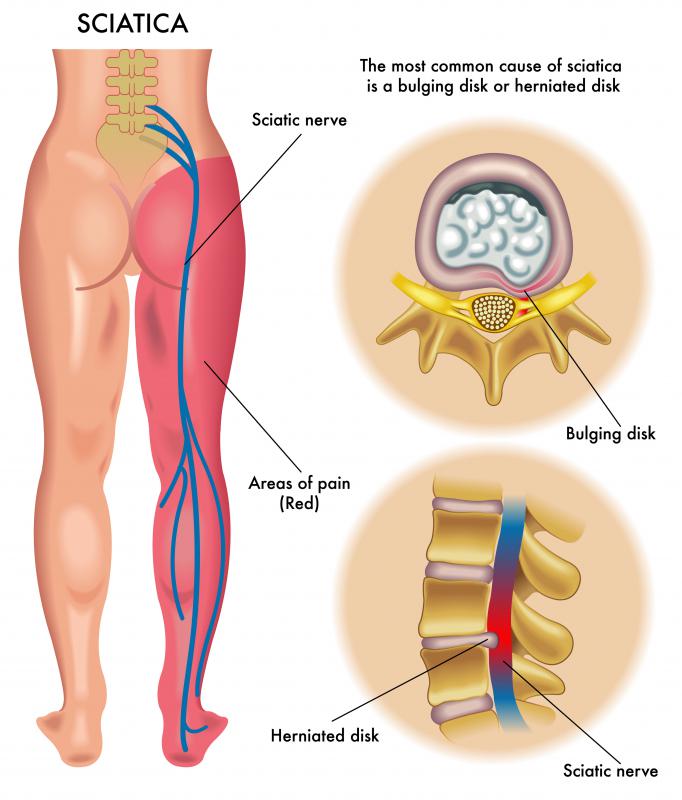
Another very common symptom is sciatica. Sciatica is when the slipped disc places pressure on the sciatic nerve, thereby radiating pain that starts in the lower back or buttock and extends down into one leg. It is often experienced as a sharp pain that can be described as being similar to an electric shock. Sciatica can cause numbness, muscle weakness, and difficulty in moving the affected leg.
Diagnosis and Treatment

Medical experts can typically diagnose slipped discs through a combination of physical examinations and diagnostic tests like X-rays, magnetic resonance imaging (MRI) scans, or a computerized axial tomography (CAT) scans. These tests are non-invasive and are usually the best way to get a glimpse into what is happening on the inside. Professionals who know how to analyze and read the results are often able to pinpoint exactly which discs have slipped and how far they’ve moved, which can make treatment much more effective and personalized.

Treatment for slipped discs usually involves a combination of medication and physical therapy. In most cases, the discs can be coaxed back into place with specific exercises, and medications can both lessen the pain involved with this process and help the muscles relax enough that it can be effective. Surgery isn’t usually recommended simply because of how invasive and risky it is, though people sometimes will need this sort of fix if the slippage is very severe or if the problem recurs over time to point where it’s a more or less constant issue.
AS FEATURED ON:
AS FEATURED ON:









-
![Back pain might indicate a slipped disc.]() By: mangostockBack pain might indicate a slipped disc.
By: mangostockBack pain might indicate a slipped disc. -
![In rare cases, a herniated disc must be surgically removed.]() By: Alila Medical MediaIn rare cases, a herniated disc must be surgically removed.
By: Alila Medical MediaIn rare cases, a herniated disc must be surgically removed. -
![Weakness in the neck is common with a slipped disc.]() By: nebariWeakness in the neck is common with a slipped disc.
By: nebariWeakness in the neck is common with a slipped disc. -
![An MRI scan will commonly be used to diagnose a slipped disc.]() By: James SteidlAn MRI scan will commonly be used to diagnose a slipped disc.
By: James SteidlAn MRI scan will commonly be used to diagnose a slipped disc. -
![Patients with back pain are first given x-rays to diagnose the problem.]() By: lightwavemediaPatients with back pain are first given x-rays to diagnose the problem.
By: lightwavemediaPatients with back pain are first given x-rays to diagnose the problem. -
![If the sciatic nerve becomes irritated, it can cause pain and numbness down the leg.]() By: rob3000If the sciatic nerve becomes irritated, it can cause pain and numbness down the leg.
By: rob3000If the sciatic nerve becomes irritated, it can cause pain and numbness down the leg. -
![Patients with a slipped disc are often treated using physical therapy in conjunction with anti-inflammatory drugs.]() By: AmbrophotoPatients with a slipped disc are often treated using physical therapy in conjunction with anti-inflammatory drugs.
By: AmbrophotoPatients with a slipped disc are often treated using physical therapy in conjunction with anti-inflammatory drugs.




Discuss this Article
Post your comments