
At WiseGEEK, we're committed to delivering accurate, trustworthy information. Our expert-authored content is rigorously fact-checked and sourced from credible authorities. Discover how we uphold the highest standards in providing you with reliable knowledge.
What are the Educational Requirements to Becoming a Lawyer in the US and Abroad?
 Nicole Madison
Nicole Madison
Nicole Madison
In the United States, prospective lawyers are required to earn college degrees and graduate from accredited law schools. A law student can attend a law school accredited by the American Bar Association (ABA) or a state authority. Some states allow law students to study law in law offices, instead of through accredited law schools. A few states allow law students to study law through correspondence schools. A selection of states require prospective lawyers to register and obtain approval from the State Board of Law Examiners before entering law school or during the first years of legal education.
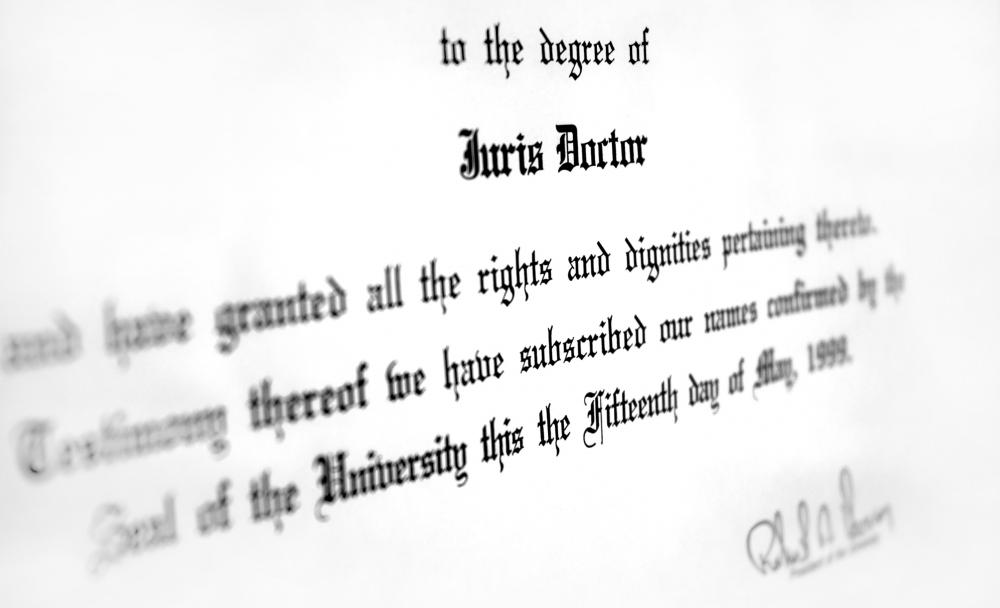
Typically, four years of college and three years of law school education are required for prospective lawyers in the United States. In college, there is no particular pre-law major. However, prospective lawyers must develop logic, reading, writing, speaking, research, and analytical skills. Prospective lawyers are encouraged to take English, public speaking, government, history, and philosophy courses. Math, economics, computer science, and foreign language courses may be helpful as well. Graduating laws students are granted the Juris Doctor degree.

In addition to required education, each state sets its own requirements for becoming a lawyer. Each state requires prospective lawyers to be licensed or admitted to the bar. The highest court in the jurisdiction establishes rules for lawyer licensing and bar admittance. In all states, a prospective lawyer must take and pass a written bar examination to gain admittance to the bar. In some states, lawyer candidates are also required to pass written ethics examinations.

A lawyer must be admitted to the bar in each state in which he or she wishes to practice law. However, some states, on occasion, allow lawyers to be admitted to their bars without taking the state-specific bar exam. In such cases, the lawyer must meet the standards set by the particular jurisdiction. When an individual has graduated from a law school that is not accredited by the ABA, he or she is restricted to taking the bar exam in the state or jurisdiction in which the school is located. Federal courts and agencies create different standards for lawyers.

To become a lawyer abroad, a candidate is typically required to obtain a Bachelor of Laws degree. Often, legal education is administered by an undergraduate college department, sometimes called a faculty of law. Some countries require prospective lawyers to earn bachelor’s degrees in other subjects at the same time as they are pursuing law degrees. Frequently, lawyer candidates must also complete government-provided coursework, special examinations, and legal apprenticeships.
Nicole Madison
Nicole’s thirst for knowledge inspired her to become a WiseGEEK writer, and she focuses primarily on topics such as homeschooling, parenting, health, science, and business. When not writing or spending time with her four children, Nicole enjoys reading, camping, and going to the beach.
Learn more...
Nicole Madison
Nicole’s thirst for knowledge inspired her to become a WiseGEEK writer, and she focuses primarily on topics such as homeschooling, parenting, health, science, and business. When not writing or spending time with her four children, Nicole enjoys reading, camping, and going to the beach.
Learn more...AS FEATURED ON:
AS FEATURED ON:









-
![There are different educational requirements for becoming a lawyer in the US and abroad.]() By: -Marcus-There are different educational requirements for becoming a lawyer in the US and abroad.
By: -Marcus-There are different educational requirements for becoming a lawyer in the US and abroad. -
![Prospective lawyers must earn a Juris Doctor degree from an accredited law school.]() By: Lane EricksonProspective lawyers must earn a Juris Doctor degree from an accredited law school.
By: Lane EricksonProspective lawyers must earn a Juris Doctor degree from an accredited law school. -
![Lawyer qualifications include passing a bar examination.]() By: Gina SandersLawyer qualifications include passing a bar examination.
By: Gina SandersLawyer qualifications include passing a bar examination.


Discussion Comments
@anon42684: Actually, in New Zealand, you complete a four year LLB, then undertake a 4/5 month professional legal studies course before you can apply to be admitted to the bar.
Ethics is a compulsory paper of the LLB and has always been so. It was never dropped in New Zealand.
In Vermont you can still study law like Abraham Lincoln did: study on your own, after registering with the Board of Bar Examiners as a law clerk to another lawyer. After four years you can take the same bar exam that other lawyers do. If you pass, you will be no doubt better prepared to practice than most law school graduates, because you will have four years of valuable practical experience. You only need three years of college to do this, not four. Of course most other states won't accept you if you try to move there. But who would want to leave a state that is so beautiful, and practical.
A high school graduate only Vermont lawyer.
if i study in the UK to become a lawyer and move to america and take their bar test etc., would it work? i.e. are the requirements of qualifications the same? Thanks.
Anon42975, perhaps your daughter would find working as a professional mediator more rewarding than the practice of Law. I know I do!
My daughter is an attorney. I can assure you that she's a caring person, but she does work for a firm that bills for her time, so she doesn't have the ability to spend time with a client that the client isn't willing or able to pay for. This angers people I think, that attorneys charge for even the smallest amounts of time. They charge by the hour,or even minute.
If an attorney works for herself, she's able to charge what she chooses. My daughter is not since she works for her firm.
I think that if people who dislike attorneys as a group were charged with a serious crime, they'd want an attorney. Many attorneys do not work in a courtroom, but practice a myriad of other kinds of law besides litigation.
Being an attorney is stressful and requires long hours. My daughter works at least 11 hours a day. A person can work part time, but will have no real future as far as salary goes. An attorney hopes one day to make partner and begin to make more money for their 11 hours of grinding research and putting together documents in legalese.
To be an attorney takes a good mind and willingness to work, sometimes for very long hours.
Is it any wonder that the law profession is looked upon as an easy path to large amounts of moolah? I, for one have not had good experiences with lawyers and their staff. The people seem to be high-minded and stuffy, not caring or compassionate in regards to the general public. Should there ever come a time that I need a lawyer again, I will represent myself and do a much better job in the case, then the educated and most annoyingly obtuse stranger that is called 'attorney at law.'
Wow! No wonder their fees are so high! So what does a paralegal do and what kind of training and courses do they have to take?
My cousin has had a successful law firm in N.Y.C. for the last 36 years. He was expelled from law school when the Ethics Committee decided that his weekly education column in the New York Times was too liberal.
He took the bar exam and passed immediately.
He told me, as have others, law school is not
a pre-requisite to sit for the bar exam in N.Y. state.
in New Zealand, an llb is followed by at least two years in a practice as a junior before admission to the bar. Interesting to see usa lawyers are required to take ethics. This has been dropped in nz and the quality of nz lawyers has plummeted accordingly. tgpd
Post your comments