
At WiseGEEK, we're committed to delivering accurate, trustworthy information. Our expert-authored content is rigorously fact-checked and sourced from credible authorities. Discover how we uphold the highest standards in providing you with reliable knowledge.
What are the Early Signs of Pregnancy?
There are several early signs of pregnancy that, considered individually, may be attributed to other conditions, but taken together can be pretty clear indicators that a woman is expecting. A missed period, fatigue, nausea, and food cravings or food aversions can all be early signs. Generally, a woman may be pregnant if she suspects she is and exhibits three or more of these symptoms. To be certain, a woman should take a home pregnancy test or see a doctor.
Missed Period

A common assumption is that a missed menstrual cycle is the biggest of the early signs of pregnancy; however, this isn't a foolproof indicator. Since many women do not have regular periods, it can be difficult to judge if a cycle is truly late. Others may experience light bleeding, called implantation bleeding, after becoming pregnant; this commonly occurs when the fertilized egg attaches itself in the womb. In fact, some estimates indicate that as many as one in five pregnant women experience some light bleeding in the first trimester.
Fatigue

Among the early signs of pregnancy, fatigue is a symptom experienced by a large percentage of women. This tiredness can make engaging in normal activities difficult and cause a woman to suddenly require more sleep that she usually needs to get through her daily routine. Fatigue occurs because a woman's stamina decreases as her body uses much of its energy to make the physical changes required for pregnancy.
Nausea

Hormonal changes also take place, which can create a feeling similar to that experienced when coming down with the flu. Nausea, with dry heaves or actual vomiting, is common during the first six to 14 weeks of pregnancy. Though this is often referred to as "morning sickness," it can happen at any time of the day or night.
Changes in the Breasts
Another of the early signs of pregnancy are breast changes. The areolas, the colored skin around the nipples, may darken and enlarge. The breasts themselves usually become tender and full, as the body begins the biological process to allow for milk production. These changes can be similar to breast changes common among women who experience monthly premenstrual syndrome (PMS).
Food Cravings and Food Aversions

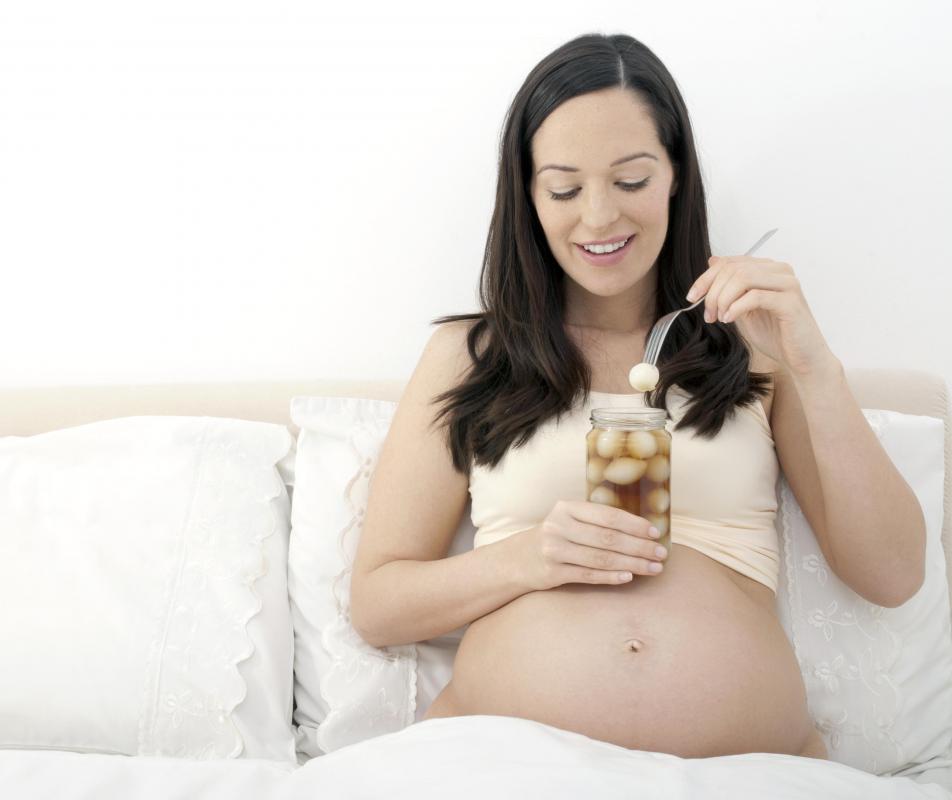
Cravings for specific foods may accompany a pregnancy. Sometimes these can be uncharacteristic, such as a vegetarian who craves meat or a person who doesn't normally like sweets suddenly wanting a lot of sugary treats. Some women actually get urges to eat unusual things, like soil or chalk, which can indicate a vitamin deficiency. Expectant mothers and women who are not pregnant should see a doctor if experiencing cravings for non-food items.

Much like unexplained cravings, food aversions are another common symptom of early pregnancy. Sudden sensitivities to foods or smells may make a woman feel sick or light-headed. This is caused by surging hormones. Common triggers for queasiness or even headache are generally strong odors or flavors, such as smoke, cologne, garlic, and eggs.
Cramping and Bloating

A general feeling of cramping or bloating in the pelvic area can also be another of the signs of pregnancy. This may be accompanied by constipation. Again, such changes can mimic PMS or another illness, and many women may not know for sure that they are pregnant based solely on this one symptom.
Frequent Urination
Frequent urination, or frequent urges to urinate, can also be an indicator that a women is pregnant. This early symptom often subsides during the second trimester and then reoccurs at the end of the pregnancy. If a woman notices that she is having to use the bathroom more often than usual, is experiencing other signs of pregnancy, and suspects she may be expecting, she should take steps to find out for sure.
Testing

Typically, the fastest and easiest way to determine if a woman is pregnant — without visiting a doctor's office — is to take a home pregnancy test. These simple tests measure a hormone called human chorionic gonadotropin (hCG), which is produced during pregnancy. The test usually consists of a chemically-treated paper or plastic strip. When dipped in a woman's urine, these chemicals react and change. The exact changes vary depending on the type of test used, but the strip typically indicates whether the result is negative, meaning not pregnant, or positive.

Though some home pregnancy tests report that they can provide a result on the first day of a missed period, it may actually take up to 10 days or more before sufficient, detectable quantities of hCG are present. Therefore, a negative result on an early test may be inaccurate, and the woman may actually be pregnant. A home test is often more reliable if it is used when a menstrual period is closer to two weeks or more late, or if it was much lighter than usual. If the test is negative but a woman still suspects pregnancy, she can wait a few more days and re-test.
Confirming a Pregnancy

A medical professional can perform a blood test that will detect much lower levels of hCG than a home pregnancy test. This type of screening is accurate even in the first days of pregnancy. If the early signs of pregnancy are present, and especially if pregnancy has been indicated with a home pregnancy test, a woman should make an appointment with a medical professional to confirm it. Proper prenatal care is vital for the health and safety of a mother as well as her baby.
Though there are many common early signs of pregnancy, it is important to note that not everyone will experience all of these symptoms. If a woman suspects she may be pregnant, she should not be misled by a lack of changes. She should instead use a home pregnancy test or see a doctor to get a definitive answer.
AS FEATURED ON:
AS FEATURED ON:









-
![Women experiencing the early signs of pregnancy should take a home pregnancy test or see their doctor.]() By: Ioannis PantziWomen experiencing the early signs of pregnancy should take a home pregnancy test or see their doctor.
By: Ioannis PantziWomen experiencing the early signs of pregnancy should take a home pregnancy test or see their doctor. -
![Extreme fatigue may be an early sign of pregnacy.]() By: petrrunjelaExtreme fatigue may be an early sign of pregnacy.
By: petrrunjelaExtreme fatigue may be an early sign of pregnacy. -
![Food cravings, due to hormones, are often an early sign of pregnancy.]() By: hartphotographyFood cravings, due to hormones, are often an early sign of pregnancy.
By: hartphotographyFood cravings, due to hormones, are often an early sign of pregnancy. -
![Morning sickness is often experienced in the first trimester of pregnancy.]() By: jedi-masterMorning sickness is often experienced in the first trimester of pregnancy.
By: jedi-masterMorning sickness is often experienced in the first trimester of pregnancy. -
![A missed period is one of the most common early signs of pregnancy.]() By: lukasmajercikA missed period is one of the most common early signs of pregnancy.
By: lukasmajercikA missed period is one of the most common early signs of pregnancy. -
![Sudden sensitivity to smells, such as cologne, may be a sign of pregnancy.]() By: adisaSudden sensitivity to smells, such as cologne, may be a sign of pregnancy.
By: adisaSudden sensitivity to smells, such as cologne, may be a sign of pregnancy. -
![Constipation during pregnancy is generally viewed as an unpleasant experience.]() By: LangstrupConstipation during pregnancy is generally viewed as an unpleasant experience.
By: LangstrupConstipation during pregnancy is generally viewed as an unpleasant experience. -
![Sudden nausea might be an early sign of pregnancy.]() By: Kaspars GrinvaldsSudden nausea might be an early sign of pregnancy.
By: Kaspars GrinvaldsSudden nausea might be an early sign of pregnancy. -
![For women with a regular menstrual cycle a missed period may be an early sign of pregnancy.]() By: John TakaiFor women with a regular menstrual cycle a missed period may be an early sign of pregnancy.
By: John TakaiFor women with a regular menstrual cycle a missed period may be an early sign of pregnancy.




Discussion Comments
My wife's period is 15 days late. Could she be pregnant? She said she does not have any symptoms of pregnancy.
I had my period in mid-February, but we had unprotected sex that very same day and normally my periods last for close to a week and are very heavy. That one only lasted maybe three days and wasn't that heavy at all. Now here it is late March and I am eight days late. No spotting or anything. I've had some mild cramping and lower back pain but yet still nothing.
I had sex with my boyfriend and we used a condom. He ejaculated in me with the condom on, but while withdrawing his penis, the condom was stuck in my vagina with the ring side hanging out of the vagina, which he later pulled out. I have missed my periods for over a month and a half and have had three negative pregnancy tests done after a week from my missed period. Am I pregnant? I really don't want to be right now, but I haven't experienced any symptoms of pregnancy apart from tender breasts. Please help.
my periods have become very light and short after intercourse and it is kind of spots of brown color. I did two tests but result was negative. What can be the reason?
My DH and I have been TTC for over nine years. I have a condition which makes penetration difficult and intercourse painful and he has a low sperm count and we have been told they are poor swimmers. Therefore, the chances of me being pregnant are very slim -- almost no chance.
So why then, am I onto the 33rd day of my cycle with none of the symptoms I usually get before my period starts and no sign of my period when I usually have a 27 - 30 day cycle? Could I be ill, or could I be experiencing a premature menopause, or could I possibly (I don't know how) be pregnant?
I am confused as I know my body well and this is not normal for me. I also ovulated late again -- unusual for me -- any ideas as to what is going on with my body? Although, I ovulated late I have never had a 33 day cycle before!
I had my last menses in late June. Just 11 days later, I had bleeding just for a day. Please explain to me what has gone wrong.
Can a woman get pregnant without sexual intercourse, but with rubbing of sex organs and penis ejaculating outside the vagina? Please answer this.
My last period was in mid-February. We had unprotected sex in early March. It is the middle of March and yet I missed my period. It's delayed. Could I be pregnant?
@anon96056: There is absolutely no way you could be pregnant. The only way you could become pregnant is if you had sexual intercourse (penis entering vagina, ejaculating). But if you said he did ejaculate on your stomach there's no way.
The trouble with these symptoms is that you can feel almost all of them with enough wishful thinking. Add to that an unreliable cycle and it's enough to make you go a little crazy.
i had sex in early march and got my period a month later in April, but have not had a period this month and it's May. Could I be pregnant?
I got married one month back and we had sex once two days back. Two days later I had bleeding after intercourse. It didn't last for more than half an hour? I am eager to know whether I am pregnant. Please advise.
my husband and i are trying for our second baby. my period was the last of February, and i ovulated in mid-March, depending on which site you calculate by. i am currently 13 days past ovulation, I'm bloated, tired moody, hungry and have sore boobs. some of my tests say positive and some say negative. I guess I'll have to wait for my period to know for sure. baby dust to all.
The first day of my period was on 25th November. I had protected sex on the 10th of December. On the 20th of December, my period came (which was three days early) I have regular cycles ranging from 26 day cycles, to a 32 day cycle. Is it possible that I'm pregnant?
My husband had a vasectomy seven years ago. Three months ago I started the birth control Natazia, (I have been on many different pills throughout the years). I was also put on an antibiotic for acne and two weeks ago I got the flu mist vaccine.
My last two periods have been extremely light, I'm bloated, nauseated, constipated/diarrhea, mild acne, frequent urination, heart burn, headache, and fatigue. Could I be pregnant? How good is a vasectomy?
i had sex with my boyfriend a week ago and a few days later I've been feeling so terrible. i never know when my period is going to come because it comes when it wants.
yesterday, i was throwing up in the morning around 9 and i had a headache. the medicine i took did not do nothing at all. my stomach is achy, I'm really tired and lazy. my few past days been going by really slow for me. my lower back has some pain.
i could not sleep all night from monday to tuesday. could this mean I'm pregnant?
In June i got my period the last week of the month and on 4th July i had intercourse with my fiancee. This month still i have not had my periods yet. Am I pregnant? Please tell me.
I was just intimate with him but we didn't have sex, but he just ejaculated on my stomach then I washed my stomach with antibacterial solution and sex part too.
My period date was 12 june but always is late by 3-4 days so am i pregnant? please tell me. i am scared.
i had sex with my boyfriend four days before my period was supposed to come on but that same day i took my birth control pill as i always do at the same time each day which is nine at night and i have an alarm that reminds me. i got real scared so i took an emergency contraception two days later and now I'm on the non hormonal pills and my period has yet to come on. I'm already on the fourth pill and nothing has happened. I'm getting scared. Could i be pregnant?
Please, give advice! I am pregnant in my third week and for the last four days i cannot eat anything. I am so tired, i try to eat but even the smell of food makes me feel so terrible! How long can i feel so terrible? What i must do?
I had my last period the third week of March. Today it's the third week of May and I haven't had my period for two months already. I always have sex with my boyfriend and he always withdrew it. That is why I've been looking for pregnancy symptoms, to see if I am really pregnant. Please help.
Last january 1 I had unprotected sex with my boyfriend, then after three days I got my period. then, we never had sex till today. however, i'm I haven't got my period for february. Am I pregnant?
My last period was late november and my next period has not started yet. usually my cycle always starts before the date. i have white discharge. is it possible to have white discharge if i am pregnant.
i saw my period 14 days ago and i'm seriously constipated, and am in my ovulation period. is it possible that am pregnant after seeing my period?
I had my period in the middle of July. usually i am getting my periods 10 days above my regular dates. if i want to check if I am pregnant, which date i should check with the self-testing kit?
hey anon33883, i had the same symptoms when i was pregnant, but i did a pregnancy test and it said negative. then i found out two weeks later i was 6 weeks pregnant. it could be too early to have a pregnancy test yet. it all falls down to the hormone levels that the pregnancy test picks up on. some people have high hormones and some low. hence why mine came out negative but then 2 weeks later it was positive and i had a scan to make sure, which told me i was 6 weeks and 5 days. :)
i have an 11 month old baby but me and my partner are trying again, recently i have been suffering with bloating and sickness, i have done a pregnancy test but it came out negative, i'm also feeling tired, i'm just not sure about the bloating as i am not constipated or anything like that, has anyone else suffered with this symptom during pregnancy?
You could try a test from a different manufacturer, or see a doctor for a more definitive answer.
My husband and I have been trying for a baby since the 10th of January. I missed my period 19 days ago and I have taken 2 pregnancy tests, but they were negative. Should I wait longer or what?
Definitely the morning sickness, especially with the first pregnancy. There is no mistake about it, when you feel sick, the first thing in the morning, I would venture to say for most expecting mothers it is in the morning, you are expecting. It usually goes on for the first 3 months.
Post your comments