
At DelightedCooking, we're committed to delivering accurate, trustworthy information. Our expert-authored content is rigorously fact-checked and sourced from credible authorities. Discover how we uphold the highest standards in providing you with reliable knowledge.
What are the Different Types of Wine Glasses?
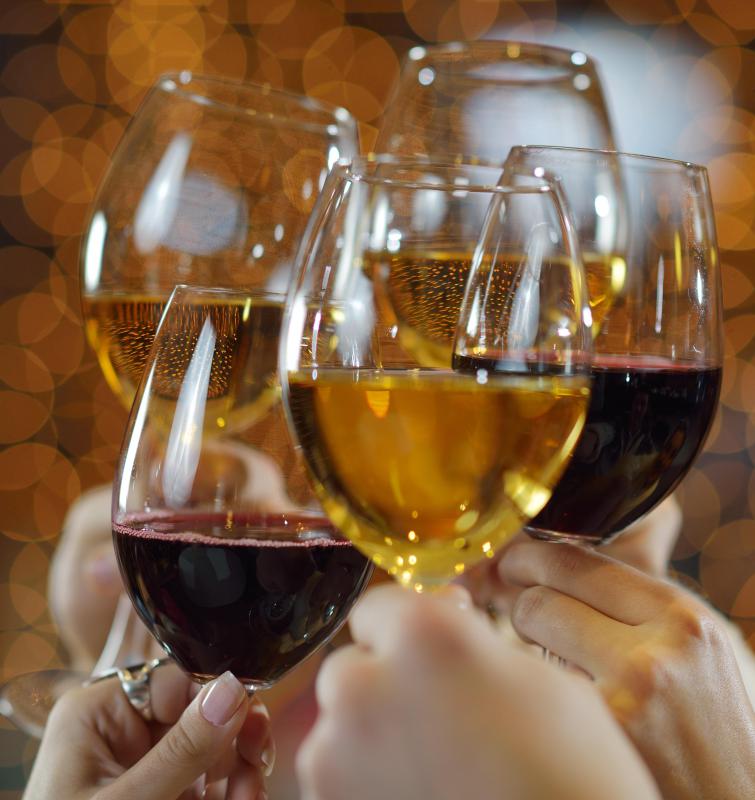
All wine glasses follow the same tulip-shaped design and have three essential components: the base, which keeps the glass upright; the stem, which allows a person to hold the glass without transferring his or her body heat to the wine; and a body conducive to maximum flavor and aroma for that particular type of wine. Experts recommend that glasses be made of crystal or other similar thin glass because thick glass is thought to influence the taste of the wine. They are all designed in a way that directs the wine to the parts of the mouth where its flavor will be most appreciated.
There are many types of wine glasses, but in general, only four are needed. Glasses for red wine are taller and wider so that the complexities of the wine can be better appreciated. People should have at least two types for their collection.

The first is a Bordeaux glass, which is designed for rich, full bodied red wines such as cabernets and merlots. The wide bowl allows the wine to breathe and brings out the rich aromas. Because the glass is tall, the wine proceeds directly to the back of the mouth allowing for maximum flavor. It's also a good idea to have a burgundy glass to use for other full bodied wines such as a pinot noir. Larger than the Bordeaux glass, the large bowl of the burgundy glass allows the wine to dispense to the tip of the tongue, where it's easier to taste the sweetness of the wine.

White wine glasses are smaller to help keep the wine cool. For a young crisp white wine, people will need a glass with an opening that's slightly larger than the body of the glass itself. This will allow the wine to dispense at the tip and sides of the tongue to better enjoy the wine's sweetness. A glass for more mature white wines is also recommended. This is a taller, straighter glass and will allow the wine to dispense to the rear and sides of the tongue to better taste the bolder flavor.

There are other glasses that a connoisseur might enjoy having in his collection. Champagne flutes are tall and thin, which will allow the bubbles to build up properly. Sweet wines, such as dessert wines, require smaller glasses that dispense the wine to the back of the mouth so the sweetness doesn't envelope the whole tongue and overwhelm by its flavor. Rose glasses are similar to those used for white wine in that they are smaller, though their bodies are wider to allow aromas to better develop.

Unless one is truly a wine connoisseur who understands and recognizes the complexities of all the different wines, there's no reason to have a different glass for each different wine. Most wine lovers use the use of four types of glasses, but individuals could probably get away with having one glass for each color of wine. The important thing is to use the glasses that provide the most enjoyment.
AS FEATURED ON:
AS FEATURED ON:


-
![Generally only true wine connoisseurs understand the necessity for varying wine glasses for different types of wine.]() By: .shockGenerally only true wine connoisseurs understand the necessity for varying wine glasses for different types of wine.
By: .shockGenerally only true wine connoisseurs understand the necessity for varying wine glasses for different types of wine. -
![It is truly only necessary to have one type of wine glass for each color of wine.]() By: misalevaIt is truly only necessary to have one type of wine glass for each color of wine.
By: misalevaIt is truly only necessary to have one type of wine glass for each color of wine. -
![Champagne in a flute.]() By: S.WhiteChampagne in a flute.
By: S.WhiteChampagne in a flute. -
![Glasses of white wine.]()
Glasses of white wine. -
![Rose wine in a glass.]() By: M.studioRose wine in a glass.
By: M.studioRose wine in a glass. -
![Some wine enthusiasts maintain that red wine should be served in a large oval or egg-shaped glass that tapers at the top.]() By: Andres RodriguezSome wine enthusiasts maintain that red wine should be served in a large oval or egg-shaped glass that tapers at the top.
By: Andres RodriguezSome wine enthusiasts maintain that red wine should be served in a large oval or egg-shaped glass that tapers at the top. -
![Experts recommend that wine glasses be made of crystal.]() By: nyulExperts recommend that wine glasses be made of crystal.
By: nyulExperts recommend that wine glasses be made of crystal.




Discussion Comments
To me, wine only has one flavor, and that is bitter. It causes my tongue to pucker on contact, so I don't enjoy the experience at all. I've tried several types from different kinds of glasses, and they are all extremely unpleasant.
I have had champagne in tall flutes before on New Year's Eve. I don't regularly drink wine, but this is the one time that I actually hold a type of wine glass in my hand.
The bubbles do rise very well in this type of glass. Last year, the host at the party served champagne in rose colored wine glasses, and it looked to be a pretty pink color.
@backdraft – Handpainted wine glasses would make great gifts. I would also think that the flavor of the wine would remain unaffected, since the paint would be only on the outside.
My friend owns a party supply store, but everything in it is pretty inexpensive. She only sells disposable wine glasses, because that is all she can afford to stock.
One customer really turned up her nose at the glasses. She asked her if she had anything besides that awful plastic.
I really can't taste any difference between glass and plastic glasses full of wine. I'm no expert, though.
Is there such a thing as an unbreakable wine glass that is not made out of cheap plastic?
I have a horrible problem with breaking wine glasses. If I had one that was indestructible my problem would be solved.
My wife produces and sells painted wine glasses and makes a pretty nice supplemental income doing it.
She does custom designs and also some of her own. She has her glasses in a few local shops and also has an Etsy store she set up.
I think it is such a cool idea because it is practical art. It looks amazing and also serves a purpose.
Stemmed wine glasses are mostly a French invention. The US and some parts of Europe use stemmed glasses, but many European countries such as Italy, Spain, and Greece drink wine from solid bottom glasses resembling what we in the US call juice glasses.
The stemmed glasses don't really mean anything unless you are a truly dedicated wine lover. Most people cannot tell what a wine is like any better from a stemmed glass or a solid bottom glass.
what is a wine glasses called, when it has a red wine and a white wine end. Dual openings one white, one red,stem in middle and it stands on one of the opens.
Post your comments