
At HomeQuestionsAnswered, we're committed to delivering accurate, trustworthy information. Our expert-authored content is rigorously fact-checked and sourced from credible authorities. Discover how we uphold the highest standards in providing you with reliable knowledge.
What are the Different Types of Tile Adhesive?
 Dee Saale
Dee Saale
Dee Saale
Selecting the correct tile adhesive is just as important as selecting the right tile for the project. The job of the adhesive is to bond the bottom of the tile to a surface, called the setting bed. In the last few years, there have been vast improvements in adhesives which make it easier for people to lay tile themselves, without contracting the job out to a professional. Organic mastics and thin-set mortar are most common, although latex, acrylic, and epoxy are also used.
The first step in choosing a tile adhesive is to consider the kind of installation involved in the project. A tile installer should consider whether the tile will be applied inside or outside, to the wall or the floor, or in a wet or dry area, among other issues. In addition, the installer should reflect on the kind of setting bed that will be used: drywall, concrete, plywood, or backerboard.

Organic mastics are among the most popular kinds of adhesives. They are commonly purchased because they do not require mixing and they help wall tiles stay in place without slipping. Those who use them must be careful of where the tiles will be set, however, because this type of adhesive shouldn't be used in locations that are exposed to heat or for tiles applied outside of the home.

The other most common type is thin-set mortar. It is usually mixed by the person installing the tile, and has a better bonding strength and offers more flexibility than organic mastics. This adhesive is applied to the tile in a thin layer, usually not more than 0.1875 inch (4.76 mm) thick. There are a wide variety of thin-set mortars available, so it is easy to find the right fit for almost any given job.

Water-mixed mortar or dry-set mortar is a form of thin-set mortar. It is a combination of Portland cement, sand, and an element that promotes water retention. This mortar is simply mixed with water and is beneficial because it allows the adhesive to hydrate. It is a favorite amongst the adhesives in the tile industry.
Latex mortar and acrylic-mixed mortar have additives that increase adhesion and lower water absorption, and either is perfect for wet or dry installations. Epoxy mortar is made from sand, cement, resins, and hardeners and is more expensive than most other tile adhesives. It is a good option when the setting bed is not compatible with cheaper adhesives. Medium-bed mortar is applied thicker than the rest — 0.25 inch (6.35 mm) — making it a strong option that is best for handcrafted tiles or those with uneven backs.

Following the general tile adhesive guidelines and asking plenty of questions at the home improvement store should make selecting the correct type easy. It is also important for consumers to read the instructions for each adhesive before purchasing one. Each company may have many kinds of adhesives, and some may have stronger bonding, quicker drying times, greater resistance to water, and less shrinking than others.
Dee Saale
Dee is a freelance writer based in Colorado. She has a B.A. in English Literature, as well as a law degree. Dee is especially interested in topics relating to medicine, legal issues, and home improvement, which are her specialty when contributing to HomeQuestionsAnswered.
Learn more...
Dee Saale
Dee is a freelance writer based in Colorado. She has a B.A. in English Literature, as well as a law degree. Dee is especially interested in topics relating to medicine, legal issues, and home improvement, which are her specialty when contributing to HomeQuestionsAnswered.
Learn more...AS FEATURED ON:
AS FEATURED ON:


-
![Organic mastics come premixed and is sufficient for most tile projects.]() By: tezzstockOrganic mastics come premixed and is sufficient for most tile projects.
By: tezzstockOrganic mastics come premixed and is sufficient for most tile projects. -
![Tile adhesive depends on whether the tiles will be inside or outside, or on the floor or wall.]() By: Greg PickensTile adhesive depends on whether the tiles will be inside or outside, or on the floor or wall.
By: Greg PickensTile adhesive depends on whether the tiles will be inside or outside, or on the floor or wall. -
![Sanded grout is recommended for use with ceramic tile floors.]() By: CandyBox ImagesSanded grout is recommended for use with ceramic tile floors.
By: CandyBox ImagesSanded grout is recommended for use with ceramic tile floors. -
![Portland cement, which is commonly used for pouring slabs and paving, may also be utilized in grout.]() By: podsolnykhPortland cement, which is commonly used for pouring slabs and paving, may also be utilized in grout.
By: podsolnykhPortland cement, which is commonly used for pouring slabs and paving, may also be utilized in grout. -
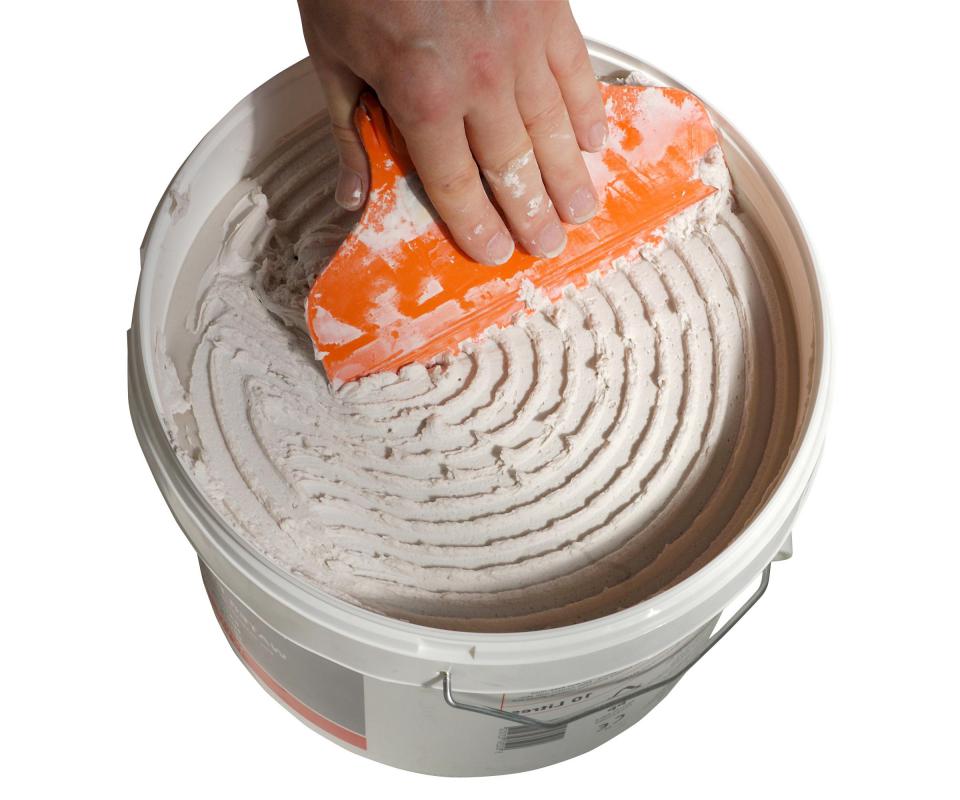
![Because of its appearance, tile adhesive is often called "mud."]() By: Barabas AttilaBecause of its appearance, tile adhesive is often called "mud."
By: Barabas AttilaBecause of its appearance, tile adhesive is often called "mud."


Discussion Comments
Now I understand why my kitchen does not looks nice. I chose a bad version of the grout for the tile.
Great article. Now I know what type of tile adhesive I should choose to make my bathroom beautiful.
I'm about to put down new ceramic tile in the entrance of my home, and have already bought the pre-mixed adhesive to do it with. Am I right in thinking that this will suffice, or should I go with a more watertight kind? After all, this is going to stick around for a while (hopefully) and I'd sure hate to flub it up from the get-go. I’d much rather go ahead, eat a few bucks and have it last longer than to use an adhesive that isn’t going to work for the long haul. I've got to say though, that I'm pretty sure what I've got is supposed to be a waterproof tile adhesive.
Wow - I had no idea this was so in depth. I actually had the nerve to put up my own backsplashes in my kitchen. Now I'm thinking to myself, "Is my tile going to fall off the wall because it's near the stove?" I used the pre-mixed adhesive with natural stone tile rather than porcelain tile. So far, so good - it's been up a few months.
I purchased my tile and adhesive and left it outside and I'm afraid that it may have frozen. Can I still use it? It's Daltile acrylic for ceramic tile.
Post your comments