
At Sports&Hobbies, we're committed to delivering accurate, trustworthy information. Our expert-authored content is rigorously fact-checked and sourced from credible authorities. Discover how we uphold the highest standards in providing you with reliable knowledge.
What are the Different Types of Tents?
Tents are simple structures that are used for shelter and that consist of a frame supporting some type of material. In many cases, they are made to be easily assembled or taken down, making them ideal for travel. They can be used as semipermanent shelters, for short-term camping trips, for special events such as wedding receptions or for other purposes. There are many types of tents, and they can be classified in various ways, such as by their shape or by their intended use. Among the most common types are the traditional tent, such as a yurt, wickiup or tipi; a camping tent, such as a pup tent, dome tent or A-frame tent; and the special occasion tent, such as a party tent or circus tent.
Traditional
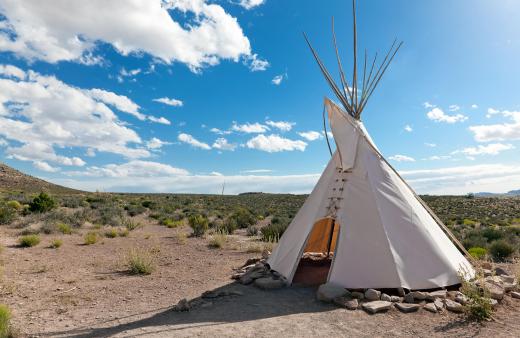
Traditional tents include the yurt, wickiup and tipi. Yurts have been used by Asian nomads for many generations. They are round structures with wooden poles for supports and are covered with felt or canvas. The top of the yurt is a crown shape, with a hole in the center that allows smoke to escape and light to enter. In North America and Europe, the basic yurt design has been used for durable temporary and semipermanent structures.
Wikiups and tipis have been used by some Native American tribes. Both are temporary or semipermanent structures. These tents usually are made with wooden supports and hide coverings.
Camping
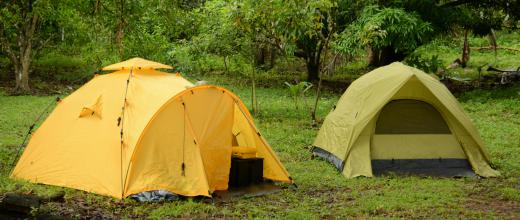
There are many types of modern tents available for camping, each with its own special advantages. Some are light and easy to pack, and others are heavier and more durable. Some retain heat even in freezing temperatures, and others are built for hot-weather camping and have excellent air flow. Modern versions range from the one-person pup tent to the large cabin tent capable of accommodating many people.
An A-frame tent is one of the most classic designs. Well known for its use by Boy Scouts, an A-frame is what many people think of when they imagine a tent. This type of tent has two upright poles, one at each end, and another pole that connects the tops of the upright poles. A material such as canvas is draped over the top pole, pulled outward at an angle and staked to the ground, forming the tent's A-frame. Ropes or wires can help hold the poles and covering in place, but this style can be quite unstable in windy conditions, and its lack of a floor covering can be a problem.
The dome tent is one of the most popular designs in use. It is available in a variety of configurations, with the most common being one in which the frame is formed by two flexible poles that cross over one another to form a large, bent X. In most cases, the dome's walls and floor are connected in a single covering material, and the poles are anchored to the frame, so the user does not need to disassemble the tent to move it, if necessary. This type of tent is easy to set up and is relatively stable in windy conditions if it is secured to the ground.
A cabin tent is a large structure designed for use with car camping or other forms of camping in which the weight of the tent is not an issue. It is heavy and large, and it provides a great amount of internal space. A cabin tent usually consists of several poles joined together, supporting the tent's covering material. It usually features a high ceiling and might include internal walls that can divide the tent into multiple rooms.
The geodesic tent has gained popularity among campers. This style takes the design of the dome tent and improves upon it to give it better strength and resistance to wind. It has more poles that cross many times, lending strength to the entire structure, which can withstand wind and snow. This type of tent us often used in extreme weather conditions, such as on high-altitude mountain climbs.
In addition to these four main configurations, each type may come with different modifications suited for specific weather needs. A hot-weather tent, for example, utilizes mesh walls to allow the camper to breathe and moisture to escape the tent easily. For camping in cold or wet weather, the tent's covering material can be thicker and less porous, keeping out wind and precipitation.
Special Occasions
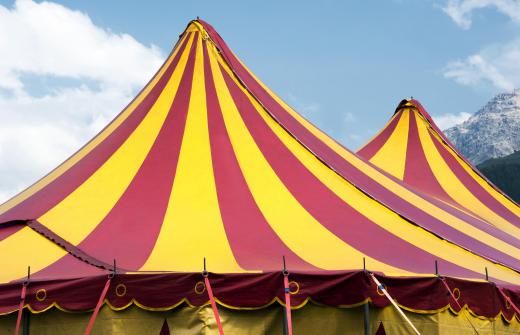
Some tents are designed for large gatherings rather than for sleeping. A party tent typically provides a high ceiling over a large area, allowing many people to be seated or standing under the tent during the event. This type of tent might or might not include walls. It often is rented just for a special occasion, such as a birthday party, wedding reception, family reunion or graduation party. Circus tents are much larger and higher, providing plenty of room for large crowds, and their covering material usually features a variety of bright colors.
AS FEATURED ON:
AS FEATURED ON:


-
![A teepee is a traditional Native American shelter.]() By: aragamiA teepee is a traditional Native American shelter.
By: aragamiA teepee is a traditional Native American shelter. -
![There are many types of modern tents available for camping.]() By: ftlaudgirlThere are many types of modern tents available for camping.
By: ftlaudgirlThere are many types of modern tents available for camping. -
![Circus tents can be used for parties and other special occasions.]() By: atm2003Circus tents can be used for parties and other special occasions.
By: atm2003Circus tents can be used for parties and other special occasions.


Discussion Comments
Dome tents are nice when camping because they give you a little extra room at the top to stand up. If you are very tall, you may still have to lean over a bit, but most people should be able to stand up with no problems.
Our family has used several kinds of Coleman tents throughout the years. We have camped in everything from canvas tents, to pup tents to three room tents. All of them served their purpose and great memories were always made sleeping in a tent on our camping trips.
If you're planning an outdoor wedding, a family reunion, or a political event, you're going to need a party tent. It's a good idea to think about renting a party tent. You never know what the weather will be - sun, wind, or rain. You want your guests to be comfortable.
Think about what kind of tent you want and what holds it up. Frame tents are stable and easy to set up, but you can only get them so large. Some people like pole tents. These can be huge, but sometimes there are poles in the middle of the tent.
I think people feel very regal and important when they are under a tent. Party tents are becoming very popular today.
I remember the little pup tent. It was barely big enough for a small child. You were sure to get claustrophobia when you went in. Yes, getting in - you had to get down flat on your stomach and slide in like a snake.
If you had an air matress, it would just barely fit. Then in the middle of the night, when you turned over, it would flip up and you would slide down. Then you may hit the side of the tent and the pup tent would give way - down it would come. Such frustration.
And then, what fun is it to be camping and have to sleep by yourself in a cramped tent? You miss all the fun of joking around with your friends in a larger tent.
Post your comments