
At TheHealthBoard, we're committed to delivering accurate, trustworthy information. Our expert-authored content is rigorously fact-checked and sourced from credible authorities. Discover how we uphold the highest standards in providing you with reliable knowledge.
What are the Different Types of Language Disorders?
Different types of language disorders not only affect speech, but also involve reading, writing, and listening. Behaving appropriately in social situations, understanding others, and making oneself understood are common struggles people with language impairments face. Aphasia, auditory processing disorder, and semantic pragmatic disorder are a few examples of the many types of language disorders.
Aphasia, also called dysphasia, is an example of the acquired types of language disorders. This disorder describes partial or total impairment of comprehension or production of written or spoken language. It is acquired, meaning that it is not present at birth, but rather is a side effect of brain injury. Brain tumor, stroke, and brain hemorrhage are some conditions that can cause aphasia.

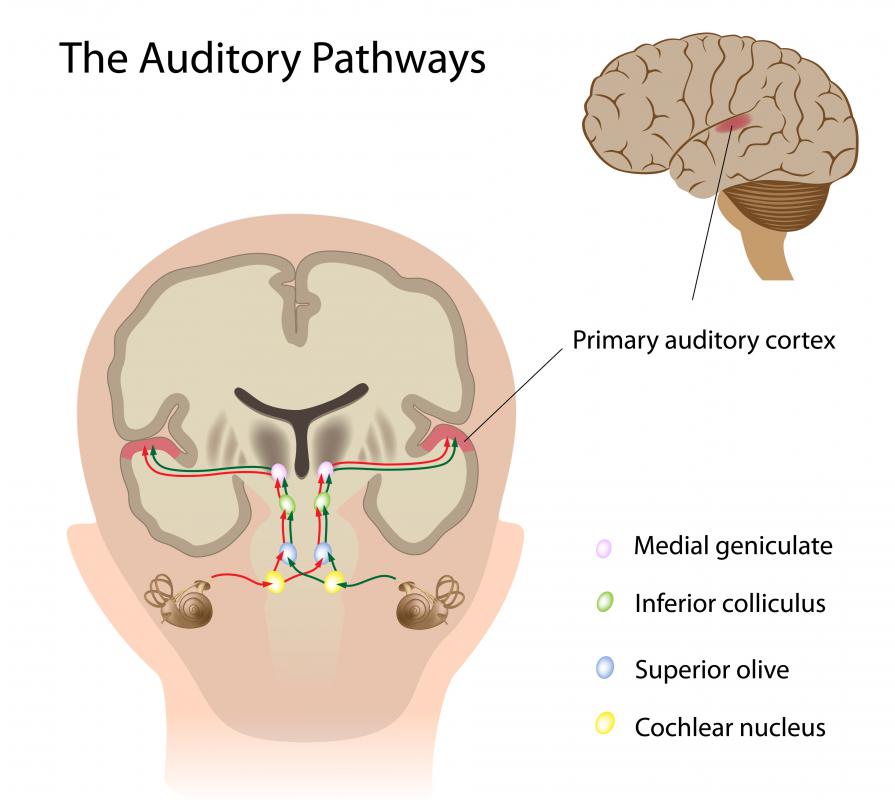
Auditory processing disorder, also called central auditory processing disorder, is one of the rarer types of disorders of language, affecting about 5 percent of children. The problem stems from dysfunction in communication between the ears and brain, leaving children unable to comprehend speech properly. People with this disorder can usually hear sounds normally, and the problem occurs in the processing of auditory information, such as differentiating between similar sounding words.

Dyslexia, also called developmental reading disorder, is one of the most common types of language disorders. This disorder describes an inability to process graphic symbols, such as those in written language. The problem is not related to vision, but rather the processing and understanding of what is being seen. People with dyslexia have a hard time connecting letters of words to the sounds of language. An early sign of dyslexia is often difficulty rhyming.

Lisps are also common types of disorders involving language. This disorder describes a person who cannot make a specific speech sound. Interdental, lateral, and palatal are the three types of lisp. Interdental lisps occur when the tongue obstructs speech by coming in between the teeth while trying to make a sound. Lateral lisps occur when air escapes from the sides of the tongue, and a wet sound is produced that prevents proper speech. Lastly, a palatal lisp is caused by the mid-section of the tongue touching the soft palate.

Semantic pragmatic disorder is one of the types of language disorders linked to autism. This disorder was originally thought to be separate from autism, but recent findings have shown that many people with autism also have this kind of language impairment. Understanding others and effectively communicating is very difficult for people with this disorder. Confusing the words I and you, difficulty understanding questions involving why and how, and repeating phrases out of context, often from a television program, are some common symptoms of semantic pragmatic disorder.
AS FEATURED ON:
AS FEATURED ON:


-
![Central auditory processing disorder is thought to be an issue with the auditory pathways.]() By: Alila Medical MediaCentral auditory processing disorder is thought to be an issue with the auditory pathways.
By: Alila Medical MediaCentral auditory processing disorder is thought to be an issue with the auditory pathways. -
![Some language disorders occur when the tongue obstructs speech.]() By: yanmingzhangSome language disorders occur when the tongue obstructs speech.
By: yanmingzhangSome language disorders occur when the tongue obstructs speech. -
![Drinking may temporarily affect a person's speech.]() By: Minerva StudioDrinking may temporarily affect a person's speech.
By: Minerva StudioDrinking may temporarily affect a person's speech. -
![Patients with aphasia usually cannot express the words that they wish to use in verbal communication.]() By: chuugoPatients with aphasia usually cannot express the words that they wish to use in verbal communication.
By: chuugoPatients with aphasia usually cannot express the words that they wish to use in verbal communication. -
![Some language disorders may affect a person's ability to read.]() By: pathdocSome language disorders may affect a person's ability to read.
By: pathdocSome language disorders may affect a person's ability to read. -
![Some people -- including those with autism -- have auditory processing disorders that can affect how they perceive sounds.]() By: elisabetta figusSome people -- including those with autism -- have auditory processing disorders that can affect how they perceive sounds.
By: elisabetta figusSome people -- including those with autism -- have auditory processing disorders that can affect how they perceive sounds. -
![Echolalia, or repeating of words and phrases, is common among children with autism.]() By: HalfpointEcholalia, or repeating of words and phrases, is common among children with autism.
By: HalfpointEcholalia, or repeating of words and phrases, is common among children with autism. -
![A speech-pathologist may be employed to develop a treatment plan for children with semantic-pragmatic disorder.]() By: sneksy13A speech-pathologist may be employed to develop a treatment plan for children with semantic-pragmatic disorder.
By: sneksy13A speech-pathologist may be employed to develop a treatment plan for children with semantic-pragmatic disorder. -
![Children with difficulties understanding and using language may be suffering from semantic-pragmatic disorder.]() By: Andy DeanChildren with difficulties understanding and using language may be suffering from semantic-pragmatic disorder.
By: Andy DeanChildren with difficulties understanding and using language may be suffering from semantic-pragmatic disorder.







Discussion Comments
I would classify a lisp as a speech sound/articulation disorder and it could have a neurological basis as the motor planning for those sounds is not automatic.
Yes, a lisp can be treated with therapy as with most communication disorders (any hearing, speech and/or language disorders that are developmental or acquired that may impact receptive and/ or expressive language as well as spoken and/or written language in one or more of the following semantics, morphology, syntax, phonology, and pragmatics). People may overcome a communication disorder in language or they may learn how to compensate for the disorder. And a lisp could impact a child's willingness to speak for fear of teasing therefore impacting the quality of life and qualifies as impairment by the World Health Organization.
Also as in any articulation disorder it can impact how the child spells words. He/she may spell words as they are produced. Suspected speech and/or language disorders should be evaluated by a certified Speech Language Pathologist (SLP) and hearing disorders should be referred to a certified audiologist.
My six year old nephew has a language disorder, it's called a mixed receptive-expressive language disorder. He has difficulty in both understanding language as well as speaking.
If there is a difficulty in just reception, or just expression, I believe it is referred to as "receptive language disorder" or "expressive language disorder" only. My nephew unfortunately has both from birth and so his disorder is called "mixed."
He is now doing a program called visualizing and verbalizing language program which tries to help him visualize what he hears so that he understands it better. And also to help him speak better. It seems to be helping but there haven't been any dramatic improvements so far.
Most of the time he seems pretty aloof to what's going on around him and it's not really possible to have a conversation. But he's still very young so he still has a lot of time to work on it.
I saw a movie recently about a child with dyslexia. He had trouble speaking, writing and understanding what he heard. He often wrote letters backward and couldn't read it if it wasn't written the same way.
The movie was such an eye opener for me because they emphasized that language disorders like dyslexia is not mental retardation. People with dyslexia are as smart as everyone else, they just need additional assistance in school with teaching methods and graphics.
But in the movie it showed that people took this child to be a "stupid" child who didn't pay attention in school and didn't try hard enough. But nothing could be further than the truth. I think there is a big lesson to be learned here because most of us now little to nothing about language disorders in children and the different types. We don't really understand why it happens and how it should be treated.
I had never considered lisps to be a language disorder before. It seems to be a much more minor issue than other types of language disorders which have to do with the way brain functions. Lisps are caused by how the mouth is used I believe.
And having a lisp doesn't seem to prevent someone from speaking and writing which is not the case for a language disorder like dyslexia for example.
I know that people with lisps can overcome it with speech therapy. Is the same true for other language disorders? Is it possible to overcome them with therapy and practice as well?
Post your comments