
At HomeQuestionsAnswered, we're committed to delivering accurate, trustworthy information. Our expert-authored content is rigorously fact-checked and sourced from credible authorities. Discover how we uphold the highest standards in providing you with reliable knowledge.
What are the Different Types of Lace?
There are hundreds of different types of lace, with lovely and exotic names such as Valenciennes, Honiton, Belgian and Chantilly, placenames that have become associated with the type that was traditionally made there. The easiest way to break down the types is by the method used to produce them. The most common lace-making methods are needle lace, bobbin lace, crochet and tatting.
Needle lace uses a threaded needle to make the lace, often within insertions cut out of woven fabric. The needle works over a supporting thread, making a buttonhole stitch over the thread to give it a bulkier, knotted appearance. Loops and filets can be created and connected to provide connectivity and shape.

Bobbin lace is actually a form of weaving that uses small bobbins and a pillow. The pattern is pinned to the pillow, and the bobbins are held in the hands and passed over and under one another in intricate patterns dictated by the paper pattern. The weaving is held to the pillow form by pins as the work progresses, and the pillow becomes a bristling mass of pins. Some patterns can use dozens or even hundreds of bobbins.
This was a pastime of Belgian nuns, and an experienced lace-maker in action is amazing to see. The bobbins are tossed one over the other in rapid succession and the maker's fingers are practically a blur, as the lace slowly emerges from the dance of the bobbins. Chantilly, Honiton, and Valenciennes are all made with bobbins in this way.
Airy open-work patterns can be easily crocheted. Although for years, crocheted products were considered a kind of "faux" lace, it is now fairly widely accepted. For the laciest look, use the thinnest of crochet threads and the smallest of crochet hooks. Irish lace is typically crocheted.
A form of lace-making rarely seen these days is tatting. Tatting employs a small shuttle of about 1 inch (2.54 cm) in length, which is wound with thread. The tatter makes a loop and then tosses the shuttle within the loop in intricate ways to make small knots line the base thread, similar to the needle form.
Tatting is a type often characterized as Victorian, although it predates Queen Victoria's reign. The type produced is bulkier than other forms and was often used as appliques on collars and cuffs. Of course, most lace today is machine-made, although the finer types try to duplicate the handmade look.
AS FEATURED ON:
AS FEATURED ON:


-
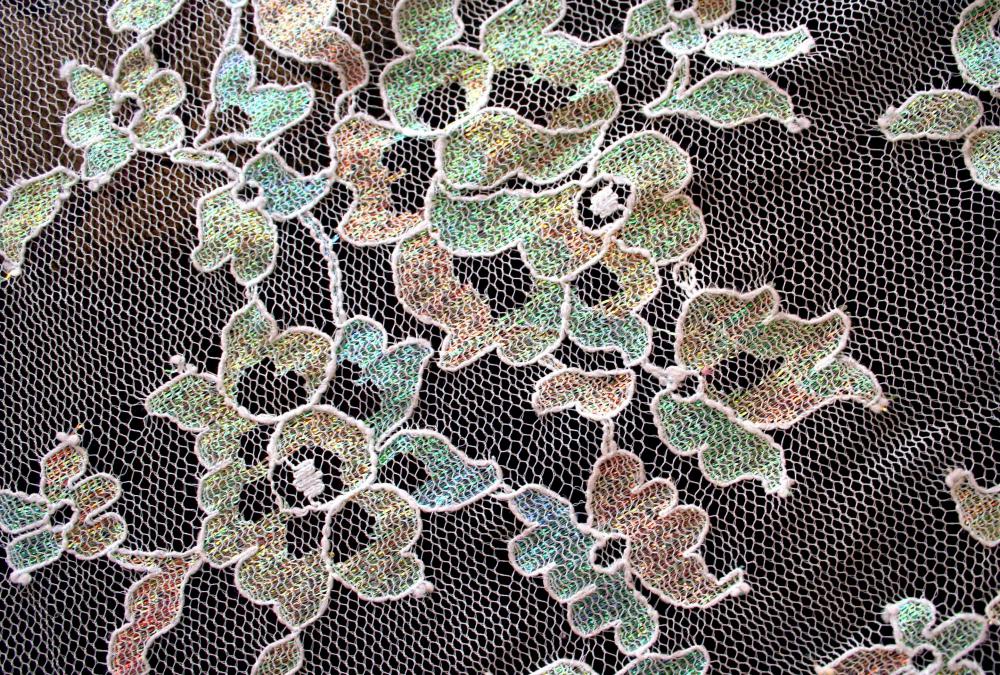
![There are hundreds of different types of lace.]() By: Julia KellerThere are hundreds of different types of lace.
By: Julia KellerThere are hundreds of different types of lace.
Discussion Comments
Last year I had the chance to take a tour to Cyprus and visit the famous village where they make Lefkara lace. The story goes that Leonardo Da Vinci once went there and bought an altar cloth, which he later gave to the cathedral in Milan.
It was a lot of fun to see so many things made from lace fabric. It made it pretty hard to choose things for souvenirs.
@Valencia - Your great aunt's house sounds delightful to me. Have you ever tried lace making yourself? It's not terribly difficult once you get started and learn the basics.
I have a wonderful pair of vintage lace curtains which I came across on an Internet auction site. After reading through this article I think they may have been made by the bobbin method. All I know for sure is that they're Victorian and look great at my bay window.
As a child I used to love visiting my great aunt, largely because I was fascinated by her living room. It seemed to me that pretty much every surface was covered with some sort of lace material. My father used to complain that if you stood still long enough she'd add a lace trim to you!
I know some people think this kind of thing is old fashioned, but in the right kind of house there's something really lovely about it.
Post your comments