
At WiseGEEK, we're committed to delivering accurate, trustworthy information. Our expert-authored content is rigorously fact-checked and sourced from credible authorities. Discover how we uphold the highest standards in providing you with reliable knowledge.
What are the Different Types of Hydronephrosis Treatment?
The different types of hydronephrosis treatment generally depends on the location of the obstruction, as the initial goal is to drain any trapped urine. Once the urine has been removed, the focus of treatment switches to ensuring that the problem doesn’t reoccur. Hydronephrosis treatment usually begins with either a catheter or tube inserted into the body in order to drain the fluid. Once this has been completed, the blockage often needs to be removed usually through surgery.
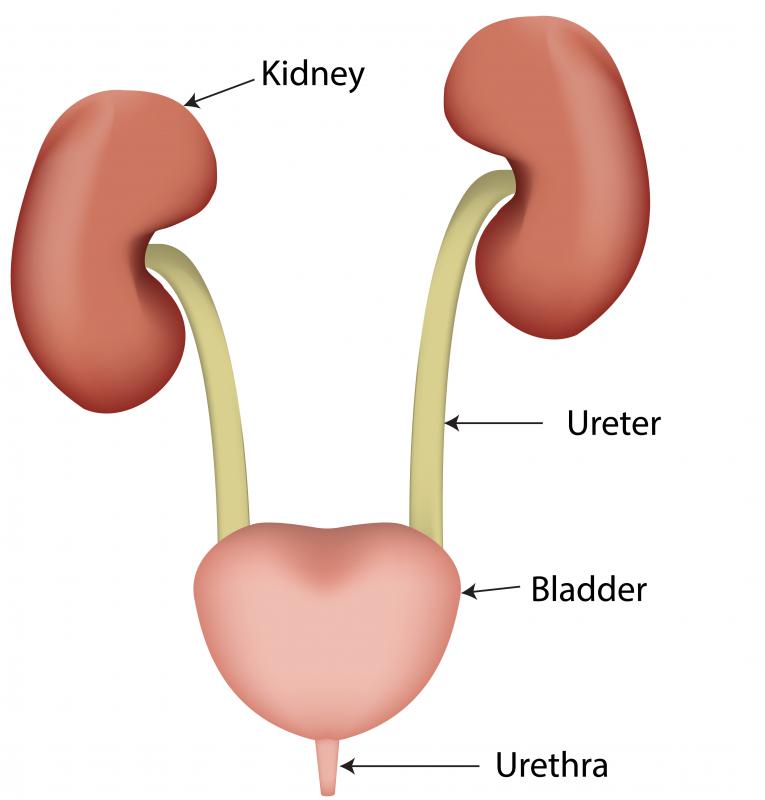
Removing any trapped urine and relieving pressure on the kidney is the primary goal of hydronephrosis treatment, as this is important in preventing kidney damage. Often this is achieved through a catheter which is inserted into the bladder. Treatment for a buildup of urine sometimes includes the insertion of soft tubes directly into the kidney, however. In most cases, a blockage in the upper urinary tract will require a tube while a blockage in the lower section requires a catheter.

Draining urine from within the kidney is an essential part of hydronephrosis treatment, but it doesn’t address the underlying problem. The blockage usually needs to be removed, otherwise the urine will build up again over time. Not all cases require surgery, but the majority do.
As with the drainage process, the type of surgery for hydronephrosis depends on the location of the blockage. Hydronephrosis treatment to eliminate the blockage is essential, however; if it is left for a long period of time, the condition can cause permanent kidney damage. In the past, open or laparoscopic surgery techniques were used, but endoscopic surgery is now more common for this condition and is usually less invasive.

If the blockage is being caused by a narrowing of the ureter, which is a tube carrying urine to the bladder, then surgery to remove this section may be required. If the condition is caused by a stone in the kidney, then removal is also often required. Many people make a complete recovery from hydronephrosis surgery, as long as the condition is caught relatively early.

The proper treatment also depends on the severity the condition and whether it is chronic or acute. If the condition is chronic, which means that it builds up slowly, then treatment is usually not urgent, but will need to occur at some stage. If the symptoms are more acute, drainage of the urine may need to be performed more quickly in order to prevent long term damage to the kidneys.
AS FEATURED ON:
AS FEATURED ON:









-
![When a problem is caused by a stone in the kidney, then hydronephrosis surgery may be required.]() By: airborne77When a problem is caused by a stone in the kidney, then hydronephrosis surgery may be required.
By: airborne77When a problem is caused by a stone in the kidney, then hydronephrosis surgery may be required. -
![Individuals who experience frequent urinary problems may have an increased risk of developing bladder cancer.]() By: joshyaIndividuals who experience frequent urinary problems may have an increased risk of developing bladder cancer.
By: joshyaIndividuals who experience frequent urinary problems may have an increased risk of developing bladder cancer. -
![Endoscopic surgery is preferred for hydronephrosis treatment, although sometimes laparoscopic surgery is necessary instead.]() By: CosmicEndoscopic surgery is preferred for hydronephrosis treatment, although sometimes laparoscopic surgery is necessary instead.
By: CosmicEndoscopic surgery is preferred for hydronephrosis treatment, although sometimes laparoscopic surgery is necessary instead. -
![Draining urine from within the kidney is an essential part of hydronephrosis treatment.]() By: 7activestudioDraining urine from within the kidney is an essential part of hydronephrosis treatment.
By: 7activestudioDraining urine from within the kidney is an essential part of hydronephrosis treatment. -
![Catheters play an instrumental role in hydronephrosis treatment.]() By: Jacob KearnsCatheters play an instrumental role in hydronephrosis treatment.
By: Jacob KearnsCatheters play an instrumental role in hydronephrosis treatment. -
![Removing trapped urine and relieving pressure on the kidney is important in preventing kidney damage.]() By: joshyaRemoving trapped urine and relieving pressure on the kidney is important in preventing kidney damage.
By: joshyaRemoving trapped urine and relieving pressure on the kidney is important in preventing kidney damage. -
![The type of surgery for hydronephrosis depends on the location of a blockage.]() By: vadim kozlovskyThe type of surgery for hydronephrosis depends on the location of a blockage.
By: vadim kozlovskyThe type of surgery for hydronephrosis depends on the location of a blockage. -
![Frequent urinary tract infections may be a symptom of blockage in the kidneys.]() By: Alexander GospodinovFrequent urinary tract infections may be a symptom of blockage in the kidneys.
By: Alexander GospodinovFrequent urinary tract infections may be a symptom of blockage in the kidneys.




Discussion Comments
My son has hydronephrosis; it was diagnosed when I was pregnant. At 5 months of age, he had his first reconstruction surgery, because his blockage was in the ureter. It was fine until he was 5, and at that point his urologist decided to try to inflate the narrow part of the ureter. That didn't work, so she did the reconstruction yet again. His body was rejecting the stents the urologist was using and she had to go in twice to try different stents. Finally he was all set, so we thought. He is nearly 10 and it's happening all over again.
So to sum it all up, hydronephrosis just doesn't go away forever. My son is a pretty strong kid and does great, but he has lost a lot of function in his kidneys. We continue to pray that he doesn't lose complete function. He would be devastated that he will never be able to play a contact sport.
@strawCake - You're right that hydronephrosis is unpleasant. One of my uncles had acute hydronephrosis, and it came on really suddenly. His main symptom was a severe pain in his back, right in the kidney area. He originally thought he had a kidney stone or something!
However, when he went to the hospital, they found out that he had hydronephrosis. Once he got treatment for hydronephrosis, he recovered fairly quickly.
He often says he's glad he had the acute version of this illness, because the chronic version can be a lot harder to pinpoint. Usually people have a bunch of urinary tract infections and other symptoms for quite awhile before a doctor makes a diagnosis of hydronephrosis.
@SZapper - A few different things can cause hydronephrosis (kidney blockages, tumors, narrowing of the ureter) so I think it's probably important for doctors to figure out the cause of the problem before they treat the patient. Obviously they would do something different for someone that has a tumor versus a patient with a narrowing ureter.
I'm sure it's also important to figure out if the condition is chronic or acute. If someone has acute hydronephrosis, it sounds like it's much more urgent than the chronic kind.
Still, both kinds sound uncomfortable.
It sounds like treatment for hydronephrosis of the kidney focuses on getting the urine out of the body, and also preventing the problem from occurring again. I think this makes a lot of sense.
If you don't figure out where the blockage is and take care of it, this problem could easily reoccur and the patient might need even more surgery. If you take care of the problem and the cause, then you don't have to worry about it anymore!
Post your comments