
At Sports&Hobbies, we're committed to delivering accurate, trustworthy information. Our expert-authored content is rigorously fact-checked and sourced from credible authorities. Discover how we uphold the highest standards in providing you with reliable knowledge.
What are the Different Types of Fishing Poles?
There are probably almost as many types of fishing poles as there are fish, but one way to break down the choices is to consider where the user will be fishing. Freshwater poles are different from saltwater or ocean poles, and are usually much smaller.
Among freshwater options, there are rod and reel poles, fly fishing poles, catfish poles, crappie poles, and cane poles. The reel, on rod and reel poles, can be closed, open, or a specialty reel called a baitcaster. The difference is usually important to the individual angler, since some feel that with a closed reel, the fishing line tangles more easily than with an open reel. Others have found the complicated baitcaster not worth the expense.
Fly fishing poles are made for use in trout fishing, although they can also be used to catch other types of fish as well. It takes a little more practice to get the hang of dancing the fly above the water, but many anglers find the experience rewarding. Anglers who enjoy fly fishing may also enjoy tying their own flies. Most well-stocked fishing supply stores will have a variety of flies to choose from for those who are just getting started.
Catfish and crappie poles are both different types of rod and reel poles. Catfish poles are stiff and are usually made with extra support to bear the weight and fight of a big catfish. Crappie poles are smaller and more limber. Cane poles are another type of catfish pole and do not have reel; basically they are just a piece of cane with fishing line attached.
Like freshwater fishing poles, saltwater poles break down into several categories. Most anglers divide saltwater poles by location: inshore, offshore, and surf. The biggest difference in these categories is the weight of the type of fish each pole is designed to catch.
Inshore fishing is done from shallow water and sometimes from a pier. The poles used are designed to catch fish up to about 20 pounds (9 kg). Offshore fishing, or deep sea fishing, requires poles that are much, much larger. They often require additional support, as some fish can be more than 300 pounds (136 kg). Surf fishing is unique in that the pole must be long and thin, flexible enough to get the cast beyond the waves to where the fish are. A surf fishing pole can be as long as 14 feet (4.2 m).
Some newer poles are made of graphite, which is stronger than the traditional cane or fiberglass poles. Graphite is also a better choice as it is less likely to break. Anglers should also consider the weight of a pole, since lighter is often better after a long day of fishing.
AS FEATURED ON:
AS FEATURED ON:


-
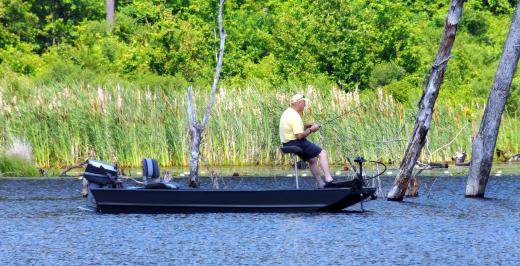
![Fishing poles are usually designed for specific types of fishing.]() By: bonniemarieFishing poles are usually designed for specific types of fishing.
By: bonniemarieFishing poles are usually designed for specific types of fishing.

Discuss this Article
Post your comments