
At HomeQuestionsAnswered, we're committed to delivering accurate, trustworthy information. Our expert-authored content is rigorously fact-checked and sourced from credible authorities. Discover how we uphold the highest standards in providing you with reliable knowledge.
What are the Different Types of Caulk?
Caulking refers to the process of sealing a gap between two surfaces for the purpose of making it air or watertight. The word can be used as both a noun (when referring to the sealing substance) or as a verb (when referring to the act of sealing). There are hundreds of different types, but those most used in home repair include those made of acrylic latex, butyl rubber, and silicon.
Acrylic latex caulk (sometimes called painter's caulk): This type is used primarily as a sealant around windows and doors. It is available in a range of colors, and it can be painted over to match the adjoining surfaces. This type is easier to apply than silicon, and clean is easy with soap and water.
Butyl rubber caulk: This kind is the strongest and most durable. Its main use is to fill cracks in concrete and brick, but it can also be used to seal metal surfaces. Although Butyl rubber does not come in assorted colors, it can be painted to match surrounding surfaces. Clean up requires the use of a solvent.
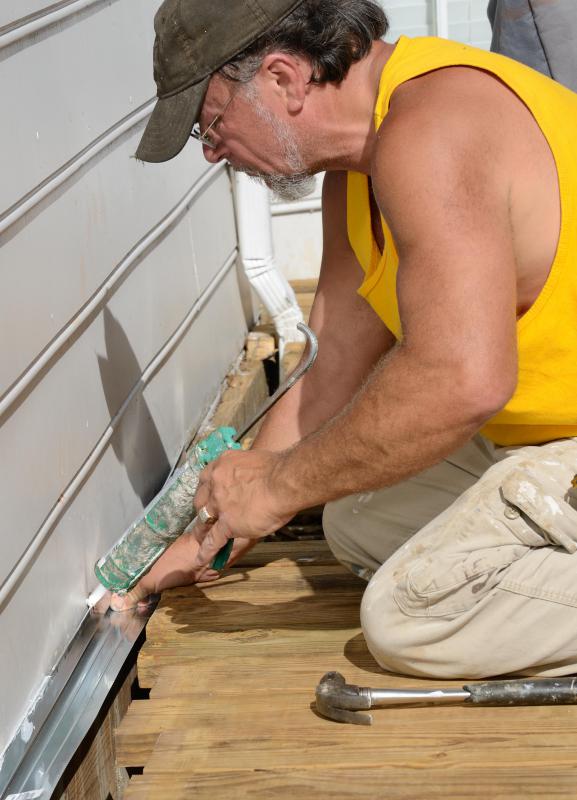
Silicon caulk: When you want to keep an all-purpose caulk on hand, this is the type you will want. Silicon can be used on a wide variety of non-porous surfaces, from metal to plastic. Its best feature is that is remains somewhat flexible even after drying, so it is not prone to cracking due to temperature fluctuation. Silicon cannot be painted; however, it is available in a range of colors.

Besides the three basic types, there are many specialized varieties designed for specific tasks. Some of these include kitchen and bath caulk with a built-in mildew fighter; mortar caulk that holds up to high heat; roof sealant to repair minor leaks; gutter and flashing sealant; and asphalt sealant.
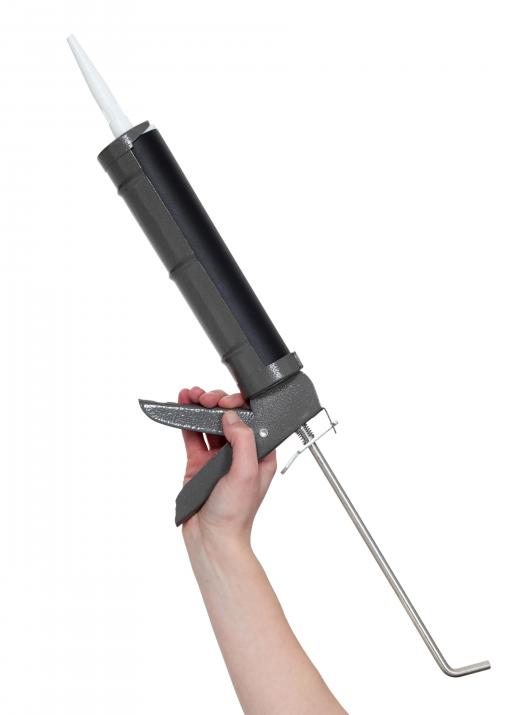
Caulk has traditionally been applied with a special caulking gun designed for that purpose. However, manufacturers these products have recently begun offering their products in squeeze tubes or pressurized can with an extended narrow tip so the do-it-yourselfer doesn't have to invest in a gun for just one simple repair job. Applying this material is a fairly simple task, although it may take a bit of practice to perfect drawing a uniform bead. Before applying any type, be sure that all surfaces are clean and dry.
AS FEATURED ON:
AS FEATURED ON:


-
![Caulk can typically be applied with a caulking gun.]() By: auremarCaulk can typically be applied with a caulking gun.
By: auremarCaulk can typically be applied with a caulking gun. -
![Silicon caulk is ideal when working with a wide variety of materials, like steel, aluminum, brick or concrete.]() By: SeanPavonePhotoSilicon caulk is ideal when working with a wide variety of materials, like steel, aluminum, brick or concrete.
By: SeanPavonePhotoSilicon caulk is ideal when working with a wide variety of materials, like steel, aluminum, brick or concrete.

Discussion Comments
I looking to seal up my house in the country a bit more so nasty bugs stay out, and this is the info I needed to go on to choose the right sealant. messy job, but the man has go to do it.
We are looking for a caulk that will work in a harsh environment -40 C we use silicon caulk now but is pulling away from the seams when bring the freezer down in temperature. The only thing I can think of is the Class is a 25 and we may need to get in a high class range. is there anyone you could recommend we look at?
this is exactly the information i needed for my science fair project. thanks wiseGEEK.
Dear WiseGeek,
I'm an artist and would like to do a mosaic project with the shards of mirror that remained after an accidental breakage....
Questions:
1. Can you make a general recommendation for an appropriate glue to adhere the pieces to a new surface?
2. I'm thinking about using caulking to seal between the cracks (sort of as if they were irregular tiles). Would this be safe enough to hold and avoid jagged edges? If so, can you recommend a type of caulking for this?
3. Assuming this would work so far, would you recommend some sort of allover glaze or sealant at the end of the process?
Thank you very much for your time.
Signed,
Trying to offset superstitious worry by creating something redemptively beautiful
I caulked between my molding and the drywall for decorative purposes at my cabin. The caulk has pulled away from the molding. I wonder if I used the wrong caulk or if the temperature is too cold in the winter for the caulk?
What should I use to remove caulk debris from brick and wood (window casings) before re-caulking? What is the easiest way to re-caulk around the windows once the debris is removed? I would appreciate a prompt response as I would like to complete this project before the weather turns! Thanks!
I made a mistake an used silicon caulking for crack filling on my cedar sided house. Do I have to remove it or can I just use some latex caulking over it before painting?
Post your comments