
At WiseGEEK, we're committed to delivering accurate, trustworthy information. Our expert-authored content is rigorously fact-checked and sourced from credible authorities. Discover how we uphold the highest standards in providing you with reliable knowledge.
What are the Different Types of Acne Treatment?
 Paulla Estes
Paulla Estes
Paulla Estes
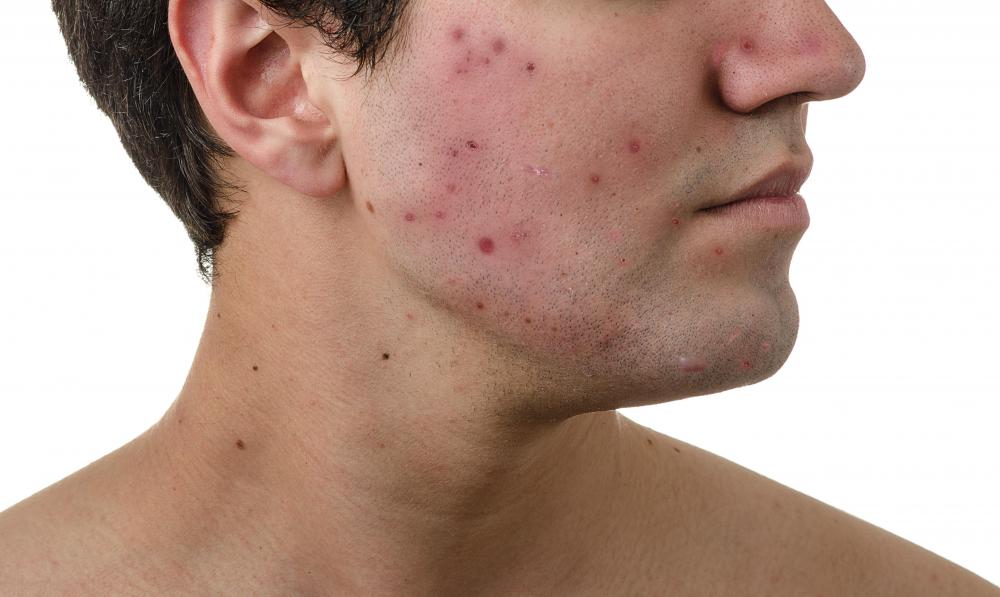
Acne is an inflammatory skin ailment that is marked by pimples appearing on almost any part of the body, but most commonly on the face. Though it occurs most commonly among teenagers, it can be caused in any one by hormones, improper diet, vitamin deficiencies, and even stress.
There are various forms of acne, ranging from the mild to the severely damaging. The mild type includes whiteheads, blackheads, pimples or pustules, and many other skin irritations and bumps that can be painful, irritating, and unsightly. Some of the more problematic types can form large boils that take months to dissipate.

While the precise cause of acne is unknown, it is clear how it forms. Most blackheads, whiteheads, and pimples are formed when a pore in the epidermis layer of the skin swells or collapses, preventing oil from moving naturally out of the pore. When the oil is blocked, a small infection occurs. What is unknown is why the pore becomes blocked in the first place.

While there is no permanent cure for this condition, it can be treated and even prevented quite successfully. The first step in treating and preventing acne is to keep skin clean and dry. Although pores often become blocked or clogged regardless of the cleanliness of a person’s skin, clean skin goes a long way towards preventing outbreaks.
Always cleanse the skin with a gentle cleanser that is non-drying and non-aggravating, also called non-comedogenic. Medicated cleansers are not necessary. Cleansing the skin should simply involve a cleanser, water, and your hands.

Often, a wash cloth or hand towel may irritate the skin. Scrubbing should be avoided, as it does not cure acne; in fact, it can even lead to more breakouts. Simply wash and then dry with a soft towel. Wash the skin twice daily, or more if the skin is unusually oily. Astringents can be used on exceptionally oily skin, but avoid alcohol-based astringents, as they dry out and can damage the skin.

The second step in treating and preventing acne is medication. There are both Over-The-Counter (OTC) and prescription medications for this condition. Most OTC medications contain one or more of a few basic ingredients: benzoyl peroxide, salicylic acid, sulfur, and resorcinol. These are generally drying agents that also draw the pores out, causing blockages to open.

Prescription acne medication comes in many different forms, from higher dosages of benzoyl peroxide mixed with a mild antibiotic, to powerful antibiotics, oral contraceptives, accutane, acid treatments, and even stronger medications that often take off several layers of skin. Prescription treatments usually take longer to work, and the side effects can sometimes be as irritating as the acne itself. A dermatologist will be able to help those with this condition decide how they want to treat it.
Paulla Estes
Paulla is a freelance writer and website editor who currently lives in Maine. Paulla has a B.A. in English Literature from George Mason University and over 15 years of experience as a freelancer. She relishes the flexibility and consistency of working on WiseGEEK articles, as well as the opportunity to constantly learn something new.
Learn more...
Paulla Estes
Paulla is a freelance writer and website editor who currently lives in Maine. Paulla has a B.A. in English Literature from George Mason University and over 15 years of experience as a freelancer. She relishes the flexibility and consistency of working on WiseGEEK articles, as well as the opportunity to constantly learn something new.
Learn more...AS FEATURED ON:
AS FEATURED ON:









-
![Gently cleansing is an important step in treating acne.]() By: sunabesyouGently cleansing is an important step in treating acne.
By: sunabesyouGently cleansing is an important step in treating acne. -
![A female with acne.]() By: badmanproductionA female with acne.
By: badmanproductionA female with acne. -
![OTC or prescription medications may be applied topically to treat acne.]() By: CopridOTC or prescription medications may be applied topically to treat acne.
By: CopridOTC or prescription medications may be applied topically to treat acne. -
![A dermatologist may prescribe antibiotics to treat a patient's acne.]() By: NorGalA dermatologist may prescribe antibiotics to treat a patient's acne.
By: NorGalA dermatologist may prescribe antibiotics to treat a patient's acne. -
![Scrubbing the skin can lead to more acne breakouts.]() By: Ocskay BenceScrubbing the skin can lead to more acne breakouts.
By: Ocskay BenceScrubbing the skin can lead to more acne breakouts. -
![Some birth control pills can be taken to treat acne.]() By: Kimberly ReinickSome birth control pills can be taken to treat acne.
By: Kimberly ReinickSome birth control pills can be taken to treat acne. -
![Patients using accutane must be monitored closely for depression or other negative mental health side effects.]() By: silent_47Patients using accutane must be monitored closely for depression or other negative mental health side effects.
By: silent_47Patients using accutane must be monitored closely for depression or other negative mental health side effects. -
![Some prescription acne medications contain higher doses of benzoyl peroxide, mixed with a mild antibiotic.]() By: AustralisPhotographySome prescription acne medications contain higher doses of benzoyl peroxide, mixed with a mild antibiotic.
By: AustralisPhotographySome prescription acne medications contain higher doses of benzoyl peroxide, mixed with a mild antibiotic. -
![Showering regularly can help with acne.]() By: ollyShowering regularly can help with acne.
By: ollyShowering regularly can help with acne.



Discussion Comments
When I get an acne flare-up, I am tempted to scrub my face too hard. For some reason I think this will help, and it only seems to make it worse, and my face is really red and irritated.
I have some antibiotic cream that I use when I get acne. I don't like taking oral antibiotics because I always end up getting a yeast infection. The cream seems to clear up the acne within a few days without the side effects of taking an oral medication.
I still have some acne scars from the severe acne I had growing up. Even while I was in college I had some of the worst acne I have ever had.
I was given a prescription for accutane, which did clear up my acne, but it is a very strong medication that I don't know if I would ever take again.
I thought once I got old enough I wouldn't have to worry about acne anymore. My doctor told me that adult acne is common and many times is considered hormonal acne.
I think that hormones play a huge role in acne at any stage of our lives. From being a teenager all the way through menopause and middle age, the change in hormones can cause people to break out.
Thankfully this adult acne has been easily treated with some over-the-counter products.
I don't know many young people who don't have acne at some point. There are a few lucky people who hardly have any problems with this, and others who really struggle with acne.
I was one of the unfortunate ones who had bad acne as a teenager. No matter how clean I tried to keep my skin, it didn't seem to make a difference.
I will say that ever since I began the habit of washing my face morning and night as a teenager, I still do that faithfully today.
I had to end up taking antibiotics to get my acne to clear up. This was the only thing I found that really worked for me out of all the other acne products I tried.
@JessicaLynn - Your acne could have been caused by hormones. Maybe something was causing your hormones to fluctuate, and then whatever it was stopped?
I'm personally not a big fan of putting chemicals on my body, so I used natural remedies when I get acne. I like to use tea tree oil, and it works really well. I just use a q-tip to put a little dab on the offending blemish, and it usually goes away within a few days.
I had some body acne when I was younger, which was pretty horrible. It was all over my back, so I didn't wear a tank top or go swimming for about a year at one point, because I was so embarrassed about it!
I tried a bunch of different scrubs and things from the drug store, and nothing really worked. Then, the acne went away on it's own and never came back. I have no idea what finally made it get better, but I'm really glad it's gone!
@lighth0se33 – It sounds like it is time for you to see a dermatologist. I had severe acne until I was twenty-six, and the only treatment that ever worked was a combination of chemical peels and prescription medicine.
My dermatologist would give me a chemical peel every time I came, which was every two weeks for about six months. He put me on an antibiotic, and I think this had the greatest effect on my acne.
He also prescribed a topical gel for me to use every night. It took a few months, but I began to see a dramatic reduction in breakouts.
I am so glad that I went. Nothing I did on my own could have helped, because this was a very severe case of acne.
@eidetic - Some of the antibiotics that are used for acne pimples treatment are very strong! I'm female, and I've never had acne, but if I did I would probably try birth control pills first. They worked really well for my sister when she had acne as a teenager.
It seems that salicylic acid works for all of my friends, but it has done nothing for me. I have chin acne, but nothing I do to treat it seems to work.
I have tried astringents, scrubs, spot treatments, and medicated cleansers. So, my skin is probably pretty tired out from all that I've been putting it through!
I really want to get rid of this acne before I graduate college. I don't want to go out in search of a job looking like a pimple-faced teenager! What can I do?
@PelesTears - That is so interesting! I never would have though that the quality of your tap water could cause severe acne. It's great that you guys found out what the problem was though, so your fiancee didn't have to use prescription drugs.
I actually have had a few friends who have tried the prescription drugs, and none of them were very happy with the results. One of my friends still had acne while she was on the medicine! Meanwhile, my other friend's acne cleared up, but the antibiotics bothered her stomach so much she stopped taking them.
A lot of over-the-counter acne products contain benzoyl peroxide. I tried several of them years ago, but I could not tolerate this ingredient.
It dried my skin out horribly. The first time I used it, I just smeared it all over my nose, chin, and forehead. My skin became so dry and itchy, and even after I washed the medicine off, it stayed red for hours.
I know that this was meant to be used as a spot treatment, but it had the same effect when I just put a dab of it on top of a pimple. I had to avoid benzoyl peroxide and find something more gentle.
I had a lot of acne on my skin as a teenager. I didn't eat a ton of greasy foods, so that dispelled the myth that my friends believed about acne being caused by your diet.
Products that contained glycolic acid helped me a lot. They gently exfoliated my skin, so the debris could not clog up my pores.
I had acne on the backs of my arms, my back, and my face. I used a scrub with glycolic acid on all three areas, and my skin's condition improved within a few weeks.
My fiancée has problem skin, and she has tried many remedies for her acne outbreaks. She doesn't want to go the route of prescription drugs, so she has searched high and low for a solution. About a year ago she read that the quality of your tap water can have an effect on acne breakouts. We live in Phoenix and the tap water is notoriously bad here. We went on a vacation to visit her sister, and she was able to test out this theory. Her sister has a high quality shower head filter that filters out chlorine, chloramines, bacteria, and volatile organic chemicals (VOC). In the week that we stayed there, her acne cleared right up. Sure enough, within a week of being back in the city, her acne came back. Needless to say, we have now added a filter to our shower head, and she uses filtered water to wash her face. Besides that, she only takes Neem leaf tincture (an herbal supplement that is good for the immune system and skin).
Post your comments