
At TheHealthBoard, we're committed to delivering accurate, trustworthy information. Our expert-authored content is rigorously fact-checked and sourced from credible authorities. Discover how we uphold the highest standards in providing you with reliable knowledge.
What Are the Different Organs in the Muscular System?
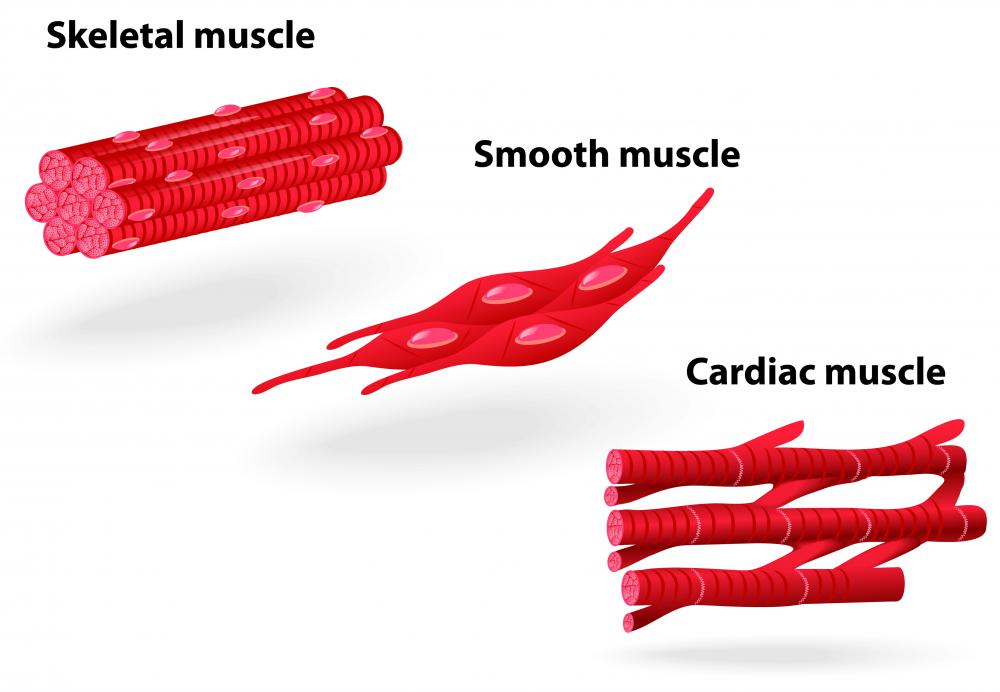
The different organs in the muscular system include cardiac muscles, smooth muscles and skeletal muscles. A complete muscle — consisting of muscle fibers, connective tissue, nerve tissue and blood tissue — is considered one organ by itself. There are roughly 600 organs in the muscular system, and these muscles make up about 40 percent of the body. These organs can be divided into four major groups: the muscles of the lower extremity, the trunk muscles, the muscles of the upper extremity and head-and-neck muscles.
Using the process of contraction, the organs of the muscular system are responsible for governing nearly all movement in the body. Even involuntary motion, such as the contraction of lungs for breathing or the heart for blood circulation, is guided by muscles. Eye shifting, breathing and smiling are all caused by the organs of the muscular system. Besides motion, organs of the muscular system also manage posture and body temperature. Muscles can heat the body by producing shivers, which are very fast, spastic, often-involuntary contractions that are designed to raise the metabolism and body temperature in frigid conditions.

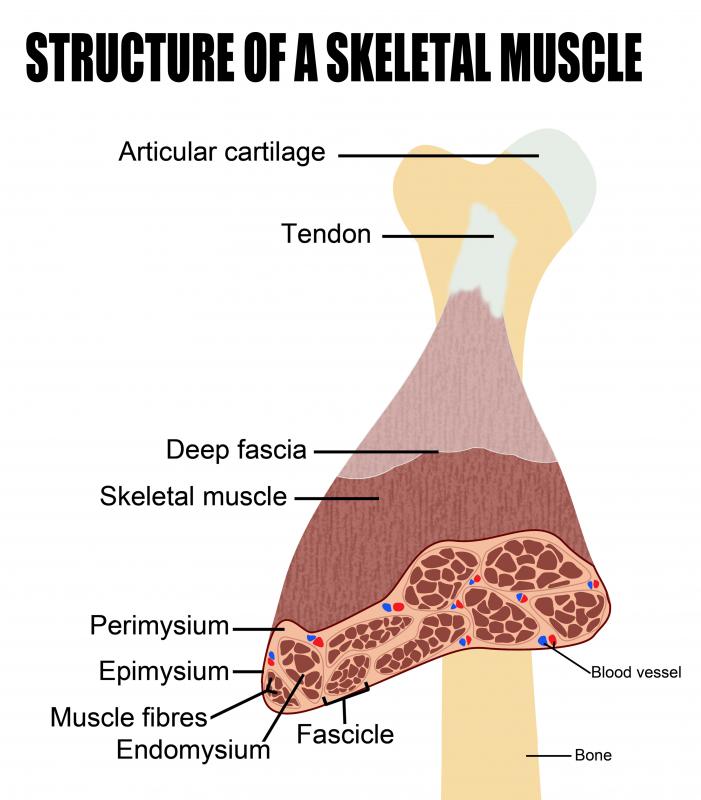
Skeletal muscles, with the help of tendons, line the bones and joints. They are the most abundant organs in the muscular system. Some skeletal muscles are tiny, and others might be massive; size varies as well, because these muscles take on whatever shape is necessary to conform to the frame of the skeleton. Muscles that are shaped like triangles are referred to as deltoids, and the muscles with the greatest width are called latissimus muscles. Trapezoid-like skeletal muscles and those resembling a rhombus are called trapezius muscles and rhomboid muscles, respectively.

Working in sets, the skeletal muscles ensure that coordinated physical action such as walking, winking, nodding and turning occur by synthesizing the pull-and-push movements of bones, rib cage, spine and skull. These muscles stretch over the skeleton like an endless mesh of rubber bands, allowing extension and contraction. More than just a physical feat, the movement of skeletal muscles begins with communication with the brain. Muscle fibers on the skeleton have nerve receptors that pick up and interpret signals from the brain, telling the muscles to execute motion. In addition to managing motor movement, skeletal muscles also support the joints, which are where bones meet.

Rhythmic contractions of cardiac muscles, which cover the heart’s wall, are responsible for the beating of the heart. All cardiac organs in the muscular system are involuntary and contract automatically. Smooth muscles line most remaining internal organs, such as the uterus in women, the bladder and parts of the digestive system, allowing the stomach and intestines to contract as food passes through so that what is consumed can be pushed through the different stages of digestion. Like heart muscles, smooth muscles also are automatic.
AS FEATURED ON:
AS FEATURED ON:


-
![An illustration of the human muscular system.]() By: adimasAn illustration of the human muscular system.
By: adimasAn illustration of the human muscular system. -
![Only the walls of the heart have cardiac muscle tissue.]() By: blueringmediaOnly the walls of the heart have cardiac muscle tissue.
By: blueringmediaOnly the walls of the heart have cardiac muscle tissue. -
![The body has three types of muscles: smooth, skeletal and cardiac.]() By: designuaThe body has three types of muscles: smooth, skeletal and cardiac.
By: designuaThe body has three types of muscles: smooth, skeletal and cardiac. -
![The muscular system controls smiling.]() By: asifeThe muscular system controls smiling.
By: asifeThe muscular system controls smiling. -
![Most of a person's internal organs are lined with smooth muscle.]() By: nerthuzMost of a person's internal organs are lined with smooth muscle.
By: nerthuzMost of a person's internal organs are lined with smooth muscle. -
![Skeletal muscles are linked to the bones in the skeleton with the help of tendons.]() By: Balint RaduSkeletal muscles are linked to the bones in the skeleton with the help of tendons.
By: Balint RaduSkeletal muscles are linked to the bones in the skeleton with the help of tendons.




Discussion Comments
What are the organs of the muscle system?
You only gave information for skeletal muscles.
Post your comments