
At Sports&Hobbies, we're committed to delivering accurate, trustworthy information. Our expert-authored content is rigorously fact-checked and sourced from credible authorities. Discover how we uphold the highest standards in providing you with reliable knowledge.
What are the Different Events in Track and Field?
Track and field is a sport that includes includes many events, most of which fall under one of the two categories: track or field. Track events are those in which the athletes compete by running. Field events are those in which the athletes jump, vault or throw an object. Some events, such as the decathlon and heptathlon, are composed of multiple other events. Common track and field events include dashes, relays, hurdles, the long jump and the high jump, among others.
Track Events
In most cases, track events are measured in meters, although some minor levels of track and field, such as competitions for children, might measure events in yards. The shorter track events are called dashes or sprints. Some of the common distances for dashes are 50, 55, 60, 100, 200 and 400 meters. On standard-size tracks, one lap is 400 meters.
Races that are 800, 1,500, 1,600 or 3,200 meters long are often referred to as middle distance events. The most common distance events, or long-distance events, include the 5,000- and 10,000-meter runs. Some competitions might include races that are even longer. The marathon, which is 26.2 miles (42.2 km), is considered a track and field event in some competitions, such as the Olympics.

Relays are events in which four teammates run, one at a time, passing a small baton from one runner to the next. The three most common distances for relays are totals of 400, 800 or 1,600 meters. These races are often identified by the number of runners and the distance they each run, rather than the total distance of the race. So, for example, the 800-meter relay might be called the 4x200 relay — typically pronounced as "four by 200 relay."

Hurdle events also are held on tracks, and the athletes must leap over the evenly spaced hurdles as they run. Common distances include the 60-, 110-, 300- and 400-meter hurdles for boys or men and the 60-, 100-, 300- and 400-meter hurdles for girls or women. These races are sometimes identified by their distance and either "high hurdles," "intermediate hurdles" or "low hurdles." The shorter the race, the greater the height of the hurdles, in most cases. For example, the hurdles might be 42 inches (106.7 cm) high for a men's 110 hurdles race and 36 inches (91.4 cm) for a men's 400 hurdles competition.
Field Events
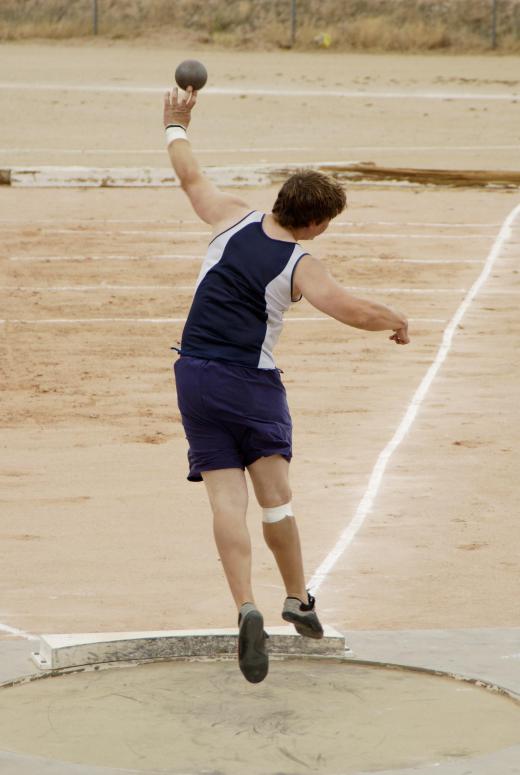
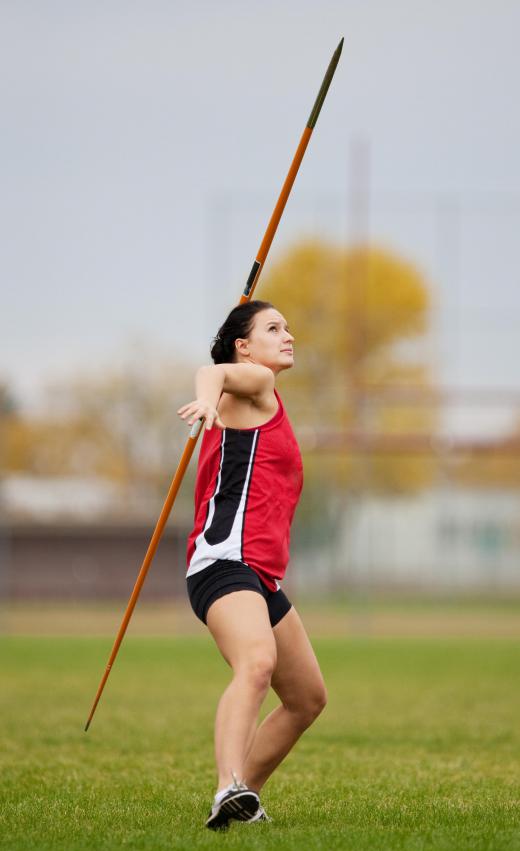
The field events include four in which the athletes throw objects: discus, shot put, hammer and javelin. The size of the objects — or implements — that are thrown can vary according to the age level and gender of the competitors. In the discus, the athlete throws a heavy disc using a spinning motion, and in the shot put, the athlete tosses a heavy sphere, usually by pushing it from his or her shoulder. The hammer is actually a heavy ball at the end of a wire with a handle at one end, and it also is thrown using a spinning motion. A javelin is a spear-like implement — youths often use javelins that have been modified to be safer — that is thrown over-handed.

There also are four field events in which the athletes jump or vault as high or as far as possible: high jump, long jump, triple jump and pole vault. In the high jump and pole vault, the athlete takes a running start and leaps over a bar that is raised after each successful attempt, and he or she lands on a large pad. A pole vaulter uses a long, flexible pole to propel himself or herself over the bar. For the long jump and triple jump, the athlete takes a running start and leaps as far as possible into a landing pit of soft dirt, sand or sawdust. In the triple jump, as its name implies, the athlete takes three consecutive jumps — sometimes referred to as a hop, a skip and a jump — and the distance is measured from the first jumping line to where the athlete landed after his or her final jump.
Combined Events

There also are combined events, such as the decathlon and heptathlon, which combine multiple events into one by using a points system to give the competitors overall scores. The decathlon usually is spread over two days and includes 10 events — four track events and six field events. The four track events are the 100 dash, 400 dash, 1,500 run and 110 hurdles. Field events in the decathlon are the long jump, high jump, shot put, discus, pole vault and javelin.

The decathlon usually is for boys or men. Girls and women typically compete in the heptathlon, which includes these seven events: the 200 dash, 800 run, 100 hurdles, high jump, long jump, shot put and javelin. Some track and field competitions, especially those for youths, might use non-standard combinations of events for the decathlon or heptathlon. Other competitions might include combined events that are made up of different numbers of events, such as a pentathlon, which has five events.
Unusual Events

Along with the marathon, which is not a part of most track and field competitions, there are other events that are rarely included. In the steeplechase, which usually is 3,000 meters for men and 2,000 meters for women, the competitors must pass over large hurdle-like obstacles and jump through a shallow water pit while running around the track. Race walks are events in which the competitors go great distances, such as 20 or 50 kilometers, as quickly as possible but cannot run — one or both feet must be in contact with the ground at all times. Some competitions might also include wheelchair races for people who use them.
There also are many events that were once standard in track and field competitions but have been discontinued in most cases. Among these are the standing broad jump; the standing high jump; team runs in which four teammates run as a group; two-handed throws of the shot put, discus and javelin; and even the tug-of-war. Some competitions might feature one or more of these events, perhaps as novelty events.
AS FEATURED ON:
AS FEATURED ON:


-
![Javelin throwing harkens back to ancient methods of warfare.]() By: SlyJavelin throwing harkens back to ancient methods of warfare.
By: SlyJavelin throwing harkens back to ancient methods of warfare. -
![The length of a long jump is determined by where a jumper lands in a sandpit.]() By: Stefan SchurrThe length of a long jump is determined by where a jumper lands in a sandpit.
By: Stefan SchurrThe length of a long jump is determined by where a jumper lands in a sandpit. -
![Pole vaulters contort their bodies to maximize the heights they can reach.]() By: FotoimpressionenPole vaulters contort their bodies to maximize the heights they can reach.
By: FotoimpressionenPole vaulters contort their bodies to maximize the heights they can reach. -
![Shot put throwers use their body weight to increase the distance they can throw weights.]() By: Jim ParkinShot put throwers use their body weight to increase the distance they can throw weights.
By: Jim ParkinShot put throwers use their body weight to increase the distance they can throw weights. -
![Hurdles are races in which runners must clear barriers along a track.]() By: bercHurdles are races in which runners must clear barriers along a track.
By: bercHurdles are races in which runners must clear barriers along a track. -
![A runner getting ready to compete in a track and field event.]() By: mezzotint_fotoliaA runner getting ready to compete in a track and field event.
By: mezzotint_fotoliaA runner getting ready to compete in a track and field event. -
![Sprinting is a track and field event.]() By: bercSprinting is a track and field event.
By: bercSprinting is a track and field event. -
![Hurdles are a running event in which the participants must leap over barriers.]() By: william87Hurdles are a running event in which the participants must leap over barriers.
By: william87Hurdles are a running event in which the participants must leap over barriers.


Discussion Comments
I'm trying out to get into Nationals. I had to fill a form out first so that's why I went on this website to answer a few questions. It helped a lot. Wish me luck!
this site really helped me out because i don't know anything concerning P.E., so thanks for making this site.
I had a powerpoint presentation on Track and Field but i am not that kind of sports person. This was 100 percent helpful!
I am presently training to be a physical education teacher and this info was very helpful. Thanks and good job keep it up!
i want to do middle school track. i was wondering what events were in it this site really helps me decide on what to do!
Gave me a good idea of what types there are.
I'm a senior in high school and I run track. My events includes: Hurdles, long and triple jumps, and sprinting. This web is great! Thanks.
I just would like to point out that triple jump is actually measured from the first jump you take, not from the last jump as this seems to indicate.
Thanks so much for this info. It gave me a great source for my English report.
Also, to the folks wondering about what events are available in middle school and high school, this varies depending on how wealthy your school is.
My school did not have middle school pole vault, because it would be too expensive to buy middle- school- sized poles. The only real thing that I can say definitively is that I have never seen any school that does javelin, at any level (up until college). Other than that, it's anyone's guess.
I think this website is really helpful and helped me understand that track is more than just running so I can focus on the parts of "field", so to speak. Thanks a lot for making this website and now that I know more I will be able to join the track team next year.
I'm an eightth grader and this is my first year in track. It's actually pretty fun. I run the 800 and the mile and also do the high jump!
I'm in my first year in middle school and going out for the track team. this site helped give me ideas of what i wanted to do in track.
i have to do research about the track and field events and i didn't know what to do.
thanks to this website, i finished my research immediately.
I actually was looking for a site to tell me what events i can do. I'm a middle school student and i know that some events you can't do in high school. Anybody have any answers for me?
I am a seventh grader too and I was doing a essay on track and field so this site really helped me.
Hi my name is JaMyra and I'm a seventh grader in middle school. This year I'm trying out for the track team. I just want to thank you for the information on this website.
Actually, discus, javelin, and shotput (hammer too, I think), were war tools used by ancient Romans/Greeks.
Hello,
My name is Antilia. I'm an 8th grader in Middle School. I am writing for our school newspaper and my subject is track and field. I need to know all the events in track and field... Please comment me back... Thanks, Antilia
I think that this website is very helpful, thanks for making it.
The triple jump has always struck me as being the funniest event! It doesn't even look like anything really athletic because you look so funny doing it, although I have to admit that it takes more coordination that I have. I wonder how it came about though!
Also the shotput and the discus throw - they must have ancient roots because they seem sort of random, but I think a lot of those kinds of things have a history and continue out of tradition even when they don't seem to make as much sense any more.
Post your comments