
At WiseGEEK, we're committed to delivering accurate, trustworthy information. Our expert-authored content is rigorously fact-checked and sourced from credible authorities. Discover how we uphold the highest standards in providing you with reliable knowledge.
What are the Different Blood Components?
In general, human blood — and most animal blood too, for that matter — is made up of two main components. Cellular matter holds the bulk of blood’s importance, at least on a physiological level; it includes red blood cells, white blood cells, and platelets. Each of these has a unique and important role in overall health and body functioning. Fluid materials help the cellular matter move from place to place, and provide the viscosity needed to keep everything held together. Plasma is one of the most important components in this category, which itself is made mostly of salt and water. In healthy people, both cellular and fluid materials are held together in suspension. Separating out the elements, as is sometimes required for certain diagnostic testing or medical transfusion purposes, generally requires specialized equipment.
Understanding Blood Composition Generally

Despite its relatively simple appearance, blood is considered by most health experts to be a remarkably complex substance. It is responsible for maintaining the health and functioning of most internal organs, fighting infection and providing immune support, and delivering oxygen to the heart and brain, among other things. Understanding the role of each of the key components can help people realize and appreciate the many roles of this substance.
Red Blood Cells

The cellular portion of blood contains several different types of cells and cell fragments. Red blood cells, which are known scientifically as erythrocytes, are the most numerous of these. The red blood cells use a molecule called hemoglobin to transport oxygen from the lungs to tissues in the body and to help move carbon dioxide back to the lungs to be removed. This makes them absolutely essential to growth and functioning. Mature red blood cells lack nuclei and organelles, and have a distinct biconcave shape that greatly increases surface area.
White Blood Cells

White blood cells are less numerous, but no less important. These are also called leukocytes and their main job is to help the immune system fight infection. They are created in the bone marrow and course throughout both the blood and the lymphatic tissue system.
Platelets
Platelets, commonly known as thrombocytes in the medical community, are another key part of the blood’s cellular makeup. These are fragments of large cells called megakaryocytes and are a key element in forming blood clots. They help the blood clump together to prevent massive loss, and can also work to plug holes in broken vessels and arteries.
Plasma

Plasma is another important blood component, but it is a fluid rather than a single cell. It is made of a matrix of water and numerous dissolved materials, including glucose, proteins, minerals, and carbon dioxide. Plasma is the fluid that carries blood cells through the body; without it they’d have a much harder time getting from place to place, and would not be as effective. Blood serum is the portion of plasma that has nutrients and other dissolved materials but lacks clotting proteins.
Blood Processing
It can be hard to recognize these individual components on sight alone. Blood usually just looks like a thick, viscous red liquid. Seeing the different pieces in isolation almost always requires specialized equipment.

Blood processing is the technique of differentiating blood components from each other. For example, a hematocrit is a tube that is lined with an anti-coagulant, such as heparin, that contains blood and is placed in a centrifuge. This causes the cells pull away from both each other and their liquid suspension. Various blood processing techniques can be used during blood component therapy. For example, if a patient specifically needs platelets, these can be extracted from the whole blood and given in a blood transfusion.
Considerations for Transfusions and Donations
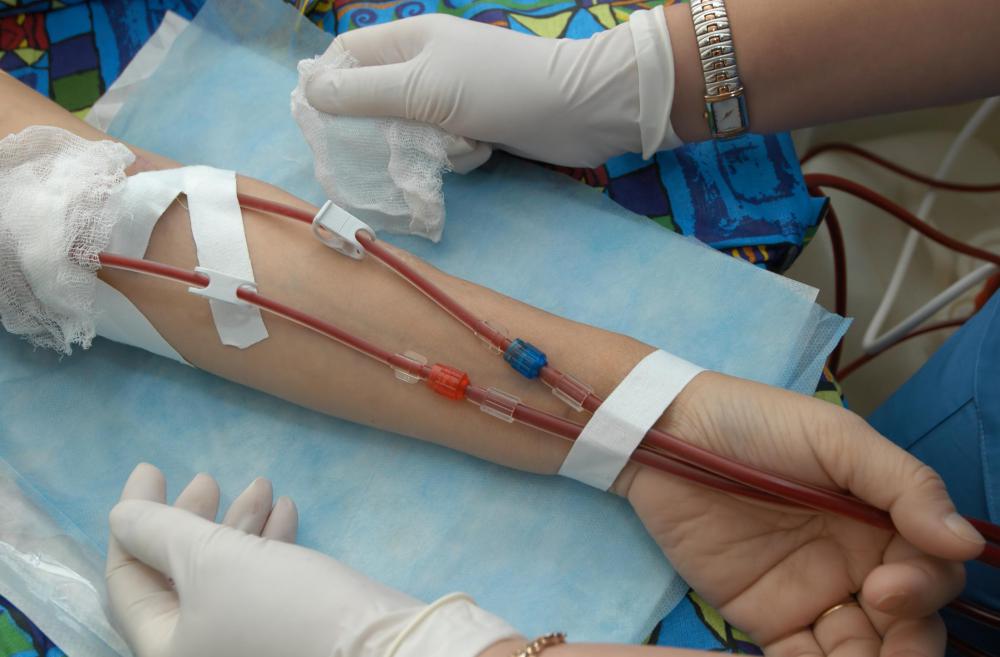
There are often instances, usually during a medical emergency, in which a person needs a blood transfusion. A transfusion is a process through which blood from someone else is injected into the patient, usually through an intravenous needle. Both blood and plasma can be transfused this way, and many hospitals and clinics have donation centers where healthy people can donate their blood. Sometimes donations are made with one specific patient in mind, but more often they’re done generally and are deposited in a “blood bank” where they can be used wherever needed most.
During blood component therapy that involves transfusion of the cellular portion of blood, it typically is important to find blood of the same type. All cells in the body have specific markers on their cell membranes called “antigens.” If blood cells with antigens that do not match the host are injected during a blood transfusion, serious consequences can follow, including death in some cases.
AS FEATURED ON:
AS FEATURED ON:









-
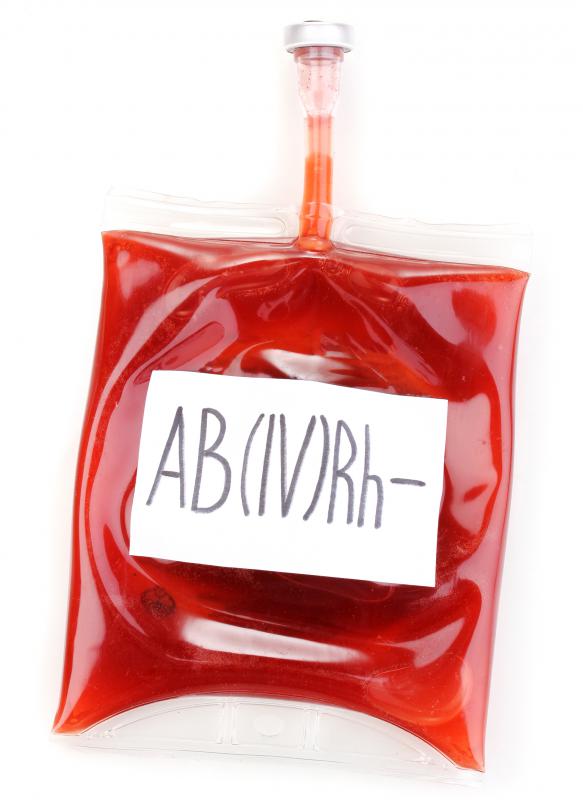
![A pouch of AB- blood.]() By: Africa StudioA pouch of AB- blood.
By: Africa StudioA pouch of AB- blood. -
![A diagram showing different types of white blood cells.]() By: apple1A diagram showing different types of white blood cells.
By: apple1A diagram showing different types of white blood cells. -
![Red blood cells are also called erythrocytes.]() By: Monika 3 Steps AheadRed blood cells are also called erythrocytes.
By: Monika 3 Steps AheadRed blood cells are also called erythrocytes. -
![During blood component therapy that involves transfusion of the cellular portion of blood, it is important to find blood of the same type.]() By: Max TacticDuring blood component therapy that involves transfusion of the cellular portion of blood, it is important to find blood of the same type.
By: Max TacticDuring blood component therapy that involves transfusion of the cellular portion of blood, it is important to find blood of the same type. -
![Individuals who have disorders that affect the number or function of red blood cells may experience fatigue.]() By: bst2012Individuals who have disorders that affect the number or function of red blood cells may experience fatigue.
By: bst2012Individuals who have disorders that affect the number or function of red blood cells may experience fatigue.



Discussion Comments
@VivAnne - Ah, isn't blood complex? I think it's really fascinating how diverse humanity is, even on a blood cell level.
@SkittisH, I wanted to comment on this too and let you know that component-wise, the biggest indicators of blood type and whether one blood type will interact well with another are the antibodies in the plasma and the type of red blood cell.
See, the whole concept of blood types, besides counting on whether one blood sample attacks another or not, is mostly based around slightly different kinds of red blood cell.
Red blood cells can have different surface materials with different uses. The surface differences are actually substances that naturally form on the surfaces of the red blood cells, and those are the antigens that VivAnne here is referring to.
It helps to imagine the red blood cells having different coatings on them, like coats of paint. Whatever visualization method you use, just remember that the red blood cells' slight differences are inherited.
This is why certain blood types can run in families more than in others, and why family members are often good candidates for donating blood and even organs.
@SkittisH - You're right, the blood components are slightly different depending on what blood type, also called a blood group, that a person has.
For starters, blood type is determined by the presence or lack of certain components called antigens, as well as blood serum components called antibodies. Antigens and antibodies also determine which blood types are compatible with which other blood types.
For example, a donor with blood type A- cannot donate blood to a recipient with blood type B-, because blood type A in any form does not contain antigens for any blood type except for A.
Forms of blood type A also all contain antibodies that fight the antigens found in any form of blood type B.
That same A- blood type donor could give blood to a recipient with blood type AB, though, because AB type blood doesn't contain antibodies against A blood types, and contains antigens for blood types A and B.
In short, in order to be compatible for a blood transfusion, two blood types must having matching antigens, and they must not have conflicting antibodies.
If either of these doesn't match, the body will reject the donated blood as an invading substance, and your own blood's antigens and antibodies will attack and try to kill the new blood cells that were introduced.
@hanley79 - Blood is one of those things that most people take for granted. When you examine and research blood components even a little, it's really pretty fantastic that your body can do so much with such tiny organisms flowing through your veins.
I've always thought of the human body as a kind of planet. I know it sounds weird, but if you think of the cells as animals and consider the size difference, it's pretty similar. Cells are living things, and they come in many different varieties -- kind of like animals on the earth, isn't it?
Just like the population of the earth, the population of your body's blood cells is constantly growing, while other cells are constantly hitting the ends of their life cycles, or sickening, and dying as well.
If the cells are the animals, then the fluids could be considered the oceans of the planet that is you. Just like the earth's oceans, the fluids in your blood have an ideal level of different components and of healthy creatures (cells) living in them.
When the balance of your blood sugar or plasma levels is thrown off, the cells can suffer as a result -- kind of an environmental message for your veins.
Donating blood, as you were describing, changes that balance temporarily, but like the earth and the ocean, when you leave your body be to recover it will recover and flourish all on its own.
@gimbell - To answer your last question, there, yes and no. If you donate plasma, and you donate a significant amount, you'll probably feel that wobbly low blood sugar feeling.
This is because plasma is one of the human blood components found in the liquid state, and that liquid also happens to contain your blood's glucose -- the sugar.
If you donate platelets only, I don't imagine you would feel anemic, because that involves loss of iron and red blood cells, or like you had low blood sugar, because as mentioned above that involves the liquid components in your blood.
Donating whole blood is extremely useful, but donating platelets and plasma can still save lives. I highly encourage you to go donate one of the three, if not all of them.
@ElizaBennett - Nice screenname -- I love Pride and Prejudice!
About the blood doning. Is there any kind of blood drive that just wants red blood cells or white blood cells? There are a lot of diseases, such as anemia, that could be treated using just more of those, but I'm not sure what kind of condition is considered serious enough to warrant getting a blood transfusion.
I know that whole blood is used for people who have lost a lot of blood, or that have a blood disease and need to have most if not all of their own blood eventually filtered out of the mixture. I would imagine that white blood cells on their own would still be immensely useful for a donor to give.
I've never heard of donating plasma or platelets by themselves -- that's pretty cool! Does it leave you feeling anemic and low on blood sugar like a regular blood doning session?
Are there any differences in the components in blood depending which blood type somebody has? It seems like there's a pretty specific "formula" for human blood that would dictate how much plasma your body produces in comparison to how many cells your body mixes into its blood.
However, something makes different blood types unique, or we wouldn't be able to tell which blood type will blend with ours and which won't.
The fact that certain blood types will not blend together makes me wonder if there are different cells that would fight each other if the two types were mixed, or if the plasma and fluid blend is slightly different in one type and will throw the other's blend off.
Does anybody else wonder about this stuff? Any thoughts on blood types and whether their ability or inability to blend is based on the mixture of their components?
@jennythelib - First of all, it's great that you plan to donate! You can save three lives (often, premature babies). A blood drive generally collects whole blood, but components can also be donated separately. I've heard of donating platelets and plasma.
You can donate whole blood every 8 weeks, but platelets and plasma can be donated much more often. I'm more familiar with platelet donation, which I've seen done. With platelet donation, your blood passes through a special machine that scrubs out some platelets, then the rest of the blood is returned to you.
I hope yu'll become a regular donor and consider doing platelets as well!
I have maybe a dumb question about blood donation. My work is having a blood drive next week and I've never donated before, but they really want us to all participate.
With blood donation, do they take all the components of your blood, or just some of them?
Post your comments