
At TheHealthBoard, we're committed to delivering accurate, trustworthy information. Our expert-authored content is rigorously fact-checked and sourced from credible authorities. Discover how we uphold the highest standards in providing you with reliable knowledge.
What Are the Differences between the Male and Female Reproductive Systems?
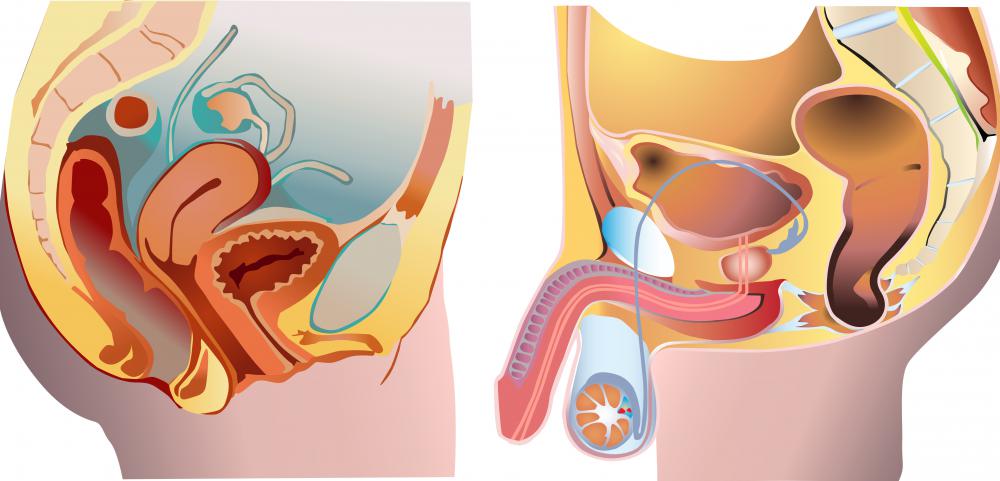
Male and female reproductive systems have evolved for different specialties, but for the same goal: to produce children. All of a woman's reproductive system is inside of the body, whereas much of a man's is outside of the body. The functional difference between the two systems is that a woman's is designed to nurture a baby while it grows enough to survive in the world and a man's is a delivery system for sperm. The individual components of the systems also differ.
The reproductive system in women is entirely internal, with exit and entrance points at the vagina. One of the most noticeable differences between men and women is the male genitalia on the outside of the body. The lower temperatures of the outside environment help keep sperm healthy and prevent damage from the levels of heat found inside the body.

A woman has separate openings for urine and for menstruation and sexual intercourse, whereas the man only has one opening to let out urine and semen. Although the external portions of the vagina tend to become engorged with blood during sexual intercourse, a man's penis exhibits much more obvious enlargement. This allows him to use his penis for functional reasons and insert it into the vagina.

Both the male and female reproductive systems produce hormones, but the hormones differ. Women produce higher levels of female hormones like estrogen and men have more testosterone, for example. These hormones produce wide-ranging effects on the body, such as the development of secondary sexual characteristics like breasts or broad shoulders. Both reproductive systems start making an increasing number of hormones at puberty.

Women have eggs already stored in the ovaries at birth, and the eggs are released every month. Men, on the other hand, make new sperm regularly. The female reproductive system requires a monthly period to renew the lining of the womb, whereas the male system does not require regular maintenance in the same way.
Structurally, the female reproductive system is an area for holding and nurturing an unborn baby. In addition, it is a space where the woman's eggs can mix with the male sperm to produce a new human, which allows the woman to pass on some of her genes to the next generation, and the man to do the same. The male reproductive system does not contain any biological equipment that can support a new baby. Instead, it is a production and delivery system for sperm.
AS FEATURED ON:
AS FEATURED ON:


-
![The male reproductive system has external and internal parts.]() By: peterjunaidyThe male reproductive system has external and internal parts.
By: peterjunaidyThe male reproductive system has external and internal parts. -
![The reproductive system in women is entirely internal.]() By: javiindyThe reproductive system in women is entirely internal.
By: javiindyThe reproductive system in women is entirely internal. -
![A woman has separate openings for urine and menstruation.]() By: matka_WariatkaA woman has separate openings for urine and menstruation.
By: matka_WariatkaA woman has separate openings for urine and menstruation. -
![The external portions of the vaginal will become subtly engorged during sexual intercourse.]() By: Piotr MarcinskiThe external portions of the vaginal will become subtly engorged during sexual intercourse.
By: Piotr MarcinskiThe external portions of the vaginal will become subtly engorged during sexual intercourse. -
![The primary function of the female reproductive system is to carry and nurture unborn children.]() By: blueringmediaThe primary function of the female reproductive system is to carry and nurture unborn children.
By: blueringmediaThe primary function of the female reproductive system is to carry and nurture unborn children. -
![The reproductive system in women is entirely internal, with exit and entrance points at the vagina.]() By: isysteThe reproductive system in women is entirely internal, with exit and entrance points at the vagina.
By: isysteThe reproductive system in women is entirely internal, with exit and entrance points at the vagina. -
![Both the male and female reproductive systems produce hormones, although the hormones differ.]() By: jelena zaricBoth the male and female reproductive systems produce hormones, although the hormones differ.
By: jelena zaricBoth the male and female reproductive systems produce hormones, although the hormones differ. -
![A woman's reproductive system is designed to carry and nurture an unborn baby.]() By: JackFA woman's reproductive system is designed to carry and nurture an unborn baby.
By: JackFA woman's reproductive system is designed to carry and nurture an unborn baby.






Discussion Comments
@truman12: There are a variety of birth control methods, all of which can have some sort of effect on the menstrual cycle. The most common effect is that taking birth control helps with regulation of the cycle, however that depends on the type of birth control you choose. There are shots, pills, patches, things that are inserted into the vagina and more. All of these will have a different effect on the menstrual cycle. You should discuss the different methods with your doctor and he or she will advise you about the method that works best for you.
@summing: Men go through the change of life, just like women. Both cause an imbalance of hormones in the body, which is why you are feeling different. Just as women take hormone replacements to get back to normal, it is pretty much the same for men. If you are wanting to feel like your self again, taking hormone replacements is extremely common. Unfortunately, going through "the change" is just part of the aging process.
I am considering going on to the birth control pill but I have heard that it can have serious effects on my menstrual cycle. What should I expect and can anyone recommend a brand? Thanks!
I have been seeing a lot of ads recently for testosterone enhancement medication for men. Has anyone taken this before? What were the results?
I am 45 and definitely feeling a lot different than I did when I was younger. I am interested in testosterone supplements but kind of skeptical about some of the claims that they make. How much of my problem is related to hormones and how much of it is just a consequence of getting older?
Post your comments