
At TheHealthBoard, we're committed to delivering accurate, trustworthy information. Our expert-authored content is rigorously fact-checked and sourced from credible authorities. Discover how we uphold the highest standards in providing you with reliable knowledge.
What are the Common Causes of Severe Chills?
Experiencing chills, or rigors, is often just a symptom of exposure to cold temperatures or a rapid shift in temperatures to which the body is exposed. They can also be caused by a wide variety of illnesses, medical conditions like childbirth, by taking certain medications. Severe chills that last more than an hour can be a symptom of rarer conditions like malaria or hypothermia. Depending on the cause, rigors can often be treated at home, but more serious cases require medical help.
Symptoms

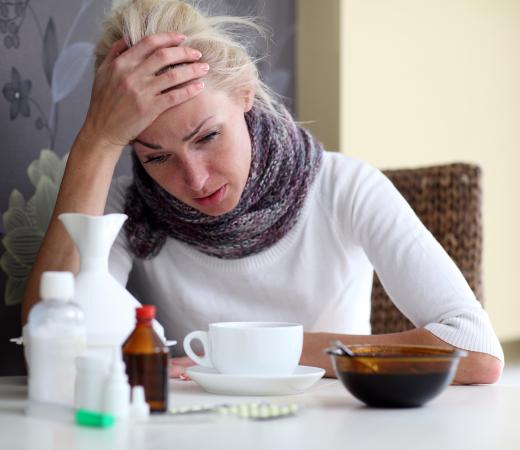
A person with severe chills generally feels very cold, even when wearing heavy clothes or wrapped in quilts or heavy blankets in a warm room. Depending on the underlying condition, he or she may cycle through periods of feeling too hot and too cold, and many people have a fever at the same time. He or she may also get very pale and have goose bumps. Children may be listless and sleepy, or irritable, depending on the cause. Rigors that cause violent, uncontrollable, prolonged shaking often indicate an infection that's spread throughout the body, and should be reported to a healthcare provider.
Causes

Many different conditions can cause severe chills, but viral and bacterial diseases like influenza and pneumonia are among the most common. Other infections and inflammations in the body, like Urinary Tract Infections (UTIs), colds, heat stroke, Severe Acute Respiratory Syndrome (SARS), and rheumatic fever can cause shivering and similar symptoms. Trauma from an abscessed tooth, or an infected wound can also trigger shivering. Other medical conditions that are associated with rigors include pleurisy, psoriasis, and meningitis. Some people even get chills just from the common cold.

Serious bouts of chills and shivering can also be associated with medical conditions like childbirth and miscarriages. Puerperal fever and sepsis, a life-threatening infection that is associated with childbirth, can cause this symptom, so any bouts of shivering after giving birth or miscarrying should be reported to a healthcare provider. Side effects or allergic reactions to prescription medications can cause also severe chills, along with medical procedures such as a blood transfusions, heart surgery, and dental work.
Hypothermia
One of the most common causes of severe chills is hypothermia, in which the body's temperature becomes too low. Though the body usually maintains a healthy temperature on its own, which rises and falls during the day and night in reaction to normal temperature cycles and the external temperature, certain medical conditions can cause it to get abnormally and dangerously low. Things like cardiovascular disease, anorexia, hypothyroidism, substance abuse, and trauma may predispose a person to hypothermia. Being in extremely cold places, particularly those that have a high humidity and low wind chill can also quickly lower a person's core temperature.

Symptoms of hypothermia are indications that medical treatment is necessary. These include shivering, slurred speech, pale skin, and slow breathing. People also lose coordination and feel lethargic and confused. Hypothermic babies often have cold skin that appears bright red.
Treatment
If the underlying cause of the chills is something that's not too serious, like a cold, then home treatment with warm blankets and liquids, a hot water bottle, Over-The-Counter (OTC) medications, and rest can be used. For more serious causes like pneumonia, UTIs, and influenza, a person should seek medical attention and prescription medication.

Anyone who shivers continuously or shows signs of hypothermia should seek immediate medical help, and have a caretaker ready to administer Cardio-Pulmonary Resuscitation (CPR) immediately if he or she stops breathing. The person should be kept away from sources of cold and covered with warm, dry blankets until medical personnel arrive. Hot water and other heating devices should not be used, particularly on the extremities, since this can make the body's core temperature fall. Warm beverages are good, but the person should not have any kind of alcohol, since it causes blood vessels to expand, routing blood away from main organs.
AS FEATURED ON:
AS FEATURED ON:


-
![A hot water bottle, which can help with severe chills.]() By: simmittorokA hot water bottle, which can help with severe chills.
By: simmittorokA hot water bottle, which can help with severe chills. -
![Viral and bacterial diseases commonly cause severe chills.]() By: CreativaViral and bacterial diseases commonly cause severe chills.
By: CreativaViral and bacterial diseases commonly cause severe chills. -
![Hypothermia is a condition characterized by a drop in body temperature, usually due to exposure to cold weather.]() By: lunaHypothermia is a condition characterized by a drop in body temperature, usually due to exposure to cold weather.
By: lunaHypothermia is a condition characterized by a drop in body temperature, usually due to exposure to cold weather. -
![Common indicators of the H1N1 flu virus include chills, fever, and headache.]() By: emde71Common indicators of the H1N1 flu virus include chills, fever, and headache.
By: emde71Common indicators of the H1N1 flu virus include chills, fever, and headache. -
![A person with severe chills may experience goose bumps.]() By: Oleksii SergieievA person with severe chills may experience goose bumps.
By: Oleksii SergieievA person with severe chills may experience goose bumps. -
![In some cases, chills may signal heat exhaustion or heat stroke, a potentially life-threatening condition.]() By: MaridavIn some cases, chills may signal heat exhaustion or heat stroke, a potentially life-threatening condition.
By: MaridavIn some cases, chills may signal heat exhaustion or heat stroke, a potentially life-threatening condition.


Discussion Comments
I don't know if many people realize it, but there can come a point where a person has become so cold that they don't shiver anymore. People shiver in order to heat themselves back up. If they get to a point where they aren't shivering with chills, that's a symptom that they are getting close to death and drastic measures should be taken. If you're outside and there's no other help, you need to at least provide body warmth.
@Iluviaporos - Well, people have a fever because the body is trying to burn out an infection. I think they get the chills because they get too hot and the body freaks out and sweats a lot to try and bring the temperature down. If anything, it's more dangerous to not feel cold, because it means the fever isn't breaking at all.
I would suggest using sage tea if you've got a fever, but the problem is that it can mask the symptoms. It's good for people who get hot flushes and chills that aren't related to fever, but it can be dangerous if you should have a fever and you aren't doing anything else to combat an infection.
The worst thing about having chills when you've got a fever is that they keep changing. First you feel like you can't get warm enough, no matter how hard you try and then, an hour later, you wake up feeling like you're going to roast to death because you've suddenly become so hot.
It's particularly annoying because the thing you need most when you're sick is to sleep and it's impossible to sleep when you feel so uncomfortable. I can't understand why your body makes it so difficult by having fever chills right when you need to sleep well.
Post your comments