
At TheHealthBoard, we're committed to delivering accurate, trustworthy information. Our expert-authored content is rigorously fact-checked and sourced from credible authorities. Discover how we uphold the highest standards in providing you with reliable knowledge.
What are the Common Causes of Arm Swelling?
While arm swelling, in and of itself, may not seem very serious, it is often a symptoms of a more serious condition. The most common causes include a broken bone, a strained or sprained muscle, or an infection. In some cases, water retention associated with a diet rich in sodium or a poorly functioning cardiovascular system can also be to blame.
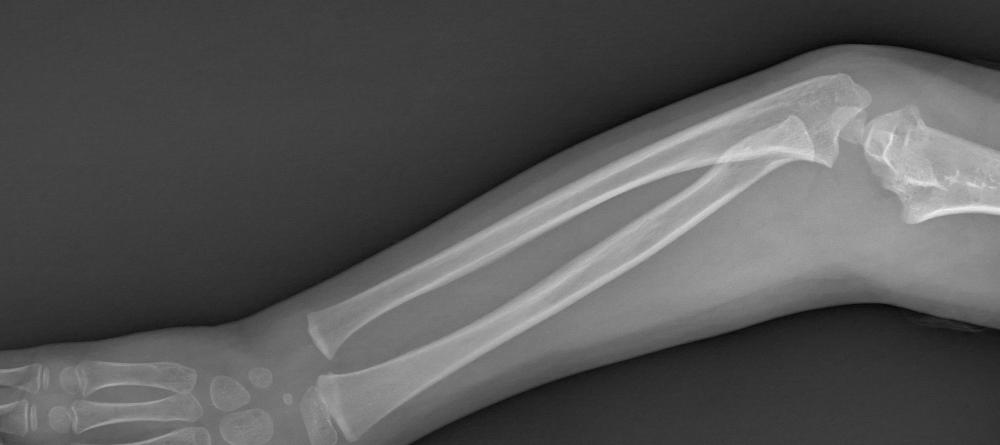
One of the most common causes of arm swelling is a broken bone. Typically, swelling that is caused by a broken bone comes on almost immediately after the break occurs, and it is isolated to one particular area. As with any break, it is important that those who are injured to seek medical assistance as soon as possible. Usually, once the broken bone is treated and placed in a cast, the swelling associated with the injury will decrease relatively quickly. Swelling that does not go down within a short period of time should be evaluated for possible infection.

Another similar cause is a strain or sprain to one of the muscles of the arm. As with a broken bone, swelling associated with a strain or sprain comes on very quickly after the injury occurs. Usually, the best way to treat it is simply to rest the affected body part and use an ice pack to decrease the inflammation. Individuals who have suffered from this type of injury should be sure to wrap the ice pack in a clean, dry towel in order to prevent potential skin damage from the ice.

In some cases, an infection can also lead to serious arm swelling. A broken bone, or a cut, scrape, or other type of abrasion can get infected easily if it is not cleaned and cared for correctly. In serious infections, prescription medication may be required to completely treat the condition.
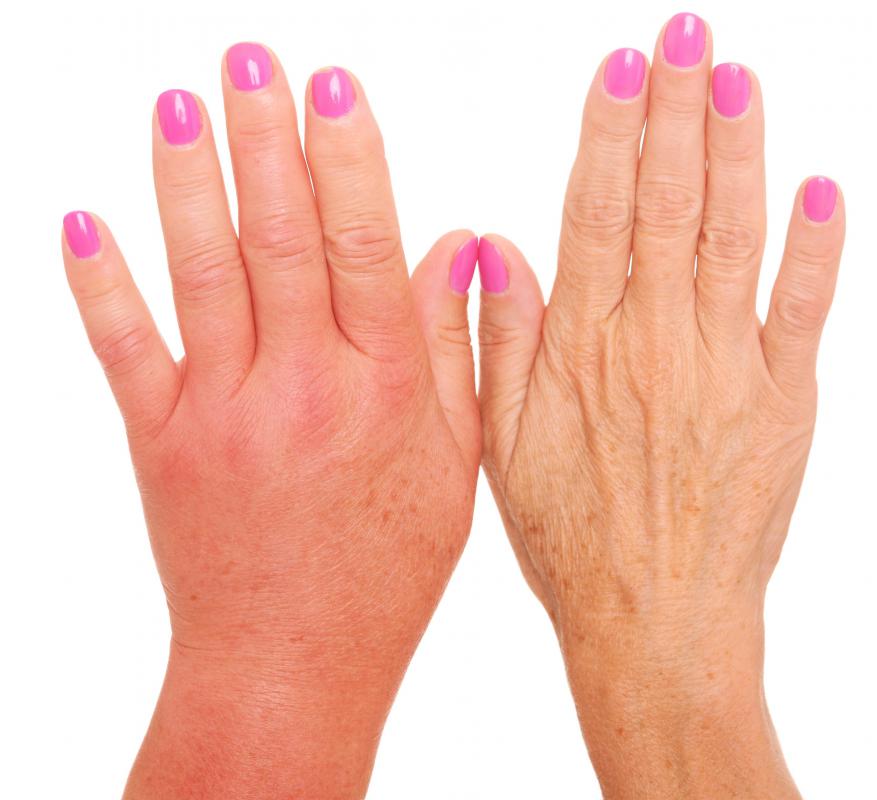
Swelling is also sometimes caused by fluid retention, and occurs most often in the lower end of the limb, near the hand. Usually, this type of swelling is caused by a diet that's high in salt, or poor circulation. Individuals with this problem may find that reducing their salt intake and taking measures to improve their cardiovascular health can have a big impact on fluid retention.
AS FEATURED ON:
AS FEATURED ON:


-
![An ice pack, which can help reduce arm swelling.]() By: Marc DietrichAn ice pack, which can help reduce arm swelling.
By: Marc DietrichAn ice pack, which can help reduce arm swelling. -
![Arm swelling is commonly caused by a broken bone, which may be treated by a cast.]() By: ttanothaiArm swelling is commonly caused by a broken bone, which may be treated by a cast.
By: ttanothaiArm swelling is commonly caused by a broken bone, which may be treated by a cast. -
![Arm swelling will come immediately after a person suffers a broken arm, meaning they'll likely need an x-ray taken of the arm.]() By: Silvia CrismanArm swelling will come immediately after a person suffers a broken arm, meaning they'll likely need an x-ray taken of the arm.
By: Silvia CrismanArm swelling will come immediately after a person suffers a broken arm, meaning they'll likely need an x-ray taken of the arm. -
![Fluid retention in the hands may be caused by poor circulation.]() By: KalimFluid retention in the hands may be caused by poor circulation.
By: KalimFluid retention in the hands may be caused by poor circulation.


Discussion Comments
Once I was on a long flight where I sat still for many hours. I had also eaten some salty foods. When I arrived, I saw that my arms, hands, lower legs and feet were all a little swollen.
I was very worried but wasn't sure what to do. After a long nap, the swelling disappeared. I am not looking forward to long flights for this reason. But I have been watching my salt intake, I have reduced it.
@burcinc-- I think so because repetitive movements can strain muscles. That's actually how carpal tunnel syndrome develops.
When muscles and tendons are strained, they become inflamed. Depending on how bad it is, the swelling may actually be visible. Do you also have pain?
There is also something called a stress fracture and I think that repetitive movements and to much tension can cause this too. You really ought to see a doctor for the diagnosis. If you had any injury lately such as a fall, don't waste time because there might be a fracture. Put an ice pack on your arm to control the swelling.
Is it possible to get arm swelling from repetitive movements?
Post your comments