
At TheHealthBoard, we're committed to delivering accurate, trustworthy information. Our expert-authored content is rigorously fact-checked and sourced from credible authorities. Discover how we uphold the highest standards in providing you with reliable knowledge.
What are the Characteristics of Epithelial Tissue?
The most basic characteristic of epithelial tissue is that it covers the surfaces of the body, whether external or internal. It acts as a protective covering or boundary for such surfaces, including the outer layer of the skin, as well as the inner surface of "hollow" organs like the stomach, colon, and blood vessels. Beyond this, the tissue is typically identified as having six characteristics: it is made almost entirely of cells, contains cells joined by specialized contacts, has distinct upper and lower surfaces, is not supported by blood cells, retains the ability to regenerate, and is supported by connective tissue.
All epithelial tissues share a feature that is sometimes referred to as cellularity. Cellularity simply means that the tissue is made almost completely of cells, with very little space in between them. In other tissues, particularly connective tissues, an area of nonliving matter called the extracelluar matrix exists between cells. Epithelial cells all share special points of contact as well. These contacts are made by possible by special proteins called integral membrane proteins.

Another shared characteristic of this tissue is that its upper cells are different from its lower cells. This feature is known as polarity, and the upper and lower surfaces are called apical and basal, respectively. The apical cells are "free" in the sense that they are not attached to other cells, except for neighboring epithelial cells. The basal cells are attached to what is called a basement membrane, which is necessary to attach the tissue to nearby connective tissue. All of these tissues are supported by connective tissue, another common feature among them.

Epithelial tissue contains no blood vessels and is therefore said to be avascular. It is instead supported by capillaries in connective tissues, which supply it with nutrients through a process called diffusion. Although the tissue contains no blood vessels, it does contain nerve endings.
The cells are capable of rapid division, which is the process that creates new cells. Many epithelial cells in different parts of the body are lost due to friction or exposure to harmful substances. The skin, for instance, constantly produces new cells to replace the dead cells closest to the outer surface. The cells of tissues lining the digestive tract, including those of the esophagus, stomach, and intestines, also undergo continuous division.
AS FEATURED ON:
AS FEATURED ON:


-
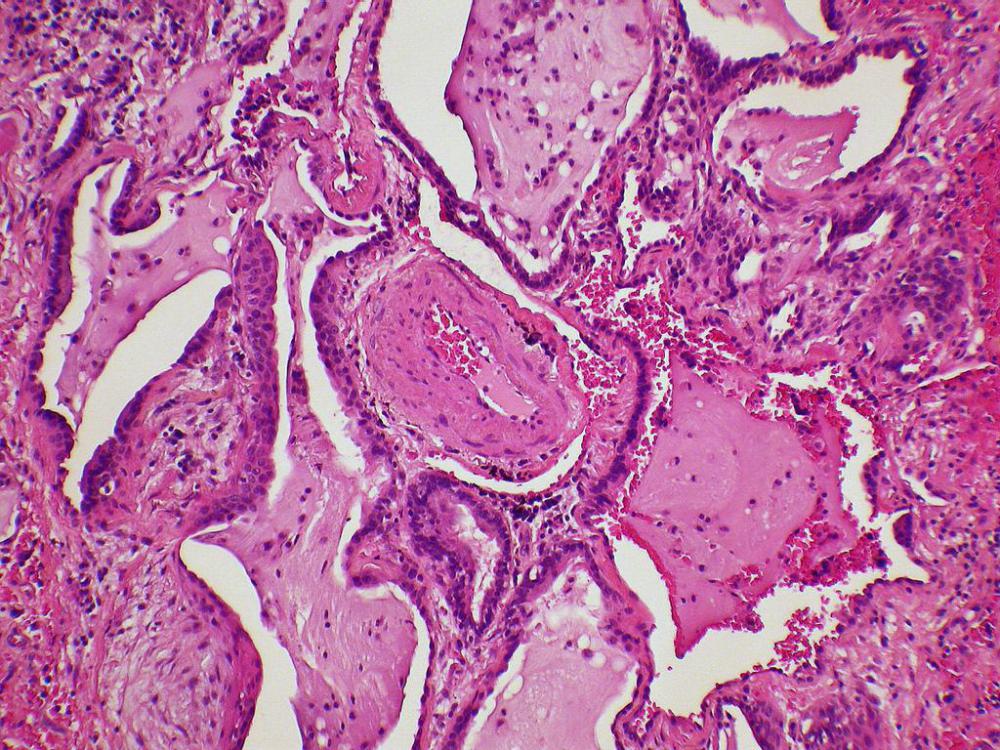
![Respiratory epithelium separated by bands of inflamed tissue and muscle.]() By: Yale RosenRespiratory epithelium separated by bands of inflamed tissue and muscle.
By: Yale RosenRespiratory epithelium separated by bands of inflamed tissue and muscle. -
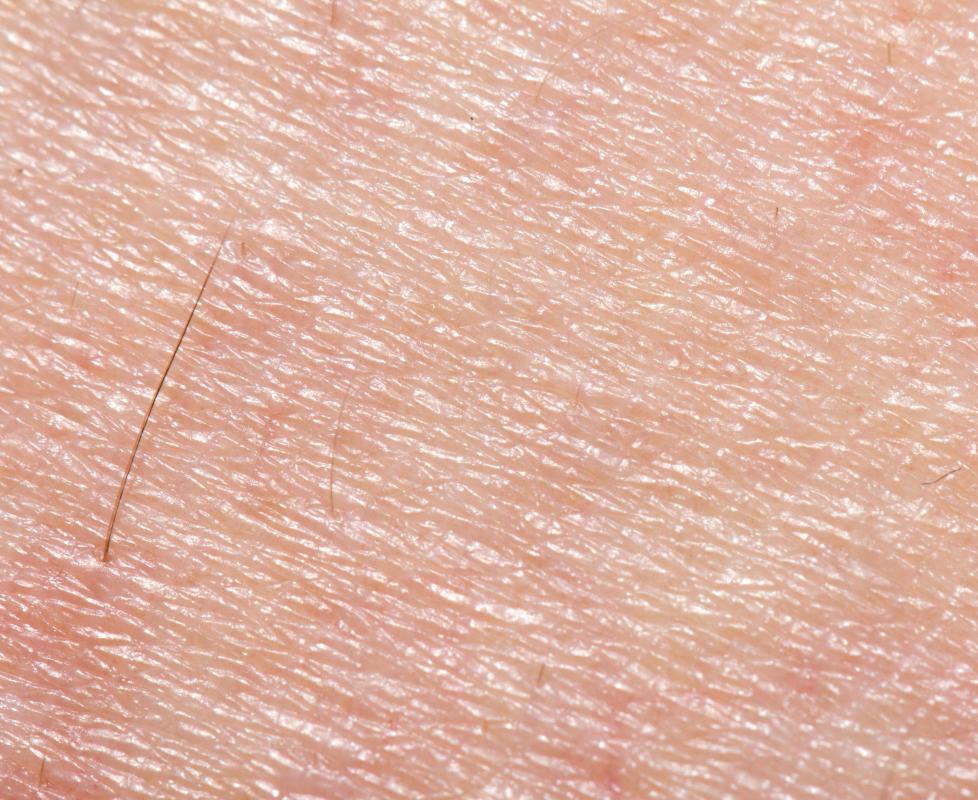
![Skin is epithelial tissue more than one cell thick and known as stratified epithelium.]() By: schankzSkin is epithelial tissue more than one cell thick and known as stratified epithelium.
By: schankzSkin is epithelial tissue more than one cell thick and known as stratified epithelium. -
![Epithelial cells lining the digestive tract -- including those of the esophagus, stomach and intestines -- undergo continuous division.]() By: snapgalleriaEpithelial cells lining the digestive tract -- including those of the esophagus, stomach and intestines -- undergo continuous division.
By: snapgalleriaEpithelial cells lining the digestive tract -- including those of the esophagus, stomach and intestines -- undergo continuous division.

Discussion Comments
If your cells change from normal columnar ciliated epithelial cells to stratified squamous epithelial cells, does this mean you have squamous cell carcinoma?
How much epithelial tissue does our skin shed per day? I heard that we lose millions of dead skin cells daily. Is this true or an exaggeration?
However, there are three types of epithelial tissue and I don't think that all three are visible to the naked eye. Some can only be detected with use of a microscope and lab tests. I'm not sure which kind you saw in your urine but if you did have a urinary tract infection, you probably had several kinds in your urine at that time.
By the way, nice observation!
I had to give a urine sample at the hospital last week because my doctor suspected me of having a urinary tract infection.
When I was giving the urine sample to the nurse, I saw these small white colored particles floating around in the urine. I asked her what these were and she said that it's epithelial tissue and that it's normal for it to be in urine.
I had never heard of epithelial tissue before this. Which membrane does this epithelial tissue come from? And why is our body throwing it out through urine?
@clintflint - It sounds kind of disgusting, but then I've always found it a bit icky that milk comes from the glands of cows. I still drink milk and eat cheese and such but I try not to think too hard about where it comes from.
Learning that it's produced by the same kinds of cells that produce other body fluids doesn't really make things any better. It is kind of amazing how different all these cells are though. Some of them, like the ones lining the lungs, almost seem like little animals themselves, since they can move their cilia and others, like the simple epithelial tissue, look essentially like building blocks when we check them out in my science classes.
What I found fascinating when studying this in class is that some kinds of epithelial tissue function as glands. Sweat and saliva and breast milk and other substances that mammals produce are all essentially made by these cells.
I remember my biology teacher talking about how at some point they might be able to grow milk producing cells in the lab and maybe produce milk from those cells directly, without having to keep large herds of cows. Bad for farmers, maybe, but that would be really cool for the environment.
@lighth0se33 - You're right, I remember another one: Pseudostratified. It gives the appearance of the stratified, but it's not -- it's an imposter. (The things that stick in my brain...) However, it redeems itself by having an interesting characteristic: It has cilia. Cilia is like little hairs. The lungs have cilia in them to clear out mucus and such.
Smokers beware: Some authorities say that smoking wears down these hairs and they no longer function properly. It's the same as walking across a section of grass so often that it wears down and eventually just goes away.
@lighth0se33 - We are studying these cells in class now. There are many types of epithelial cells, so I will list just a few.
Squamous cells are thin and flat and line the heart, lungs, mouth, and blood vessels. They also make up the skin’s outer layers.
Cuboidal cells are square-shaped and line gland ducts and kidney tubules. They also make up the germinal epithelium, which is where egg cells and sperm cells are made.
Columnar cells are elongated and shaped like columns. They line the intestines and stomach. Some have special sensory receptors and are found in the ears, nose, and taste buds. Goblet cells are in the duodenum.
Aren’t there many different types of epithelial cells? It seems like I vaguely remember learning this in high school biology.
Post your comments