
At TheHealthBoard, we're committed to delivering accurate, trustworthy information. Our expert-authored content is rigorously fact-checked and sourced from credible authorities. Discover how we uphold the highest standards in providing you with reliable knowledge.
What are the Best Herniated Disc Exercises?
The spinal column is supported and controlled by a network of muscles all working together to maintain alignment and prevent injury. If you have a herniated disc, exercises may alleviate some of the pain, but it must be the right types of exercise. Herniated disc exercises usually target the muscles that support the injured area while working around the injury itself. This includes abdominal and hip strengthening exercises, lower back extension exercises, hamstring stretches, and gentle overall conditioning exercises such as walking or swimming.
Once you have your doctor's approval, there are many herniated disc exercises that can help alleviate pain during your recovery. Any beginning exercise program should be approved by a doctor, but if you have a herniated disc, it is absolutely vital that you follow your doctors instructions regarding whether or not to exercise. Usually, patients are instructed by a physical therapist about which types of herniated disc exercises are best for their particular injury. The most important point to remember when exercising after an injury is to go slowly, listen to your body, and stop immediately if your pain worsens during the exercise.

Abdominal Isometrics: This exercise can be performed virtually anywhere, while sitting, standing, or lying down. Simply pull your stomach muscles inward and hold for as long as you can. Visualize pulling your navel towards your spine. If you are lying on the floor or bed, press your lower back into the surface you are lying on. Be sure to isolate the abdominals with this exercise, and don't use your legs to help. Work up to ten repetitions.

Lower Back Extension: Lie on your stomach, and prop your upper body on your elbows while keeping your pelvis on the floor. At first, simply hold this position for as long as it is comfortable. As you gain flexibility, you can push up onto your hands and stretch your upper body towards the ceiling. This exercise should be performed very slowly and carefully, and discontinue immediately if you have any pain.

Lower Back and Hip Stretch: Lie flat on your back with knees bent and arms relaxed at your sides. Slowly let your knees drop to one side, hold for a few seconds, and return to starting position. Repeat on the other side. Work up to ten repetitions on each side, paying attention to your body's signals and not stretching too far until you are more flexible.

Hamstring stretch: Lie on your back with your knees bent. Raise one leg slowly and place your hands behind your knee. Straighten your leg as much as you can, and gently pull it toward your chest. Hold for a few seconds, then return to the starting position and repeat with the other leg. Do not force this exercise! You should feel a stretch in the back of your thigh. If you feel pain or discomfort anywhere else, discontinue this exercise until you are stronger.

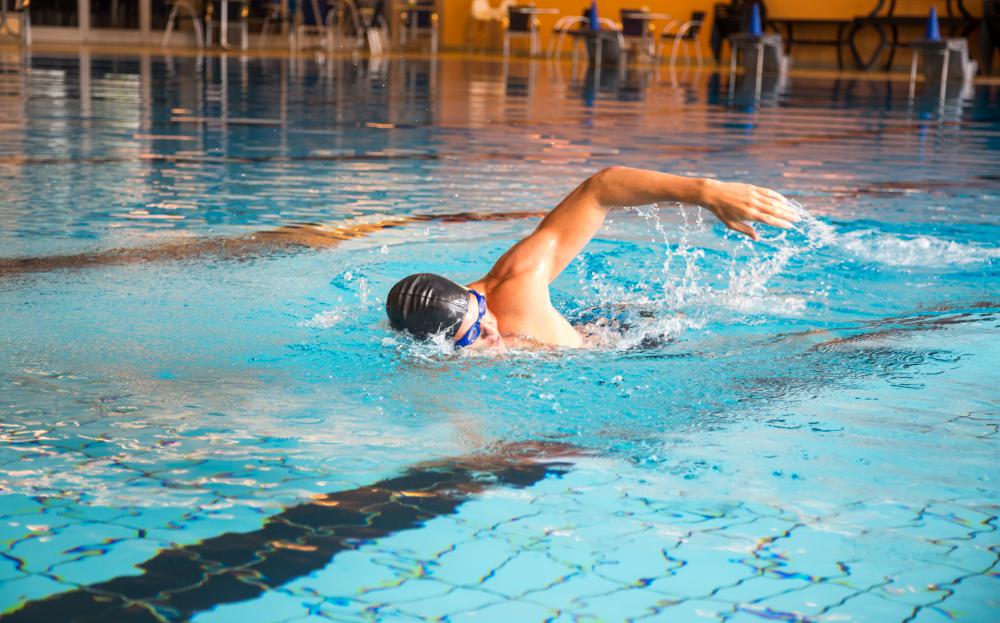
General Conditioning: Your doctor will probably recommend a general conditioning exercise in addition to specific herniated disc exercises. Walking and swimming are both gentle, safe ways to keep your body active without worsening your injury. If excess weight is contributing to the injury, walking and swimming are both aerobic exercises that burn calories, helping you with your weight reduction plan as well.
AS FEATURED ON:
AS FEATURED ON:


-
![Abdominal isometrics are good for a herniated disk.]() By: CreativaAbdominal isometrics are good for a herniated disk.
By: CreativaAbdominal isometrics are good for a herniated disk. -
![Woman working on her abdominal muscles to relieve a herniated disk.]() By: HalfpointWoman working on her abdominal muscles to relieve a herniated disk.
By: HalfpointWoman working on her abdominal muscles to relieve a herniated disk. -
![General conditioning, such as swimming or walking, is helpful in rehabilitating a herniated disc.]() By: ikonoklast_hhGeneral conditioning, such as swimming or walking, is helpful in rehabilitating a herniated disc.
By: ikonoklast_hhGeneral conditioning, such as swimming or walking, is helpful in rehabilitating a herniated disc. -
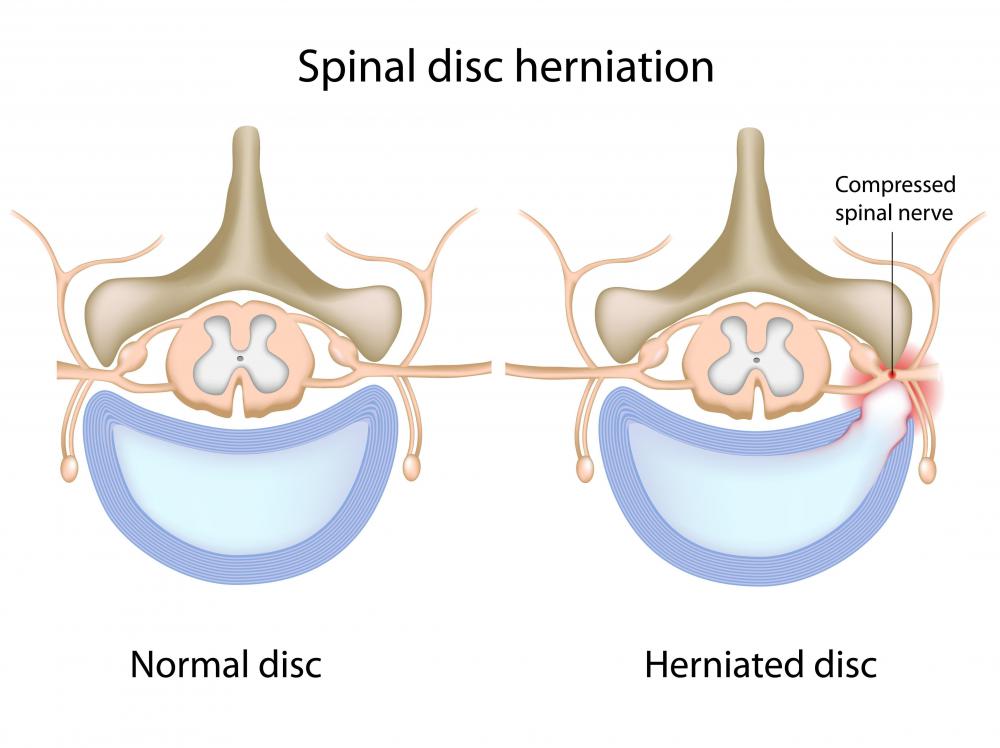
![A healthy spine and a spine with a herniated disc.]() By: AlilaA healthy spine and a spine with a herniated disc.
By: AlilaA healthy spine and a spine with a herniated disc. -
![Lower back pain might be caused by a herniated intervertebral disc.]() By: MaridavLower back pain might be caused by a herniated intervertebral disc.
By: MaridavLower back pain might be caused by a herniated intervertebral disc.



Discussion Comments
Please, for all those with back pain, look up McKenzie trained physical therapists in your area. The evidence behind McKenize is bar none, no matter how acute or chronic. If you have already tried McKenzie, look for Sahrmann or McGill trained therapists.
I am 24 and I have a herniated disc at L4 L5 and S1. What procedure should I have for it?
I am 41 and have herniation in my L5-L6 as well as sciatica. I'm in a lot of pain and have numbness/tingling in both hands and one arm. I need to lose weight, but am struggling to do so. I started with a chiro and am going to see an ortho surgeon in two weeks, but am not sure which route is best long term.
My L4 and L5 are sequestered and I have numb toes with feeling that strings are tied around them. I was advised that i needed surgery immediately or risk paralysis. It has been one year and two months and with the aid of the above exercises and no medication and I am doing OK.
I am Australian Physiotherapist. Treating back pain is our 'bread and butter' and a daily responsibility.
There are no generic exercises for herniated discs. They should be prescribed individually for a client's presentation. The first problem is that people are often misdiagnosed with 'disc' pain - sometimes through poor clinician assessment, or an false positive on an MRI.
If you have a McKenzie practitioner in your area see them.
As for Chiropractic being the only cure for herniated discs (are you kidding me?!). Most Chiros I know would not treat an acute discogenic back with neurological signs, however there are some very important exercises to do in these stages.
If you suspect you have disc-related back pain see a physiotherapist, preferably one who practices McKenzie therapy.
I'm 29 years old with a bulging disc at L4-L5 and a herniated disc at L5-S1. It was very difficult to walk for several days. I'm slowly healing and am very lucky I don't need surgery. I'm in with a good PT and most of my sciatica pain is gone.
In order to move on after my herniated disc, I got an MRI and have been to a surgeon, PM&R doc, and then to a great PT. I consider myself lucky and can only hope I continue to get better. Good luck everyone. P.S. If you have any bowel or bladder issues, seek medical attention ASAP.
I am using the Pete Egoscue method, with great success. Chiropractors weren't able to help me at all, and my PT believed I was too acute for exercises. But the Egoscue exercises reduced my pain right away, and have given me my life back. Read his books while you locate a Posture Alignment Specialist from his website.
Seven months later, I no longer need any pain meds and have resumed my normal activities. This sounds like a long time, but I couldn't even stand, sit, or walk when I first went. All I could do was crawl. The help was immediate!
Regular exercise. Weight-bearing exercises, such as walking, jogging, stair climbing, dancing, or weight lifting, keep bones healthy by working the muscles and bones against gravity.
I wake up unable to get out of bed without pulling myself up, and then my muscles and whole inside is in terrible pain. I have had a herniated L5-L4 disc for years.
Can it affect my bladder and bowels? I get constipated and that seems to make the nerve worse in my back which makes my legs feel "fuzzy" tingling. Seems no organs are functioning properly, causing pressure and pain in my abdomen. I feel a little relief when I take a muscle relaxer.
I am just trying to figure out if it is the disc causing the pain or something pushing on the disc causing it to act up, Bladder and bowels are not working properly. Pain is everywhere down there. I am 49 and female.
I'm 49 and herniated L5. i do "mackenzies," which is when you lie on your stomach and do a sort of push up leaving your hips and legs flat on the floor. it takes time but I have avoided surgery for almost 10 years.
I find that walking is much better than trying to lie down, but when I do lie down, I always lie on my stomach.
Go see a good DPT and receive a thorough evaluation followed by a well structured treatment program. Chiro's are good for spinal pathology, but they only treat the spine with a THRUST technique.
I had it done to me and felt miserable afterward (I'm not the only one who feels this way). I then asked my physician if he can recommend a good PT. The DPT treated me a few times without the need of that Thrust technique. He did do some manipulation and then created an exercise program for me to follow. No problems ever since!
The only way to get back in action is to see a good chiropractor. I've had several slipped discs and been threatened with surgery but the chiro has sorted it every time, quickly and painlessly. Doctors will only make you worse..painkillers and surgery are never the answer.
I'm in a lot of pain and on a lot of narcotics just to function. What can i do? i can't handle business with a woman (I'm a man). It's bad and very depressing.
I am 49 years old and got herniated disks at L4 -L5 eight months ago. In the first six months, I had almost no improvements at all, but after that, I feel it has getting better gradually. When it is really painful (both at lower back and leg ), using an ice pack is more helpful.
I tried the inverse table and it works but you need to start little by little. twice a week is good enough. Most important is that you need to correct all the factors that cause the problem: take enough calcium and vitamin D; sleep on a hard mattress; make sure your car seat is properly aligned. If not, buy a cushion for it. Good sleep is very important. Take sleeping pills temporarily if you don't sleep well.
Be patient. You will get better if the symptoms are not getting worse. After initial improvement, start to do some exercise and increase the intensity gradually. You will get better. It is just a question of time.
I am 39 years old. i have this problem: herniated disc at L4-L5 with thinning of disc space and disc desiccation changes. Bulging disc at L5-S1. Can this be cured without surgery and by means of some exercises? If so, please tell me some exercises.
I too, am young with a herniated disc. You will need to call the doctor and see how much motrin you can take; it may need to be increased.
I have had this on and off for years and i don't think the condition goes away but the pain should.
The motrin reduces the inflammation only. You will need to rest if in severe pain, then when pain lessens you need to start light exercise like walking.
It will go away on its own but it will take some time. The chiropractor has also helped me. Most people don't need surgery. It is the last resort.
Basically: take motrin, go to chiro, heat or ice may also help. Lose or maintain a healthy weight. When pain goes away or is at a minimum, work with a professional and exercise your abs and lower back.
I experienced no pain while I had a healthy weight and an active lifestyle.
I am 27 years old .i have a problem of this.Herniated disc at L4-L5 with thinning of disc space and disc desiccation changes.Bulging disc at L5-S1. can this be cured without surgery and by means of some exercises? If so, please tell me some exercises.
can a 2-3 mm lumbar disc bulge go back to normal without any bulge with treatment and if so what treatment can do this without surgery. will taking motrin everyday regularly for 1 week to reduce the bulge. please write me back
Post your comments