
At BeautyAnswered, we're committed to delivering accurate, trustworthy information. Our expert-authored content is rigorously fact-checked and sourced from credible authorities. Discover how we uphold the highest standards in providing you with reliable knowledge.
What Are the Benefits of Almond Oil?
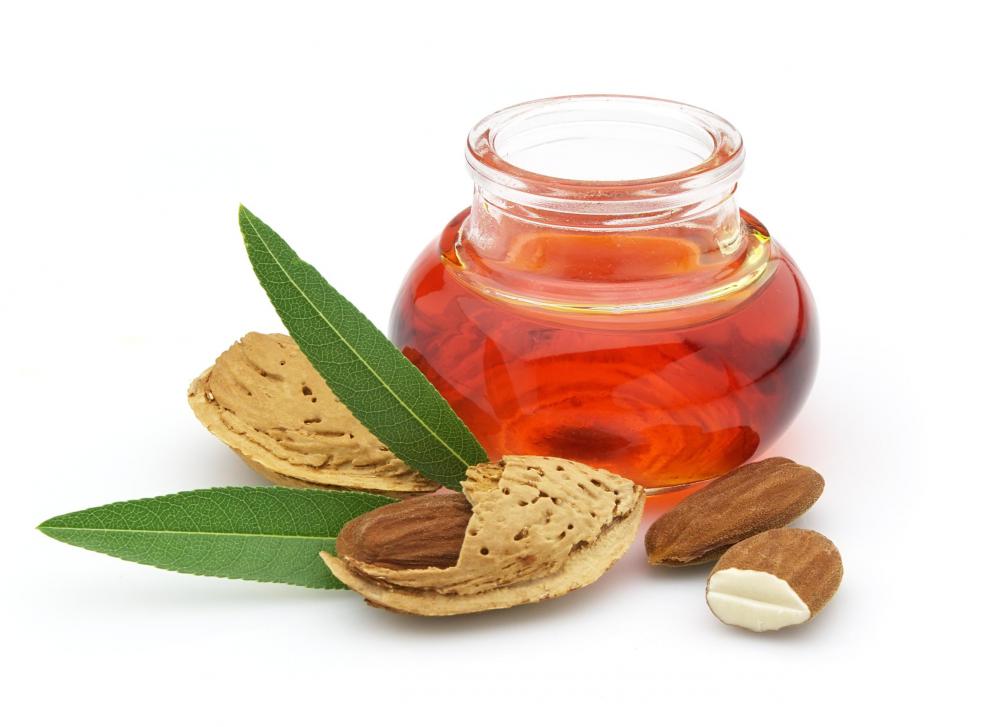
Almond oil has a number of benefits, most of them cosmetic; it is perhaps most commonly used as a moisturizer for both skin and hair, but also has antimicrobial properties, which makes it suitable for use as a healing agent as well. It can also be rubbed into the skin to aid in muscular pain relief or diffused into a room as aromatherapy, mainly to promote a sense of calm and wellbeing. The specifics of use often depend on the type of oil being used, namely sweet or bitter. Each comes from a different variety of almond tree, and in most cases the oils aren’t interchangeable. They aren’t always safe for all people, either, and should usually be used only after a bit of research to avoid allergic reactions or interactions with medications or other natural supplements.
Differentiating Available Types

In general there are two primary types of almond oil. Sweet almond oil is most common for use in cosmetics and skin and hair care, and comes from the blossoms and nuts of the amygdalus variety of almond tree, which is usually the type cultivated for human consumption. Bitter almond oil, by contrast, is from the amara variety of tree. This tree also produces nuts, but they tend to be smaller and aren’t normally sold commercially the way sweet almonds are. The oil is typically more concentrated and is most commonly used in essential oils for aromatherapy and medicinal uses.
As a Skin Moisturizer

Sweet almond oil is a natural moisturizer that can be used topically to treat dry and flaky skin, and because it is easily absorbed by the top layer of the skin it’s often used as lubricating massage oil. It tends to be rather heavy, but it is a natural emollient that is not very greasy and is quickly absorbed. This rapid absorption is key in helping to repair dry, cracked or flaky skin and in smoothing patches of hardened skin, particularly on the elbows, heels, and knees. When used regularly as a moisturizer, it makes skin soft and supple, and it has been found to be a soothing agent for various skin inflammations. It can also be used to reduce the appearance of dark circles under the eyes. Gently rubbing a drop of almond oil under each eye at night will rehydrate the delicate skin and reduce puffiness.

A related benefit of almond oil concerns medical problems with the skin. Sweet versions have been used since ancient times for the treatment of chronic dry skin conditions such as eczema or psoriasis. Two plant-derived compounds in almond oil, oleic acid and ursolic acid, are known to have anti-inflammatory properties and a restorative healing effect on the outer layer of skin. It is also rich in the skin-nourishing vitamins A and E, as well as in vitamins B1, B2 and B6, so it is prominent in many soaps and beauty products, particularly moisturizers.
For the Hair

The benefits of almond oil for the hair are almost as numerous as those for the skin. Besides helping dry and brittle hair to become thicker and stronger with its moisturizing properties, almond oil nourishes hair cuticles and adds a healthy sheen to even the dullest hair. It’s also a good cleansing agent for hair and can help support healthy hair and a healthy scalp. The regular use of almond oil as a scalp lubricant has even been found to facilitate hair growth.
Antimicrobial Properties

Almond oil has natural antimicrobial properties and can be used to treat minor wounds, sunburn, and infections. In addition to helping ward off infection, it can help moisturize the skin and thus help in the body’s natural regeneration process. It’s also a common ingredient in products designed to relieve acne since it can help stop the spread of bacterial infections that are so often the cause.
Muscular Pain Relief
Rubbing almond oil directly onto the skin has also been shown to provide relief from mild muscular pain. Its rich emollient qualities allow it to penetrate deep below the surface of the skin and, with the right pressure and with sustained application, can help release tension and promote relaxation of muscular fibers. Almond oil is similar to olive oil in its makeup of essential fatty acids, monounsaturated fats and omega-3. As such, it’s often used as a substitute in salad dressings and recipes that require oil, such as stir-fry dishes.
Aromatherapy
Of the two types of almond oil, only bitter almond oil is an essential oil — sweet almond oil is a base, or carrier, oil. Base oils don’t normally do well in diffusers since they aren’t as concentrated. Bitter almond oil is common in aromatherapy, whether in diffusers or sprays, and is often said to promote a sense of calm and reinvigoration.
AS FEATURED ON:
AS FEATURED ON:


-
![Shelled and whole almonds.]() By: ElenathewiseShelled and whole almonds.
By: ElenathewiseShelled and whole almonds. -
![Almond oil can be found in many skin care products.]() By: picsfiveAlmond oil can be found in many skin care products.
By: picsfiveAlmond oil can be found in many skin care products. -
![Almond oil can be used to make hair thicker and stronger.]() By: DionisveraAlmond oil can be used to make hair thicker and stronger.
By: DionisveraAlmond oil can be used to make hair thicker and stronger. -
![The benefits of almond oil for the skin extend to treating dark circles under eyes.]() By: WONG SZE FEIThe benefits of almond oil for the skin extend to treating dark circles under eyes.
By: WONG SZE FEIThe benefits of almond oil for the skin extend to treating dark circles under eyes. -
![Sweet almond oil may be used during aromatherapy.]() By: luigi giordanoSweet almond oil may be used during aromatherapy.
By: luigi giordanoSweet almond oil may be used during aromatherapy.




Discussion Comments
I use an all natural diaper rash cream for my daughter and the main ingredients are almond oil and lanolin. Not only does the almond oil make the cream smell wonderful, but it's also very moisturizing and soothing for skin. The almond oil moisturizes and the lanolin creates a barrier on skin to keep her bottom dry. My daughter has not had a diaper rash since using this product.
I actually used the diaper rash on my face a few times just out of curiosity and it made my face really soft and supple too!
@fBoyle-- That makes sense actually because women in India use almond oil to make kajal (eye liner). I suppose it's because of the benefits of almond oil for eyelashes. I make kajal myself as well but I make it with olive oil. I will use almond oil next time.
I've been using almond oil for years as a natural eye makeup remover. It works great and it's very beneficial for the eyelashes. It can promote eyelash growth.
I pour some of the oil on a cotton ball and wipe off my eye makeup. Too little oil doesn't remove enough makeup and too much can cause some of the oil to go into the eye. But one gets a hang of it after several uses.
Almond oil removes makeup better than many makeup removers I have used. The best part about it is that it's completely natural. It's also nourishing for skin and eyelashes.
Post your comments