
At WiseGEEK, we're committed to delivering accurate, trustworthy information. Our expert-authored content is rigorously fact-checked and sourced from credible authorities. Discover how we uphold the highest standards in providing you with reliable knowledge.
What are Tension Headaches?
 Mary McMahon
Mary McMahon
Mary McMahon
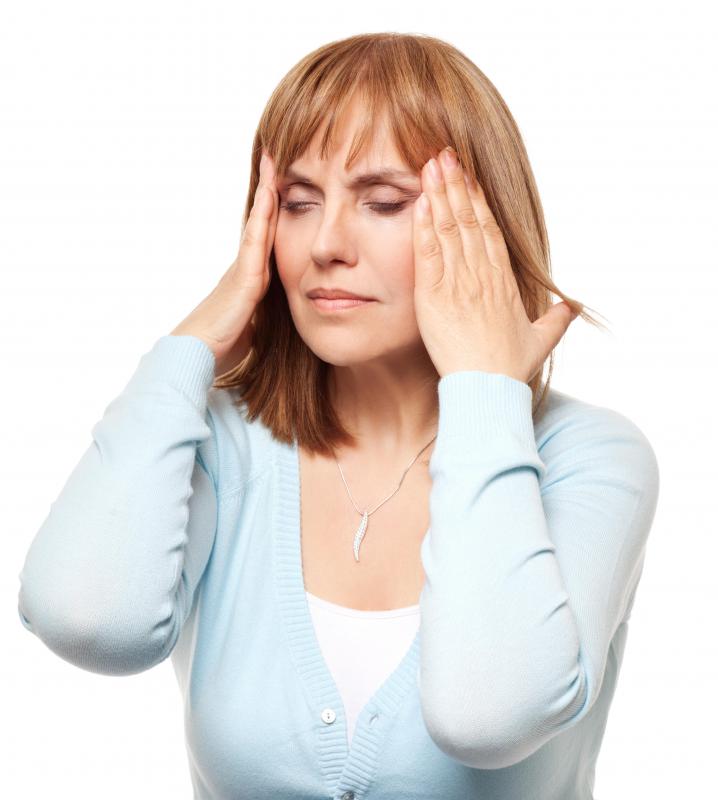
Tension headaches are the most common type of headache, and many people will experience at least one during their lifetime. More irritating than debilitating, they can take chronic or episodic forms. The exact cause of this type of headache is not understood, but there are a variety of techniques that can be used to prevent and treat them. In rare instances, tension headaches may indicate the need for medical attention.
It is believed that tension headaches form because of muscle tension around the head. They are usually termed tension-type headaches, however, because this explanation may not be fully correct. As a general rule, someone suffering from one experiences a sensation of tightness around the head and face, and sometimes pain will migrate to the back of the neck as well. The pain generally takes the form of a dull ache across the head.

When someone experiences frequent tension headaches, they are classified as chronic. Persistent headaches are an indicator that a patient needs to visit a medical professional. He or she may be able to help the patient establish triggers for the headaches, so that they can be avoided. In some cases, medication may be prescribed to prevent their onset or to treat the pain once they appear. Biofeedback therapy is also used to treat this type of headache. In biofeedback therapy, the patient works with a practitioner to listen to his or her body, attempting to correct the imbalance which may be leading to pain.

Episodic tension headaches can be treated with over-the-counter painkillers, such as aspirin. People can also find relief through taking a warm shower, lying down in a cool room, exercising, or participating in another activity that reduces the pain. These activities vary on an individual basis, and it may take some experimentation to find one which works. Some patients also find that consulting with a headache specialist yields useful techniques for dealing with the condition.

In addition to treating the pain of tension headaches when they happen, patients can also make lifestyle changes to reduce their frequency. Eating well and sleeping well appear to help with headaches and a number of other health problems. Exercising on a regular basis and reducing stress and tension in the patient's life may also prevent headaches from developing. Certain foods may increase the likelihood of tension headaches, including caffeine, and an elimination diet may help to find other trigger foods.
Mary McMahon
Ever since she began contributing to the site several years ago, Mary has embraced the exciting challenge of being a WiseGEEK researcher and writer. Mary has a liberal arts degree from Goddard College and spends her free time reading, cooking, and exploring the great outdoors.
Learn more...
Mary McMahon
Ever since she began contributing to the site several years ago, Mary has embraced the exciting challenge of being a WiseGEEK researcher and writer. Mary has a liberal arts degree from Goddard College and spends her free time reading, cooking, and exploring the great outdoors.
Learn more...AS FEATURED ON:
AS FEATURED ON:









-
![Aspirin is sometimes used to relieve a tension headache.]() By: blueskies9Aspirin is sometimes used to relieve a tension headache.
By: blueskies9Aspirin is sometimes used to relieve a tension headache. -
![Tension headaches are believed to form as a result of muscle tension around the head.]() By: Ana Blazic PavlovicTension headaches are believed to form as a result of muscle tension around the head.
By: Ana Blazic PavlovicTension headaches are believed to form as a result of muscle tension around the head. -
![Tight scalp or neck muscles can sometimes cause tension headaches.]() By: vladimirfloydTight scalp or neck muscles can sometimes cause tension headaches.
By: vladimirfloydTight scalp or neck muscles can sometimes cause tension headaches. -
![Lifestyle changes may help reduce the frequency of tension headaches.]() By: lightwavemediaLifestyle changes may help reduce the frequency of tension headaches.
By: lightwavemediaLifestyle changes may help reduce the frequency of tension headaches.



Discussion Comments
@simrin-- Do you feel as though something is putting pressure on your head? Do you get pain around the temples often? Does stress trigger it?
If so, it's probably tension headaches. I get them when I'm anxious, worried and stressed. Of course, you should see your doctor to make sure that you are otherwise healthy.
You can try some breathing exercises and meditation to relieve the stress. I've also heard that acupuncture is very effective for constant tension headaches.
I'm not one hundred percent sure but I think I have chronic tension headaches. The description in this article matches what I have.
I get it everyday. Sometimes I wake up with it, other times it develops around noon. Sometimes it's in the front of my head, sometimes in the back. Once in a while, it also feels as if the headache is inside my ears.
I haven't figured out what's triggering them. I don't avoid caffeine because sometimes that reduces my headaches. I still haven't seen a doctor, I suppose I will soon if this continues.
Post your comments