
At TheHealthBoard, we're committed to delivering accurate, trustworthy information. Our expert-authored content is rigorously fact-checked and sourced from credible authorities. Discover how we uphold the highest standards in providing you with reliable knowledge.
What are Symptoms of Adenitis?
 Tricia Christensen
Tricia Christensen
Tricia Christensen
Adenitis results in swelling of the lymph nodes, and is classed by type. Although most people know that there are lymph nodes in the neck and groin, they are actually found throughout the rest of the body. The main symptoms of this condition, wherever it occurs, are pain and possibly drainage from the swelling.
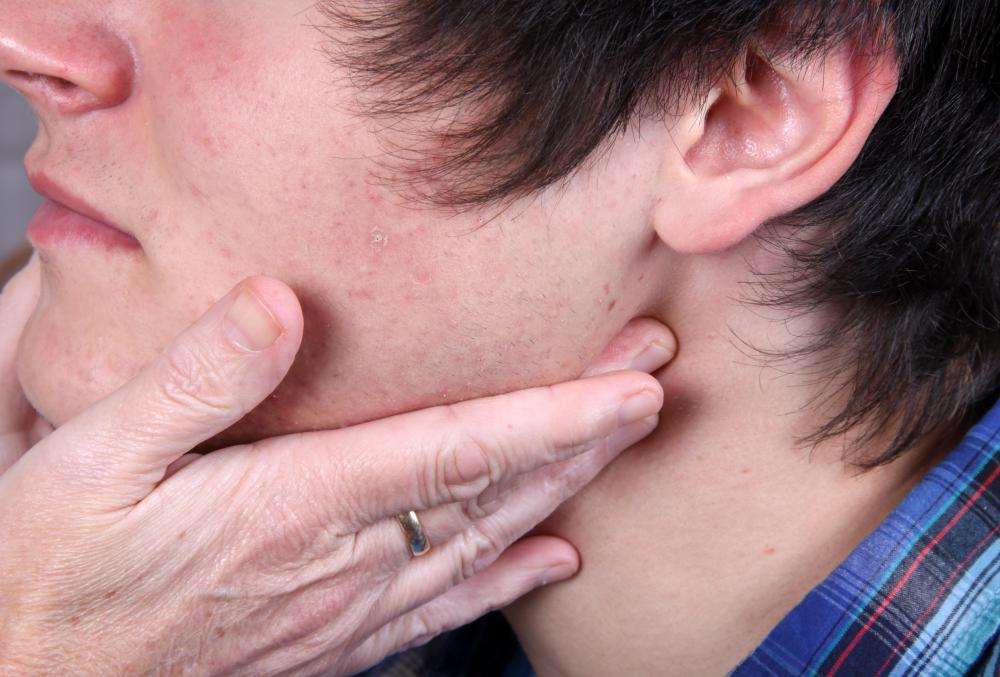
Cervical adenitis refers to a lymph node or nodes in the neck that have become swollen. It is usually caused by bacteria and results in a very painful lump in the neck. The patient usually has a fever, and the node may appear as a red mass or feel very hot to the touch.

Mesenteric adenitis is swelling of one or more lymph nodes on the right side of the abdomen, usually above the appendix. Often, only one lymph node is affected. Bacterial or viral infection causes the swelling, which is often accompanied by fever. This type results in so much pain that it is frequently mistaken for appendicitis, and an accurate diagnosis may not be made until after a surgeon has removed a healthy appendix. Even ultrasound may mistake this condition for appendicitis, since the swollen lymph node can make the appendix appear compromised. Unlike appendicitis, however, the problem will generally resolve with antibiotic treatment if caused by bacteria.

Sebaceous adenitis affects the skin and typically causes the sebaceous glands to swell. This condition is also frequently noted in certain breeds of dogs, like the Akita. Sebaceous glands produce oil and keep skin lubricated, but in people with this condition, these glands become blocked and result in what appears to be skin eruptions. They are frequently noted on the face. Cyclosporine, an antibiotic, often helps resolve the condition.

Tuberculosis adenitis, also called scrofula, also affects the skin and particularly the lymph nodes around the neck. It can be easily diagnosed by testing for the presence of tuberculosis, and since this illness is now relatively rare, this condition is as well. Symptoms usually include one or more masses at the neck, fever, chills, and weight loss, although if left untreated, it can progress to open sores. Treatment involves antibiotics and may also necessitate removal of one or more affected lymph nodes since the swelling can damage nerves in the face. Recovery rates from this complication of tuberculosis are high, and in most cases, the condition will not recur.

Lymphadenitis may refer to any one gland affected by bacteria, but the lymph nodes most often affected include those in the groin and in the armpits. Antibiotic treatment usually cures this form. If the swelling in a lymph node is caused by the abnormal growth of cells, this may be called lymphadenopathy. This may be caused by Hodgkin’s lymphoma, and is also a symptom of cutaneous anthrax.
Anyone suspecting adenitis or lymphadenopathy should see a medical professional to determine what's causing it and best method of treatment. As well, since medical professionals now suspect that about 10% of cases of appendicitis are actually mesenteric adenitis, inquiring about this possibility may be of use in diagnosis of either condition.
Tricia Christensen
Tricia has a Literature degree from Sonoma State University and has been a frequent TheHealthBoard contributor for many years. She is especially passionate about reading and writing, although her other interests include medicine, art, film, history, politics, ethics, and religion. Tricia lives in Northern California and is currently working on her first novel.
Learn more...
Tricia Christensen
Tricia has a Literature degree from Sonoma State University and has been a frequent TheHealthBoard contributor for many years. She is especially passionate about reading and writing, although her other interests include medicine, art, film, history, politics, ethics, and religion. Tricia lives in Northern California and is currently working on her first novel.
Learn more...AS FEATURED ON:
AS FEATURED ON:


-
![Cervical adenitis refers to lymph nodes in the neck which have become swollen.]() By: Klaus EppeleCervical adenitis refers to lymph nodes in the neck which have become swollen.
By: Klaus EppeleCervical adenitis refers to lymph nodes in the neck which have become swollen. -
![People with cervical or mesenteric adenitis usually experience fever and inflammation.]() By: Ocskay BencePeople with cervical or mesenteric adenitis usually experience fever and inflammation.
By: Ocskay BencePeople with cervical or mesenteric adenitis usually experience fever and inflammation. -
![Symptoms of adenitis may include chills.]() By: Tatyana GladskihSymptoms of adenitis may include chills.
By: Tatyana GladskihSymptoms of adenitis may include chills. -
![Surgery may be required to treat adenitis.]() By: Brian EnrightSurgery may be required to treat adenitis.
By: Brian EnrightSurgery may be required to treat adenitis.


Discussion Comments
I had right cervical lymph nodes. I went through surgery and six months of medication. Now I am fine. Once you start TB medicine, please don't discontinue it. You should complete the course. Only then will you be cured.
I have this adentis thing and it's really painful! Constant pains in your stomach can really drive you nuts! I'm 15, and I've had it for the past three days. The pain has eased off a little less since I first got it, but it's still really painful! Does anybody know how long this roughly lasts?
My name is jass. i had ome kind of skin roughness in my knees. once i had it checked and the doctor said it is tuberculosis. he gave me medicine but i took it for only one month. now i am OK but my face is gone so inside i started doubting. maybe it is due to that. please advise. I'm so much confused. please help me.
how many months does it take for TB adenitis to be cured?
why is adentis related to tuberculosis? what is the exact pathway or pathophysiology? what are the causes and treatment?
what is its pathophysiology of TB Adenitis?
My little girl has mesenteric adenitis and she is in so much pain. It's driving me crazy. How long does it last? It's been 5 days.
I have solid kind of bulging just below my neck. Doctor said it is Tuberculosis Adenitis. I just want to know how dangerous it is? My wife is very worried about it.
anon 090208, My son has been diagnosed as having mesenterric adenitis, and we were wondering how long this can last. He isn't on any antibiotics, and it seems to go away for a few days and comes back again. Very painful and now
he also has a fever, whereas 2 weeks ago and 4 weeks ago he did not.
My 64 year. old husband is in the hospital with high fever and lower right quadrant abdominal pain. He has been on morphine, tylenol and antibiotics for two days. The doctors can't agree on a diagnosis. Two say it's appendicitis and one says it is Mesenteric Adenitis. His fever is down today and his white blood cell count is also down, but he still has pain. What say you? Roberta
To Anon13539
A simple answer to the question of what causes tb adenitis is that it can be caused by people who are infected with tuberculosis. This is why people in most advanced cultures undergo TB testing to check for exposure. Tuberculosis is fairly easy to detect by symptoms, and most cases can be resolved with antibiotics long before scrofula occurs.
what are the causes of tb adenitis? how can we prevent tb adenitis? how can we detect tb adenitis?
How does someone contract mesenteric adenitis? How
does it affect you if not treated?
where do we get tb adenitis? what is its pathophysiology? what are the treatments and how long? why is sign and symptoms are same as SLE?
Post your comments