
At DelightedCooking, we're committed to delivering accurate, trustworthy information. Our expert-authored content is rigorously fact-checked and sourced from credible authorities. Discover how we uphold the highest standards in providing you with reliable knowledge.
What are Some Types of Squash?
 Mary McMahon
Mary McMahon
Mary McMahon
Squash is a generic name for plants in the gourd family. All of these plants have soft flesh surrounding a seeded core, and many have hard skins. There are a dazzling array of edible varieties, which fall into the categories of summer and winter. All squashes are equally delicious, and they have myriad uses depending on the type and the goals of the cook. Members of this family range from the humble zucchini to the stringy spaghetti squash, two familiar examples of summer and winter varieties, respectively.
Summer varieties tend to mature more quickly than winter types and typically have a thinner skin. They are tossed with pasta and salads, eaten with stir fries, and turned into chutneys. Some can be eaten raw and appears on vegetable platters. Summer squash is usually planted in the early spring for maturity in early summer and can be eaten through the summer.

Winter squash, planted somewhat later than summer varieties, mature much later, in the early fall. They have a much firmer skin, more like a rind, and it is not edible raw. These varieties tend to keep well, and they can be stored in a cool dry place over the winter. It is excellent roasted, added to soups and stews, and mashed. Many people also enjoy pumpkin pie, a classic winter squash food.
The flowers of both types are edible and delicious. Many Italian restaurants offer fried squash blossom, and it also appears mixed in with pastas and salads. These blossoms have a rich, delicate flavor that is quite pleasing to the tongue.

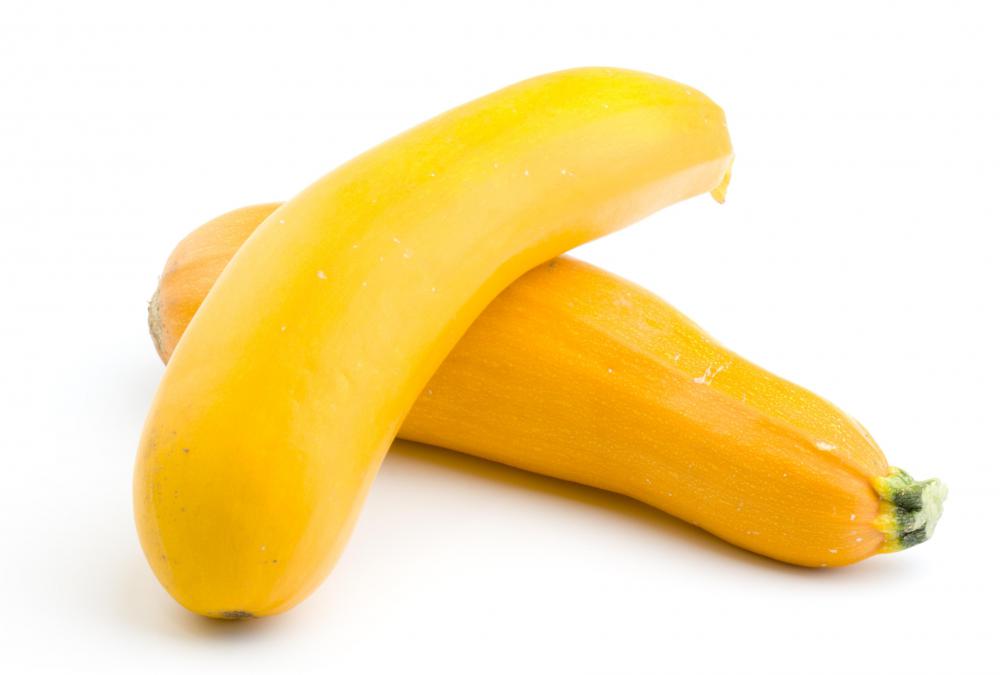
One common summer variety is the zucchini, a dark green, club-like vegetable that proliferates in most gardens. Yellow crookneck, another summer variety, ranges from very small and tender to much larger and woodier varieties, which should be roasted. Summer varieties will become woody and lose flavor if left on the vine too long, so it is better to select small, firm vegetables without bruising and discoloration in the grocery store.

Winter varieties are much more varied and provide a fun assembly of vegetables to eat in the otherwise gloomy winter. Spaghetti squash is yellow in color and oblong. When cooked, it separates into noodle-like threads that give the plant its name. Acorn squash is green and acorn shaped, and absolutely delectable roasted with a sprinkling of brown sugar and goat cheese. Banana squash is also roughly oblong and has a rich, sweet, yellow fruit.
Butternut squash is another common winter variety. It is light brown in color and resembles a vase, with striking orange flesh. This gourd is round and ranges from dark green to rich red in color, with tender, sweet flesh.

Delicata squash is corrugated and oblong, with streaks of yellow and green. The flesh is extremely sweet and tender when cooked, somewhat like sweet potatoes. Gold nugget looks like a pumpkin, bit it lacks the characteristic pumpkin color and is usually very small. Hubbard squash is a roughly shaped, lumpy variety, ranging from grey to green in color with moist yellow flesh.

To quickly prepare any winter variety, heat the oven to 350° Fahrenheit (177° Celsius) and slice the squash lengthwise. Put it face down in a pan with approximately 1 inch (2.5 centimeters) of water and roast until the flesh yields to a fork, which may take 35 to 70 minutes, depending on the type and size. Drain the pan and flip the squash face up for five to ten minutes to finish, serving with butter and salt.
Mary McMahon
Ever since she began contributing to the site several years ago, Mary has embraced the exciting challenge of being a DelightedCooking researcher and writer. Mary has a liberal arts degree from Goddard College and spends her free time reading, cooking, and exploring the great outdoors.
Learn more...
Mary McMahon
Ever since she began contributing to the site several years ago, Mary has embraced the exciting challenge of being a DelightedCooking researcher and writer. Mary has a liberal arts degree from Goddard College and spends her free time reading, cooking, and exploring the great outdoors.
Learn more...AS FEATURED ON:
AS FEATURED ON:


-
![Hubbard squash.]() By: PaulOFHubbard squash.
By: PaulOFHubbard squash. -
![Yellow squash is a very popular type of squash.]() By: web2000raYellow squash is a very popular type of squash.
By: web2000raYellow squash is a very popular type of squash. -
![Crookneck squash is a summer squash that has a crooked shape and yellow rind.]() By: zigzagmtartCrookneck squash is a summer squash that has a crooked shape and yellow rind.
By: zigzagmtartCrookneck squash is a summer squash that has a crooked shape and yellow rind. -
![The opo squash is can be identified by pale green or yellowing skin that is smooth to the touch.]() By: jiggoThe opo squash is can be identified by pale green or yellowing skin that is smooth to the touch.
By: jiggoThe opo squash is can be identified by pale green or yellowing skin that is smooth to the touch. -
![Spaghetti squash can be eaten like regular spaghetti.]() By: ollySpaghetti squash can be eaten like regular spaghetti.
By: ollySpaghetti squash can be eaten like regular spaghetti.



Discussion Comments
Butternut squash is my favorite type of winter squash. They are very mild, but sweet. You can make butternut squash into savory dishes or sweet dishes, and they can compliment many different foods well. They also store for quite a while, and they are loaded with nutrients.
Great article - I especially like the distinction between summer and winter squashes because it's very true. I like them both in different ways - summer squash is lighter while winter squash is heartier.
Post your comments