
At TheHealthBoard, we're committed to delivering accurate, trustworthy information. Our expert-authored content is rigorously fact-checked and sourced from credible authorities. Discover how we uphold the highest standards in providing you with reliable knowledge.
What are Some Rare Blood Types?
 Mary McMahon
Mary McMahon
Mary McMahon
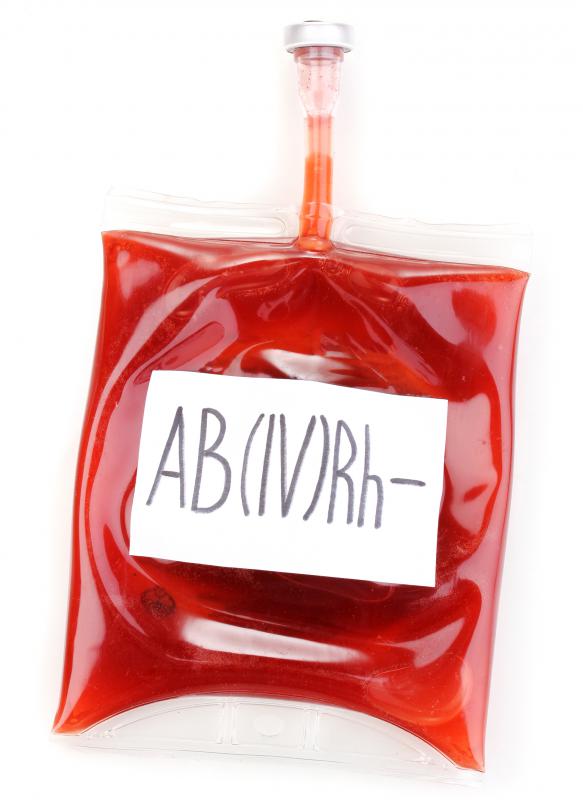
Within the ABO/Rhesus Group systems which are used to classify most blood types, there are several rare blood types. The rarest is AB-, with less than one percent of the world's population having this blood type. B- and O- are also very rare, each accounting for less than 5% of the world's population. However, there are over 30 recognized blood typing systems beyond these basic two, creating a plethora of rare blood types, some of which appear only in a handful of people.
Blood type is determined by the presence of certain antigens in the blood. The A and B antigens are very common, making it easy to classify people by which antigen they have, while people with Type O blood have neither antigen. The negative or positive symbol after the blood type indicates the presence or lack thereof of the Rhesus Factor. However, other antigens beyond A and B can be present, and these antigens can react with blood from certain donors. Someone with a rare blood type might appear, for example, to be A+, but he or she might lack another antigen, which could cause a bad reaction with A+ donor blood which contained that antigen.

People in the Bombay Blood Group lack A and B antigens, which would normally place them in the O grouping, except that they lack H antigen, a substance present in people with Type O blood. This means that if they are infused with blood from an O donor, they can get sick. This blood type is also referred to as the “hh Blood Group,” and it is named for the region of India where it was discovered.

Some of the other antigens used in blood typing include: D Factor, C Factor, E Factor, M Factor, S Factor, Le(a) Factor, K Factor, Fy(a) Factor, Jk(b) Factor, and Fy(b) Factor, among others. This means that someone could have a blood type such as AB-: Fy(b)-, K-. If blood from an AB- negative donor which contained the K Factor was transfused, this person could experience a reaction. Sometimes, these factors are referred to with names, as in “Duffy Negative” for people who lack Fy(a) and Fy(b), referencing a specific patient who first exhibited the trait.

Blood type is an inherited trait, and many rare blood types are found in specific communities and ethnic groups. African-Americans, for example, are more at risk of being Duffy Negative. This is why it is important for people from all ethnic groups to donate blood, to increase the probability of finding a matching donor. When blood from more than 200 donors must be screened to find a match for a patient, that patient has a blood type which is considered rare, but some people with rare blood types would be lucky to find blood which matched theirs in one of 200 donations. Some people with rare blood types bank their own blood in advance of surgical procedures to ensure that blood is available to them.
Mary McMahon
Ever since she began contributing to the site several years ago, Mary has embraced the exciting challenge of being a TheHealthBoard researcher and writer. Mary has a liberal arts degree from Goddard College and spends her free time reading, cooking, and exploring the great outdoors.
Learn more...
Mary McMahon
Ever since she began contributing to the site several years ago, Mary has embraced the exciting challenge of being a TheHealthBoard researcher and writer. Mary has a liberal arts degree from Goddard College and spends her free time reading, cooking, and exploring the great outdoors.
Learn more...AS FEATURED ON:
AS FEATURED ON:


-
![AB- is the rarest blood type.]() By: Africa StudioAB- is the rarest blood type.
By: Africa StudioAB- is the rarest blood type. -
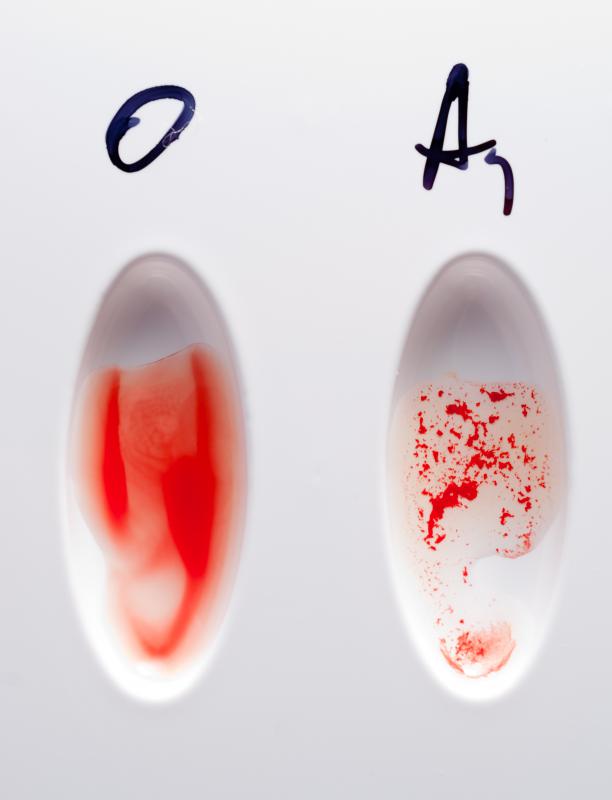
![Two types of blood on a blood typing test card.]() By: lkordelaTwo types of blood on a blood typing test card.
By: lkordelaTwo types of blood on a blood typing test card. -
![Red blood cells.]() By: Monika 3 Steps AheadRed blood cells.
By: Monika 3 Steps AheadRed blood cells. -
![The Rhesus Factor set of blood types.]() By: Maxim PavlovThe Rhesus Factor set of blood types.
By: Maxim PavlovThe Rhesus Factor set of blood types. -
![Type O blood does not have A or B antigens.]() By: dazzi-bType O blood does not have A or B antigens.
By: dazzi-bType O blood does not have A or B antigens. -
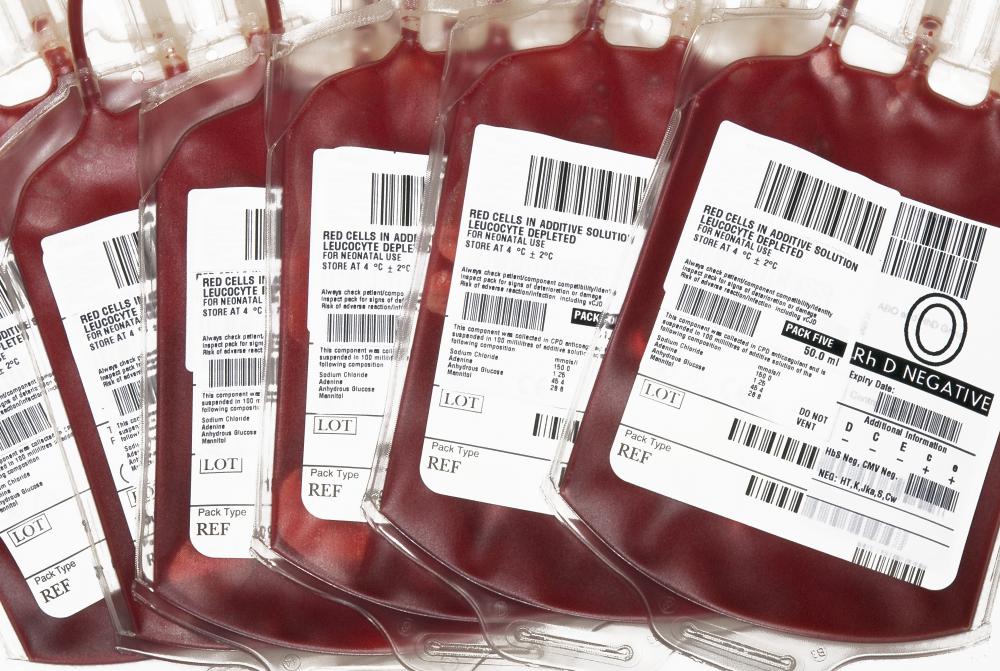
![People with rare blood types often bank their blood ahead of surgical procedures.]() By: kastoPeople with rare blood types often bank their blood ahead of surgical procedures.
By: kastoPeople with rare blood types often bank their blood ahead of surgical procedures.



Discussion Comments
I am O+ my husband is AB+. One of my boys has B+ and my youngest has A+.
I have A- blood type. My husband is A+. My pregnancies were always stressful in the beginning because I had spotting during the entire first and second trimesters, and needed RhoGam shots. We had two daughters; one is A- and the other is O-. I ended up not needed the final RhoGam shot after their births because they were both negative.
I'm 15, but when I'm old enough, I'm going to give blood because I'm AB-. I only know that because when I was little, I had to have a blood transfusion because I didn't have enough blood and I had a hole in my heart that didn't close up. Every baby is born with a hole in their heart and over 24 hours it closes up, but mine didn't close up so they had to put a metal thing over it which is called an umbrella or something. So I know I'm AB- which is very rare. Only one out of every 100 people have AB-.
I have type o+ and my wife is also o+. Is it possible that our baby can have another type?
Please explain the Kfactor to me? What causes a person to have K factor in their blood? My dad has the K factor! Could I also carry it? My mom is o- and my dad o+ with k factor. My grandparents are deceased. Is it possible that my grandmother had miscarriage years ago causing the development of K factor? I am O negative.
My dad is o+ and my mom is ab+. My sister is b+ and my brothers are a+ and I'm ab+. Is that weird?
I have rh negative. I don't know anyone with it.
One reason there is a lot of confusion about kids and parents having impossible blood types is that the parents don't correctly know their blood type.
I was in the same case. I am AB+ and my mom was B+ with B+ and O+ daughters from another marriage. However, my father always said/thought he was O. This led me to think he was not my father when I finally knew my blood type. But, due to improper quick tests, like sometimes done at health fairs, I'm sure there are many who don't know their real type. Also upon quick testing, sometimes there just might be weak reactions that aren't noticed in time for a correct result.
So, when my dad was in the hospital, I saw with my own eyes he had A+ blood. No search for a real father was needed and I believed my mom. So, since I know both halves of my blood types, I cannot father O kids. The fake reasons given for impossible results being possible are so that people don't freak out. And basically, whoever raises you are your real parents, even if not biological.
I am of blood group A+, wife wife has blood group O+, but our son is O- with a full G6PD defect. What happened?
I have O negative blood. Is that bad?
I have blood type ab+, is that rare?
Dad is B+, and Mom is O+. One child is O+ and one is B+. Is that possible?
My dad is O and my mom is AB. I am AB so does that mean that I am adopted?
I am curious about this that RH positive people have a rhesus monkey gene. That means Darwin's Theory is correct. But I know all human beings from Adam and Eve according to three major religions Jewish, Christian and Muslim. I am AB negative.
I have A- blood type but I don't know if that is rare. Could someone tell me please?
I am very concerned. I live in a small town in Colorado where the nearby hospitals have doctors who will not listen to what their patients have to say. I am 10 week pregnant and have had my blood typed three different times recently.
About 10 years ago, I donated blood at a college blood drive and was typed O+, which is what my dad's dog tags say that he was as well, but when I was in the ER four weeks ago for spotting they typed me as O-. First off, my grandma has O- blood, so I'm not surprised and wouldn't have given it another thought, but since I had been previously typed, I was worried. They typed me two times in the ER that night and gave me the Rhogam shot.
The next week, I contacted my OBGYN and he insisted that we do a third blood type test, which resulted in O-.
Last week, I had my first OB appointment, and while the doc was looking back through my chart found that they had typed me during my first pregnancy as O+ in January of 08.
I called the hospital's lab and the pathologist called me back with this explanation.
He said that I have O positive blood sometimes and O negative blood others. (I have never heard of this). He said that sometimes when they type my blood that the secondary RH factor test they do was showing "D" antigens much stronger at sometimes and much weaker at others, accounting for sometimes my RH factor is positive and sometimes it's negative.
I don't understand what is going on and I have had a few people tell me that I am a chimera blood type. Can anyone answer my questions? Does anyone have any idea about who I should contact? I'm pregnant and don't want anything to happen to my baby so any ideas or thoughts would be greatly appreciated.
I have - with RH.- Should I donate for myself?
A and B are recessive. So your grandparents' blood type play a factor as well. If both parents were ab+ then one of your grandparents was o-.
I may be the family secret! I am 52 years old and the the "Eat right for your Type" book became a crusade for my sister! My Mom is B and my Dad is O. I am the only on in seven children to have ab+ I am sitting here in a panic crying my eyes out. Someone, please tell me I am a mutant!
I always thought I was O+, but several years ago, I gave birth to my second child, who ended up in NICU with hemolytic disease due to anti-Kidd(JKa) in my blood. My doctor knew about it but was completely unprepared for the outcome.
Was there anything he could/should have done to prevent that? And what blood type do I say I have now?
To anyone with AB- or O- or any rare blood type, to ease your worry, you should immediately have some of your blood taken and stored at your local hospital for yourself, just in case! (Hopefully, you already do!)
To post #32: You are incorrect. An AB parent *can* have an O child, regardless of the second parent'a blood type.
Feel free to reread the above article and pay special attention to the Bombay Type Blood Group. There is also the possibility of Chimera, where the AB parent absorbed a twin in utero thereby making them an AB/O.
I know this for a fact. My mother is an AB-, my father is O+. There are six children. One sister is A+, one brother is A-, three sisters are O+, one unknown. Yes, they are our biological parents. No, my mother did not take the Rh factor injection and no miscarriages.
I have b- blood, my mom is o- and dad is a+, and I have nine other brothers and sisters from same parents and some have b blood and one has ab blood. There was no cheating. Could there be a mutation in our genes?
is b + rare because i feel so special to have it? my boyfriend wants to know if ABCD+ is rare?
ABO blood typing is not sufficient to prove or disprove paternity or maternity. There are always exceptions. if you question whether your parents are yours or not, get tested; don't base it off of your blood types.
I have a rare blood group: ADU. My doctor couldn't say much about it except to put me on a vegetarian diet. I am an African in Southern Africa, black African. Anyone with info, please assist.
i just figured that i have AB- blood type and I'm so worried because it's very, very rare!
My mom is A- my dad is At> I am O- is that possible?
To poster #38, actually *you* are incorrect and I know this from personal experience. Although it is rare, an RH- mother with an RH+ father can have issues with an RH+ child/1st pregnancy. The reason being, any time during the pregnancy if the mother comes in contact with the baby's blood (random bleeding, trauma, etc.), thereby exposing her to the RH+ blood, she can develop D antibodies.
I am RH- (lack the D antigen) and lack the C antigen. Unfortunately, my husband is RH+ (has D antigen) and has the C antigen. When I bled during the beginning of my pregnancy (my first pregnancy) my blood came in contact with the baby's and I created C antibodies. Fortunately, I took Rhogam which prevents creating D antibodies but in essence, it is the same thing, just a different antibody.
In summary, although rare - completely plausible for a mother to become "sensitized" during her first pregnancy.
i have O-ve blood group. i am male. sir, i want to know is there any problem for me to marry with a girl of different blood group or same blood group.
I have o+ para bombay. I found out I had it 13 years ago. Not many people have heard of it and we don't know how I got it. No one in my family has it and all three of my kids don't. I donate blood and have it stored for myself in case something happens. It has not changed my life. It is just very important to donate for yourself. I hope this will help.
the american red cross sent me a letter a few years ago saying i have the little e factor and they can save parts of my blood to give to people for up to ten years and my factor is rare. it is hard to find things out about this factor. anyone want to help me?
AB- is the rarest blood group in world even rarer than o-
What, exactly is the "K" factor? Both my husband and I are O negs, as is our daughter(as if she had a choice).
I do know my dad was an Oneg,but I'm a bit stumped with my mother and sibs. Mum is deceased, but in the 50's she had a miscarriage which resulted in a direct transfusion, and in the 1970's when I queried her about her blood type she mentioned that she had a "k" type which I know doesn't exist.
To poster #32: This is incorrect. Problems can arise with the second, not the first child. If the first child is Rh+, the Rh- mother would not have a bad reaction, but would likely develop antibodies against the positive antigen.
If the second child were Rh+, those antibodies would cause a harmful reaction.
This is similar to an allergic reaction. No one is allergic the first time they are stung by a bee/eat a peanut, etc... They develop the allergy after the first (or second or tenth) encounter.
how rare is A2B+ blood type?
To all of those saying they have parents with 'this' blood type and they have 'this' blood type, that is not possible. Perhaps you should be asking your parents if you are either adopted or if your mom slept around.
For those asking how they got their blood type from their parents:
If you are blood type A your alleles will be either AA or AO (as A is dominate); if you are blood type B your alleles will be BB or BO (as B is also dominate); if you are blood type AB you will be AB (as you need both antigens); and if you are blood type O you will be OO (as you lack both antigens).
The inheritance combinations from your parents are therefore as follows:
Mother/Father = Child
O/O = O
O/A = O or A
O/B = O or B
O/AB = A or B
A/O = O or A
A/A = O or A
A/B = O or A or B or AB
A/AB = A or B or AB
B/O = O or B
B/A = A or B
B/B = O or B
B/AB = A or B or AB
AB/O = A or B
AB/A = A or B or AB
AB/B = A or B or AB
AB/AB = A or B or AB
So in other words:
"I have type o- blood type but my parents have ab+ is it possible?" - No
"My dad has o, my mom says she has b. I'm a+. Is that possible?" - No
"I am an AB- but my mother(O-) and father(A+) are different is that possible or is a parent wrong?" - No, a parent is wrong.
"My mom has o- and my dad has o+. Why do I have AB+ and my brother is o+?" - Either your mom or your dad is not correct.
"Mom has B- and dad has AB- i have o+ and my sis has B+ isn't that weird?" Yes, you can't have O+ with those parents.
"Is it possible for parents to have O+ blood group and their child has B+ blood group?" No
You can marry any blood group. Complications can arise however when an Rh+ father and a Rh- mother have their first child, as the mother may react against the Rh+ antigens of the child. This can be resolved however.
I have o- blood type yet both my parents are o+ Is that weird? I only found out recently while I was pregnant and it's been on my mind ever since!
Is it possible for parents to have O+ blood group and their child has B+ blood group?
it is not possible for ab blood to have an o child. forget the rh factor. to anon37942
For all of you saying your parents are AB and you're an O, that's impossible. You'd get an A or B from one parent and an A or B from the other to create your blood type, either A,B or AB. O is recessive so it makes it impossible that AB parents will have an O child.
My blood group is o- and I live in Australia. Only 2 percent of the population are o-.
both my parents have rare blood types. mom has B- and dad has AB- i have o+ and my sis has B+ isn't that weird?
I'll tell you a funny story about blood type. After my son was born and in the baby room he had a card that said, Boy, Kahaly and Mom, A+. I told my husband that the nurses must think I'm doing a good job. Either I'm that dumb or I was on that many drugs! That's how I found out what blood type I was.
I have a+ but I would like to know what is the rarest blood type in the world!
What should I do if I needed blood. My blood type is 0-due+blood? Some doctors never heard of it. one was very upset when she discovered positive blood and negative blood together. I have physical problems I have had since birth. are they a result of this type of blood?
i am looking for information on anyone who has O+ bombay blood. not sure what to do. my sister has it and is in need of answers.
My Father was AB neg, my Mother O pos. As a result, I am B neg, and my sister is A neg. Would it be wise for us to have our blood typed in more detail, in case we should need transfusions at some point?
After a total joint hip replacement where i received donated blood, i was told that factor K was found in my blood. what does this means? i asked several of my doctors and was not to worry about it. I'm not worried, i just what to know what it is.
to person at message 13. o neg can marry anyone; unless your spouse does not want to marry people of that blood type. if you are asking about having a child, there needs to be more info about the male and female blood types.
i have hh (bombay) blood type.
it doesn't matter what blood type you are to marry; your children will inherit one blood group gene from mom and one from dad.
B negative blood is not the most rare type, but it is not the most common either. It isn't that hard to find your blood type, and also you can receive o negative if B's are unavailable.
My mom may have Essential Thrombocythemia. Is there any relationship between this blood disorder and her blood type which characterized as rare. Mi(a)/Vw- positive? Thank you.
I have -a blood. Is that rare?
can o- marry any group?
my phenotype is sc and my blood group is ab positive. what are the implications of this, especially the phenotype?
I give blood regularly and on my donor chart is "RD 12 Rare donor S". What does the RD 12 stand for?
My mom has o- and my dad has o+. Why do I have AB+ and my brother is o+? i'm so confused. tell me someone.
my blood group is B negative. is this a rare blood group and difficult to get?
i am an AB- but my mother(O-) and father(A+) are different is that possible or is a parent wrong?
I've just been tested on what blood type i am and i'm positive for an AB- result. The thing is my sisters also vary in blood types so i was wondering if it's possible or could one of our parents have it wrong?
Would it be recommended to wear a medic alert bracelet with my blood type o- on it? I mean would it really be nessesary? thanks
My dad has o, my mom says she has b. I'm a+. Is that possible?
I've been told by a blood bank, after donating blood, that I have type AB-+ blood. Is this even possible?
yes, that is entirely possiable. because the o- gene is recessive your parents likely missed the cut but the genes are still in them to create the o- blood type. if you are really curious ask about your grandparents and your parents' siblings to see what their blood types are. you'll likely find that there are other family members with o- blood.
I have type o- blood type but my parents have ab+ is it possible?
Post your comments