
At WiseGEEK, we're committed to delivering accurate, trustworthy information. Our expert-authored content is rigorously fact-checked and sourced from credible authorities. Discover how we uphold the highest standards in providing you with reliable knowledge.
What are Some Home Remedies for Warts?
 Tricia Christensen
Tricia Christensen
Tricia Christensen
Warts are annoying and sometimes uncomfortable light colored bumps that appear on the skin. They are caused by a form of papillomavirus, and usually occur when we have a small cut or fissure in the skin that directly exposes us to the virus. They are easier to remove in their earliest stages, but a new skin growth, especially one that exhibits uneven edges should be evaluated by a physician. Some forms of skin cancer resemble warts. If you’ve never had them before, do check out one that suddenly appears to rule out this serious condition.
Once you know that what you have is a wart, there are a number of home methods to remove them. Removal time of many of these home methods can mean several months before you see improvement. This is why many people opt to have them frozen off in a doctor’s office. Since they are contagious, continued contact with them, especially on your hands, may mean new warts.

A few at home methods for wart removal include using vitamins placed over the area. For instance, liquid vitamin A in oil form, or crushed vitamin C may help remove warts quicker. Do not take extra vitamin A orally, instead, merely break capsules and place them on each spot, a couple of times a day. You may also want to cover the warts in between treatments. Vitamin C can be crushed and added to a little water and the acid in it may help remove them. With both of these methods, wart removal time can be short, a couple of weeks if it’s new, or quite long, up to several months.
Some people also suggest rubbing a clove of garlic on each wart several times a day. This is definitely not a recommended treatment for children. Long exposure to the oils in garlic can burn their sensitive skin and cause great discomfort.

One of the most common methods suggested for home removal of warts is securely taping the wart, and keeping it covered at all times. You can use first aid tape or any type of medical tape. Some even recommend duct tape. The tape should be left on all the time, and only should be changed if it starts to loosen, or if it gets really dirty. This may remove the bumps after about three weeks of consistent taping. Some also suggest adding some castor oil prior to taping.

Other methods for removing warts involve numerous over-the-counter treatments, usually containing salicylic acid in varying strengths. Some of these come in tinctures, while others are coated pads with the acid. If you use the pads, you should be certain to cut them to fit the wart precisely, or you can ulcerate and irritate the skin all around it, which might add more warts to your skin. Another remover is an over-the-counter freezing treatment, which can be found in most drug stores.

Companies that make these remedies often claim that a treatment or two will remove most warts two weeks after treatment. Consumer reviews of this product vary. Some complain it is painful, others say it is quite effective. Still others have complained the product won’t work on stubborn ones, like plantar warts (those on the feet).
Whatever method you try, consider keeping an area with warts as dry as possible. Wear shower shoes at home and in public showering areas to keep from spreading them to others. Try to avoid touching the area by keeping it covered. Especially glove up or cover up warts if you need to care for others, like your children, or an ill person. It is easy to pass them onto others, and regardless of method, they can be stubborn to remove.
Tricia Christensen
Tricia has a Literature degree from Sonoma State University and has been a frequent WiseGEEK contributor for many years. She is especially passionate about reading and writing, although her other interests include medicine, art, film, history, politics, ethics, and religion. Tricia lives in Northern California and is currently working on her first novel.
Learn more...
Tricia Christensen
Tricia has a Literature degree from Sonoma State University and has been a frequent WiseGEEK contributor for many years. She is especially passionate about reading and writing, although her other interests include medicine, art, film, history, politics, ethics, and religion. Tricia lives in Northern California and is currently working on her first novel.
Learn more...AS FEATURED ON:
AS FEATURED ON:









-
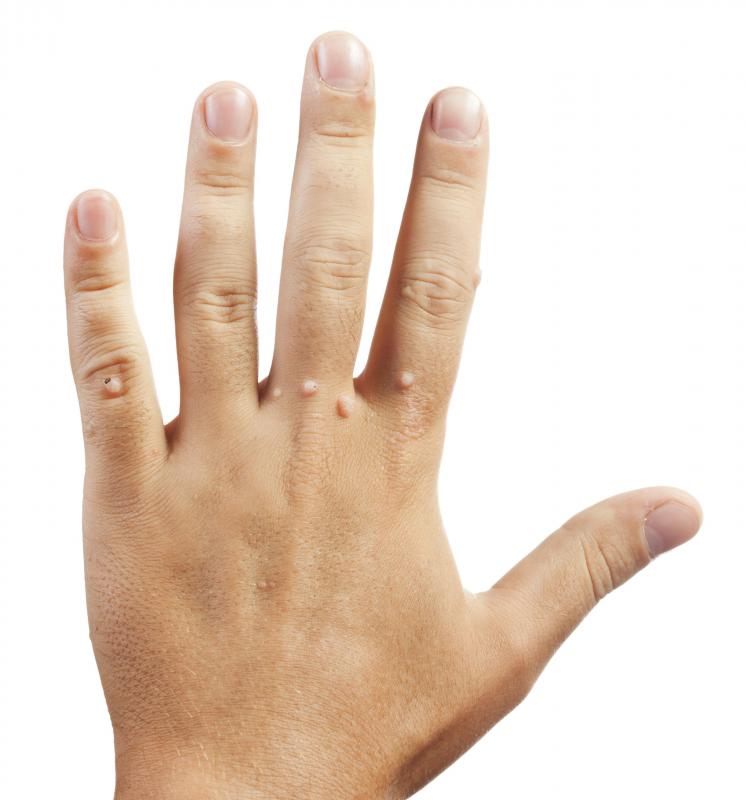
![Warts on a hand.]() By: Tiler84Warts on a hand.
By: Tiler84Warts on a hand. -
![Rubbing a clove of garlic on a wart may be an effective treatment, though it's not recommended for children.]() By: SchliernerRubbing a clove of garlic on a wart may be an effective treatment, though it's not recommended for children.
By: SchliernerRubbing a clove of garlic on a wart may be an effective treatment, though it's not recommended for children. -
![Duct tape takes some time to act as a wart remover.]() By: Kimberly ReinickDuct tape takes some time to act as a wart remover.
By: Kimberly ReinickDuct tape takes some time to act as a wart remover. -
![Freezing warts with liquid nitrogen often causes blisters to form where the treatment was performed.]() By: F.C.G.Freezing warts with liquid nitrogen often causes blisters to form where the treatment was performed.
By: F.C.G.Freezing warts with liquid nitrogen often causes blisters to form where the treatment was performed. -
![Plantar warts grow on the soles of the feet, and may be avoided by refraining from walking barefoot in public places.]() By: Jürgen FälchlePlantar warts grow on the soles of the feet, and may be avoided by refraining from walking barefoot in public places.
By: Jürgen FälchlePlantar warts grow on the soles of the feet, and may be avoided by refraining from walking barefoot in public places. -
![Plantar warts tend to grow on the balls of the feet, as well as other areas of the sole that are under constant pressure when a person is standing.]() By: Arve BettumPlantar warts tend to grow on the balls of the feet, as well as other areas of the sole that are under constant pressure when a person is standing.
By: Arve BettumPlantar warts tend to grow on the balls of the feet, as well as other areas of the sole that are under constant pressure when a person is standing. -
![Medical tape can be used to tape up warts for removal.]() By: Shariff Che'LahMedical tape can be used to tape up warts for removal.
By: Shariff Che'LahMedical tape can be used to tape up warts for removal.


Discussion Comments
Catapult43, I've come to realize that the sea is a wonderous thing. It not only removes warts, but is a *super* wound healer. One year i sliced my knee open and didn't get stitches and within four days of swimming it was fully closed (not healed, but closed).
It is definitaly the best remedy for anything.
As far as warts, I've too heard that saliva helps, and have heard many success stories, though myself have never successfully gotten rid of a wart with it. Perhaps I don't have the patience to continue or I simply forget. But at least they're more common then I thought (:
I have one on my finger and one on my foot. :( I've used Wartner on the finger one, (It's so embarrassing, I'm only 14) and it seems to have changed... I don't know.
I have heard that rubbing your own saliva on the wart, several times a day helps get rid of them. The enzymes in saliva that break down food, also break down the structure of warts.
Another remedy is dandelion sap from the root or stem applied directly on the wart.
These remedies are simple, inexpensive and should not have any harmful side effects.
I remember though, when my daughter was very little, she had several warts on her finger. We spent one whole summer at the beach, swimming in the sea with relatively high content of salt. By summers end the warts were gone. I did initially put a drop of a anti wart liquid on the warts. It was a liquid bought in the store, but it was used only a few days. The rest of the healing seemed to have been done by the sea.
Post your comments