
At DelightedCooking, we're committed to delivering accurate, trustworthy information. Our expert-authored content is rigorously fact-checked and sourced from credible authorities. Discover how we uphold the highest standards in providing you with reliable knowledge.
What are Some Different Types of Bananas?
 Tricia Christensen
Tricia Christensen
Tricia Christensen
There over 1,000 types of bananas in the world, many of them differing slightly in appearance, size, taste and use. They are often grouped into two categories: those that people can immediately eat, sometimes called dessert bananas, and those that need to be cooked prior to eating and are higher in starch, called plantains. Again, the number and types that fall into these two groups are striking. There are a few types that are easily distinguishable in a basic grocery store.
Shoppers may notice that there are many different sizes and shapes in the dessert bananas category. Red bananas, with a bright red peel that turns to brown, are becoming increasingly popular. They may be found in small or large sizes, and a deeper shade and a few brown spots usually indicate when these are quite ripe.

Another of the popular types is the baby banana. These are frequently sold in small bunches of eight to ten and may be more expensive than the average fruit banana, which most people can easily identify in the grocery store. The fruit banana is usually about 6 to 12 inches (15.24 to 30.48 cm), starts as a green color, and begins to turn yellow with brown spots as it ripens. Both baby and fruit bananas are ripe when there is no longer any green on the peel.

Even though most people call these "eating bananas," cooks certainly can prepare them in many different ways. They typically are used in dessert-type foods like banana cakes, breads, or muffins. When they are cooked, especially in recipes where the chef might be frying them at higher temperatures, a slightly green banana can be used, since it's best if a bit of the firmness remains. On the other hand, cooks who are making muffins, cake, or breads will find that a riper banana tends to be the best choice. In fact, those that are almost all brown on the peel are perfect for use in most baked recipes.

Plantains are not used as often in the US, but they make up an important staple and starch source in many other countries. These do need to be cooked, and depending upon the type and region in which they are grown, they may have only a slightly sweet, to a very sweet flavor. They’re often used in the same way that in the US might use potatoes: fried, added to stews or soups, or baked. People who see them in the grocery store may note that most plantains are much larger and heavier than the typical dessert banana.

Large plantains can be over 1 foot (30.48 cm) long, and they are usually thicker than their dessert cousins. Peel colors can vary from yellow, to green, to reddish brown, and they can be used whether they are fully green or fully brown. Usually, riper plantains are sweeter. Cooks can often find a number of ethnic cuisine recipes that make use of plantains, and these types of bananas can be fun to try. People should not try to eat them uncooked, as they can cause indigestion.
Tricia Christensen
Tricia has a Literature degree from Sonoma State University and has been a frequent DelightedCooking contributor for many years. She is especially passionate about reading and writing, although her other interests include medicine, art, film, history, politics, ethics, and religion. Tricia lives in Northern California and is currently working on her first novel.
Learn more...
Tricia Christensen
Tricia has a Literature degree from Sonoma State University and has been a frequent DelightedCooking contributor for many years. She is especially passionate about reading and writing, although her other interests include medicine, art, film, history, politics, ethics, and religion. Tricia lives in Northern California and is currently working on her first novel.
Learn more...AS FEATURED ON:
AS FEATURED ON:


-
![Bunch of bananas.]()
Bunch of bananas. -
![Red bananas.]()
Red bananas. -
![Baby bananas.]()
Baby bananas. -
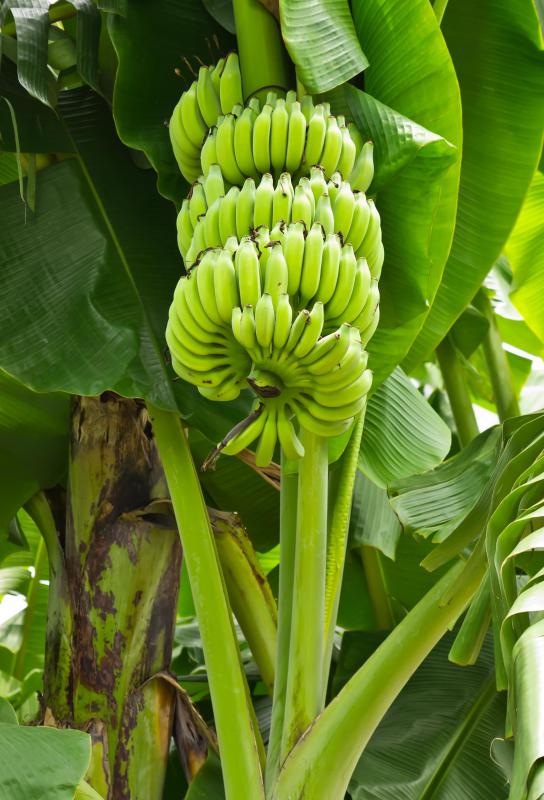
![Fruit growing on a banana plant.]() By: tungphotoFruit growing on a banana plant.
By: tungphotoFruit growing on a banana plant. -
![Bananas are divided into two groups: those that can be eaten right away and those that must be cooked.]() By: jayfishBananas are divided into two groups: those that can be eaten right away and those that must be cooked.
By: jayfishBananas are divided into two groups: those that can be eaten right away and those that must be cooked.



Discussion Comments
When I have bananas that are too ripe to eat I will usually make banana bread or muffins with them. I just put them on a plate and mash them up with a fork. This is also an easy way to make banana baby food.
If I don't have the time for baking, I will peel the bananas and place them in the freezer. That way when I am ready to make a loaf of banana bread, I already have the ripe bananas that I need.
During the week I have a banana every day for lunch. I am pretty picky when it comes to my bananas, and get frustrated when I go to the store and all they have are bananas that are already too ripe.
I like to buy green bananas and let them ripen at home. I keep them in a bowl on the counter and like them when they are still just a little bit green. This means I am making a trip to the store at least twice a week to get the bananas the way I like them.
There is a fine line between a banana being too ripe and not ripe enough. There is usually only about a 2-3 day span where I consider them to be perfect. There are many benefits of bananas, with one of them being a good source of potassium.
@fBoyle -- I also prefer the taste of a regular fruit banana over the baby bananas. I tasted some baby bananas in Hawaii and thought they were very good and quite sweet. When I got back home I bought some more of them and was disappointed in the taste. In Hawaii I was probably getting baby bananas much closer to the source!
@ysmina -- I have never eaten a raw plantain and don't imagine it would taste very good. The first time I tried plantains was a few months ago at a friends house. All she did was peel them and cook them in a skillet in butter until they were soft.
There weren't too bad, but nothing I would go out of my way to fix myself. Some people might say they don't have very much taste, but I thought they were slightly sweet but nothing like a regular banana tastes like.
What does it taste like?
Once I mistakenly bought plantains instead of bananas from the store. You have no idea how shocked I was when I peeled one and bit into it!
Plantains and bananas look similar but they don't taste alike at all. Plantains have no flavor and they're not sweet. They taste like a vegetable, not a fruit.
I've heard that fried plantains are really delicious but I never tried plantains after that experience. Raw plantain was terrible but I guess I should give cooked plantains a chance.
I was in Greece for summer vacation last year and they have the cutest baby bananas over there. The bananas are very tasty and sweet. They're also easier to eat because they're so small. I still think I prefer the regular sized bananas that we get in the US though. I think the bananas here are more fragrant, if that makes any sense. The baby bananas I had in Greece tasted good but they weren't as fragrant.
how does the type of banana affect the type of DNA?
Plantains are not bananas. There are not thousands of different types of bananas. Cavendish are the only bananas which are commercially available. There is also the Gros Michel which arguably tastes better, but it is not commercially available because it is prone to fungus.
Bananas will ripen faster on the counter than in the fridge. They release a gas called ethylene that encourages the ripening process.
Refrigeration contracts the molecules slowing down the release of the gas, and thus slowing the ripening process. If you have an unripe pear or apple and you want to hurry it along, put it in a brown paper bag with an already ripening banana for no more than two days. If you see gnats or flies, you waited too long or your banana was already too ripe.
Keep bananas away from cut flowers for the same reason. Flowers are particularly sensitive to Ethylene and cut flowers will wilt much faster when exposed to it. If you are trying to hurry up a rose bush (in the ground) you can put banana peels just under the surface of the dirt. As it decays, the enzymes break down and will go into the soil, providing a natural fertilizer for your roses. (At most, put in two peels in the same month and only when the conditions are right for fertilizing). Also, If you have small peppers, vegetables, or herbs that are not blooming, you can use a similar process by putting out a chunk of watermelon (in full sun, but nearby the plants) and letting nature have its way. It will attract butterflies which help pollinate the nearby plants and the pectins break down in the soil to fertilize your plants. Good luck and pass on the knowledge!
which kind of banana contains more carbohydrates?
Bananas are best stored at room temperature. They ripen faster in a warm environment. Placing them in the refrigerator will stop them from ripening and will turn their peel dark.
The bananas are still edible if they are placed ripened in the refrigerator, it is just that the skin turns from yellow to dark brown. Bananas are best tasting when the skin is yellow and speckled with brown sugary spots.
Will bananas brown faster on the counter or in the refrigerator?
Post your comments