
At Sports&Hobbies, we're committed to delivering accurate, trustworthy information. Our expert-authored content is rigorously fact-checked and sourced from credible authorities. Discover how we uphold the highest standards in providing you with reliable knowledge.
What are Sailboards?
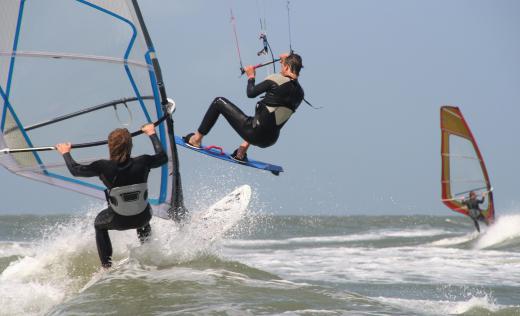
Sailboards, also known as windboards, are used in the sport of windsurfing. They are similar to a surfboard in appearance, with a tall sail which the rider holds on to and uses to steer the craft.
Sailboards were first invented in the early 1960s, though they were not patented or popularized until 1968. As a sport, windsurfing has seen many periods of relative popularity and obscurity. Throughout the 1970s and early 1980s, sailboards were fairly popular both in the United States and Europe. In 1984 windsurfing became an Olympic sport, and around the same time sailboards saw many technical changes. By the 1990s these changes in equipment had led to a drastic decline in the number of enthusiasts, more specialized boards making it much more difficult for newcomers to learn to windsurf. Around the turn of the 20th century, however, a wider range of sailboards led to a renaissance of their popularity.
Classic sailboards were designed to cut through the water as they sailed. These boards, referred to as longboards, are no longer popular except among a very small population of windsurfers. Longboards are in excess of nine feet (3m), with a small daggerboard for sailing upwind.
Most contemporary sailboards are of the type once referred to as shortboards. These boards are under 9 feet (3 m) long and built to plane over the surface of the water rather than to cut through it. Planing yields much higher speeds than cutting through the water, and this exciting method of sailing is part of what has made windsurfing so popular in recent years.
The different types of sailboards are most often optimized for different types of windsurfing. Sailboards for beginners, for example, are usually much heavier and wider than other boards, making them more sturdy. Racing boards, on the other hand, are built exclusively for the purpose of achieving extremely high speeds in excess of 40 mph (65 km/h), at the expense of handling.
Contemporary sailboards are made of a range of substances, usually blending a number of lightweight, strong materials including Kevlar®, PVC, fiberglass, carbon fiber, and thermoplastics. Beginner boards are usually made with stronger, heavier materials, giving them a better chance of surviving impact, while more advanced boards are much lighter but extremely brittle. The sails are meshes of PVC, mylar, polyester, and small amounts of Kevlar®.
AS FEATURED ON:
AS FEATURED ON:


-
![Sailboards, also known as windboards, are used in the sport of windsurfing.]() By: Jan KranendonkSailboards, also known as windboards, are used in the sport of windsurfing.
By: Jan KranendonkSailboards, also known as windboards, are used in the sport of windsurfing.

Discuss this Article
Post your comments