
At WiseGEEK, we're committed to delivering accurate, trustworthy information. Our expert-authored content is rigorously fact-checked and sourced from credible authorities. Discover how we uphold the highest standards in providing you with reliable knowledge.
What are Pinched Nerves?
 Tricia Christensen
Tricia Christensen
Tricia Christensen
A pinched nerve is a nerve that has pressure applied to it at some point, preventing nutrients and signals reaching it as they should. It is similar in some ways to the way in which a water hose can become kinked, cutting off the water supply. From the point onward of the pinch, the nerve fails to get the nutrients it needs to continue functioning properly. This prevents the nerve from send signals to back to the brain, resulting in numbness. Moreover, continued pinching can cause the nerve to permanently die, since it cannot exist long without nutrients.
Compression along any of the many nerves that leave the brain can cause them to become pinched. Nerves in the brain and the spinal cord are called central. Those that leave the spinal cord and brain in long, thin fibers are called peripheral. Compression and pinching can occur in either type of nerve.

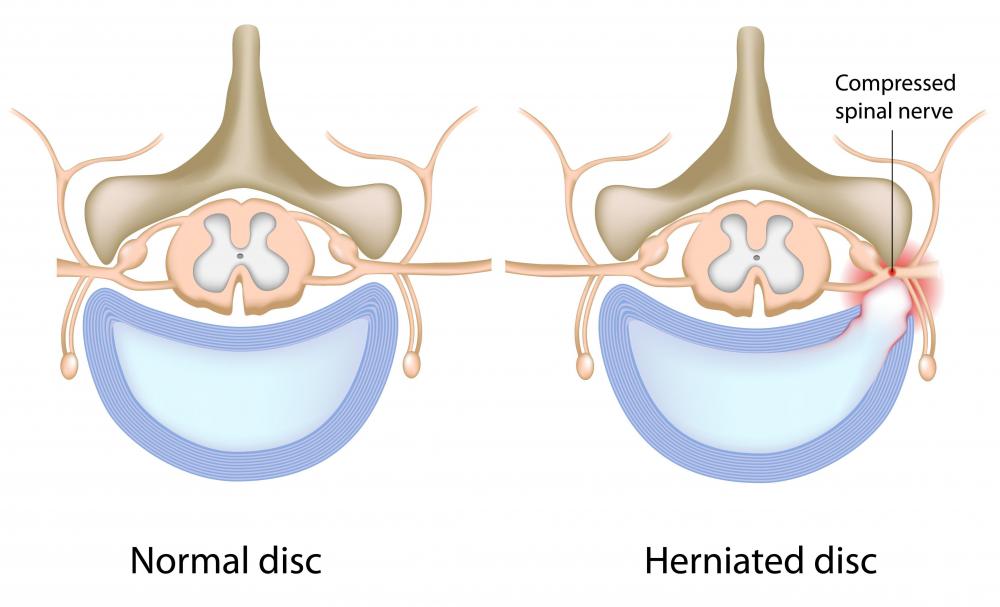
Peripheral nerves can become pinched if a person suffers spinal injury, like a herniated disc. This compresses the spine, and may in turn pinch one or more nerves. Another common area to get pinched nerve is the wrist. Carpal tunnel syndrome is often the result of improper positioning of the hands that actually pinches off nerves and causes a loss of sensation, as the tissues around the nerve swell.

Usually, a person with a pinched nerve notices a loss in sensation in the affected area as well as pain. It is generally not the compressed nerve that causes the pain, but the condition causing the problem in the first place. As tissues around the nerve swell, or as a back injury becomes more pronounced, as in a herniated disc, pain can be significant.

The person with the pinched nerve may not feel the loss of sensation at the nerve site. So, for example, a nerve in the back that is pinched might cause a loss of sensation in the arms, legs, hands, or feet. While the back aches from bone spurs or spinal compression, the individual may also note numbness in one or more of these areas, indicating that there is a nerve problem.

Treatment depends on the area where the nerve is pinched. If a slipped disc is clearly causing the problem, many patients choose spinal surgery to repair or remove the disc. In carpal tunnel injuries, reducing the motion required by the affected wrist may help restore sensation. Sometimes, using ergonomically designed equipment, like vertical keyboards can help reduce pressure on a nerve.

Swelling around an injury may be treated with cortisone injections or with anti-inflammatory medications. Sometimes, a person with a pinched nerve may require physical therapy to help restore function. How much function is restored often depends upon how long the nerve has been pinched. If the condition has existed for years, numbness may persist after repair attempts because the nerve no longer works past its pinched point. Early treatment frequently offers a better chance at restoring full function.
Tricia Christensen
Tricia has a Literature degree from Sonoma State University and has been a frequent WiseGEEK contributor for many years. She is especially passionate about reading and writing, although her other interests include medicine, art, film, history, politics, ethics, and religion. Tricia lives in Northern California and is currently working on her first novel.
Learn more...
Tricia Christensen
Tricia has a Literature degree from Sonoma State University and has been a frequent WiseGEEK contributor for many years. She is especially passionate about reading and writing, although her other interests include medicine, art, film, history, politics, ethics, and religion. Tricia lives in Northern California and is currently working on her first novel.
Learn more...AS FEATURED ON:
AS FEATURED ON:









-
![A pinched nerve can cause neck pain.]() By: Yuri ArcursA pinched nerve can cause neck pain.
By: Yuri ArcursA pinched nerve can cause neck pain. -
![Pinched nerves in the spine can be painful.]() By: psdesign1Pinched nerves in the spine can be painful.
By: psdesign1Pinched nerves in the spine can be painful. -
![A deep muscle massage may help treat a pinched nerve.]() By: lunamarinaA deep muscle massage may help treat a pinched nerve.
By: lunamarinaA deep muscle massage may help treat a pinched nerve. -
![Typing on a keyboard can be hard on the wrists, possibly aggravating carpal tunnel problems.]() By: StockPhotosArtTyping on a keyboard can be hard on the wrists, possibly aggravating carpal tunnel problems.
By: StockPhotosArtTyping on a keyboard can be hard on the wrists, possibly aggravating carpal tunnel problems. -
![The pain from a herniated disc which pinches a nerve can be treated with muscle relaxers and pain relievers.]() By: Alila Medical MediaThe pain from a herniated disc which pinches a nerve can be treated with muscle relaxers and pain relievers.
By: Alila Medical MediaThe pain from a herniated disc which pinches a nerve can be treated with muscle relaxers and pain relievers.



Discussion Comments
@Post 707: yes.
@Post 20 and everyone else here with back pain and damage.
You have disk herniation at the minimum. I'm an amateur (as in hobbyist) body builder, and at 23, I rolled a jeep and ruptured or bulged C4,C5 and C6. At this point, I honestly can't remember which ones are bulged and which are ruptured.
I became a pain killer addict for five years, because I liked them. They took away the pain and everything else about he world I didn't like. I ate them like candy, until I couldn't do it anymore. I broke the cycle, but it wasn't easy, and with nine operations, it was really freaking hard.
I will say this: surgery is the only answer in my opinion, when you are losing substantial strength in the extremities. Beyond that, I see no value in the risks that come with it relative to the possible improvements it offers.
For me, the injury wasn't noticeable until I a few days later and I was doing something silly that emulated the jeep roll over, and I felt a "crick" in my neck, but this wasn't like any crick I ever woke up with in my life. My neck was frozen from pain.
I canceled the surgery by paging the doctor nine hours before the procedure (he was ticked) and found a reliable online "pain management doctor." In truth, I needed the pills about 50 percent of the time for the first year, then 25 percent of the time the second year, and then 10 percent the third, and by year four, I didn't need them at all, but I kept taking them and taking them and taking them.
Now I'm clean, after years of work, and I say "clean" because I don't use conventional narcotics anymore. I'm on a subutex, which is an opiate and it will mind alter the non-opiate user into illness, but for a dependent user, it has no mind altering effects and blocks all other opiates from reaching the receptors of the brain. In short, you can't relapse even if you wanted to, because the receptors are full.
The downside is that when you really hurt, tough. The upside is, I'm no longer a slave to narcotics. If I stay active, strong and keep a strong core, my neck rarely bothers me. That said, I still occasionally have a flare up, but instead of nuking it with Norco or something stronger I ice the crap out of it, and rest it for a few days. I take ibuprofen when it's really bad, but ice is my best friend.
I may reach a point where surgery isn't an option, but a necessity. My numbness is increasing as of late, though my pain is nominal, and the numbness is the early sign of a a serious impingement where, if I start losing strength in my extremities, I'm at a cross roads of saving my arm, or avoiding narcotics and surgery.
To make matters worse, I have a ruptured thoracic vertebrae in addition to several lumbar ruptures or bulges. I'm finally getting them imaged, but I know they are there because the pain is so similar. I now realize I did the lumbar in high school football dead lifting. I did the thoracic in some way I can't even understand, but even without imaging, I know with 100 percent certainty that I have at least seven, if not 10 vertebrae with pathology.
I mention that because I'm in a nasty pain cycle in the lumbar region right now, where my legs went out on me on Saturday night. It's the worst one I've ever felt with the second worst being when I was 35 and dead lifting 345 pounds. That time I was tired and using poor form, and mid lift, I buckled. This time, I'm 37, and I was bending to pick up something my girlfriend dropped. No weight – just an odd angle bend at the waste with a little rotation and bam! My legs gave out. I still work out dead-lifting at 225, am in the best shape of my life and and I'll never dead-lift heavy like that again (I thought I was paralyzed), so my back is strong. My core is strong, but I guess age has a way of tearing up your body.
I'm now dying for a narcotic, but I won't do it. I did go to the doctor because the last MRI I had was in 2001 which was when I backed out of surgery. I need to know what state of degradation my spine is in and to find out what I can do to slow the degradation, which I'm sure I can do; I just don't know how yet.
I'll be seeing a physiologist because a neurosurgeon is just going to push the knife on me because that's what they do: push people into surgery they don't usually need. It's not their fault. They believe they are doing the right thing, but the medical community is being irresponsible in this category. There are articles online covering this issue.
I will make one suggestion for managing pain without narcotics and that doesn't involve "adjustments" which is hocus pocus crap, and I don't care if it works for you; that doesn't mean it's not complete nonsense. The only medically certifiable improvement ever made by chiropractor practitioners is lumbar compression reduction. Beyond that, it's all nonsense and what's worse, if you've been adjusted more than five or six times, they have forever damaged the soft connective tissue in your spine, so you will be a client for life.
Anyway, though it's early, lasers have been used for some time to treat people, but up until very recently, it was the same charlatans I mention above. They were using a laser not much stronger than a laser pointer and charging out the wazoo. Now, the Class III laser is but its still very low powered, though it's helpful in pain and inflammation reduction. Class IV lasers are very rare, but if PT's and chiropractors knew how inexpensive they really are, they'd be in every PT and cracktopractor clinic in the states.
I was treated one time in my cervical region during a flare with a 40 watt laser, and my neck was 75 percent better the next day, and 90 percent better the following day where it usually would have taken a week.
If you happen to be interested, I'm super excited about this as I am about e-cigarettes after quitting smoking after 23 years.
Can a pinched nerve cause one side of the body to go numb after waking up from sleeping?
can you get them in your fingers, because something like that happens to me a lot in drill team and color guard, from catching the 12.5 pound rifle suddenly.
After the nerve is released, is there still numbness?
I get a sharp pain in my temple near my left eye when i look down, and a little pressure too. i was wondering whether this is a pinched nerve?
No, a pinched nerve is more like something falling asleep. It's a tingling sensation. Mine is in my fingers because of being in colorguard and catching rifles. Every time I touch my fingers in certain spots they go numb and feel like they are asleep.
my hands are swollen and my shoulders crack all the time. My neck gets numb and hurts as well as my legs. Do I have a pinched nerve somewhere??
Do pinched nerves feel the same as a muscle cramp? I think pinched nerves are supposed to feel like a sharp pain, but I've had sharp pain in my calves and I wonder if that's a pinched nerve or a muscle cramp or pulled muscle or muscle spasm.
Post your comments