
At WiseGEEK, we're committed to delivering accurate, trustworthy information. Our expert-authored content is rigorously fact-checked and sourced from credible authorities. Discover how we uphold the highest standards in providing you with reliable knowledge.
What are Pea Coats?
 Paulla Estes
Paulla Estes
Paulla Estes
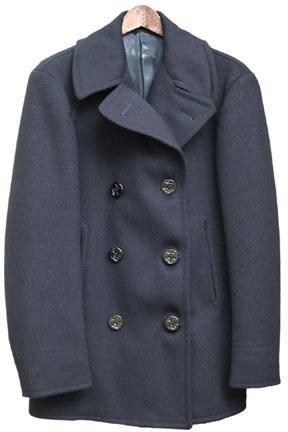
Pea coats are warm, woolen, double-breasted coats that were originally worn only by sailors. Usually a classic navy blue, they were made of heavy, course wool to protect seafarers from harsh weather on the open seas.
Some people believe that the name comes from the pea-soup conditions often endured by tough sailors, but these coats are not named for the weather. In the early 1700s, pea coats were created from pilot cloth, a thick, coarse, twilled cloth with the nap on one side. As is the tradition in the US Navy, the name "pilot cloth" was replaced by the abbreviated "P-cloth." The coat soon became known as a P-jacket, and later, a pea coat. The coats became a standard part of the gear a sailor kept in his sea chest.

Today, pea coats are still worn in the Navy, but like many other military items and paraphernalia, they have become popular among the general population and now make a fashion statement around the globe. Worn by men and women alike, they are donned as work coats, overcoats, and even dress coats. They are worn by businessmen and college students, blue collar workers and professionals. Many can be found in military surplus stores, but more and more are being made by popular fashion designers.

Authentic pea coats made for the Navy must meet US government specifications, including a double-breasted over coat, a Melton shell, full fleece lining with satin sleeves and yoke, slash pockets, cash pocket, inside breast pocket, convertible collar, wide rounded lapels, vented back with parallel tack, and of course, the traditional anchor buttons. The coats are a bit bulky due to their fiber content, but they are fitted and snug, so many merchants suggest going up a size or two for a comfortable fit. Reproductions are often identical to the Navy surplus coats, with only minor design changes that reflect signs of the times. Designers recognize the desire of consumers to have the authentic look and only an expert would know the difference.
Like most other military surplus, these coats reflect the practicality and durability of products designed for use by the US military. While they have military origins, they make a fashion statement in the rest of the world.
Paulla Estes
Paulla is a freelance writer and website editor who currently lives in Maine. Paulla has a B.A. in English Literature from George Mason University and over 15 years of experience as a freelancer. She relishes the flexibility and consistency of working on WiseGEEK articles, as well as the opportunity to constantly learn something new.
Learn more...
Paulla Estes
Paulla is a freelance writer and website editor who currently lives in Maine. Paulla has a B.A. in English Literature from George Mason University and over 15 years of experience as a freelancer. She relishes the flexibility and consistency of working on WiseGEEK articles, as well as the opportunity to constantly learn something new.
Learn more...AS FEATURED ON:
AS FEATURED ON:









-
![A U.S. Navy pea coat.]() By: SirimiriA U.S. Navy pea coat.
By: SirimiriA U.S. Navy pea coat. -
![Modern men's pea coats are available in classic colors, such as black, blue and tan.]() By: nutech21Modern men's pea coats are available in classic colors, such as black, blue and tan.
By: nutech21Modern men's pea coats are available in classic colors, such as black, blue and tan.

Discussion Comments
Peacoats were worn commonly by low-ranking seamen. A Full Dress Coat, and tail coats (if the coat has a tail) is meant for high-ranking officers.
Peacoats do not go any further than your typical car overcoat or reefer jacket.
I think little girls and boys pea coats are just adorable. When we were looking for a dressy coat for my son, this is the style we ended up going with. It isn't his favorite coat by any means because there is no super hero on it, but it was the perfect coat for this special occasion.
Even though he probably won't wear this coat very often, it is nice to have something dressier for him to wear from time to time.
There are a lot of different takes on the traditional pea coat. I know they were originally meant as a very warm, heavy coat, but now you can find them in almost any color and texture.
I think one thing that always sets these coats apart is their double breasted front. Last year I bought a hooded pea coat that I wear all the time. This is a neutral color that I can wear with just about everything and if the weather is bad I can always protect my hair with the hood.
I know a lot of people think of pea coats as being a dark blue or black in color. I have a bright yellow pea coat that is very fashionable looking.
The top is double breasted and the bottom has pleats around it that adds a special touch. I always feel sophisticated, yet feminine when I wear this coat, and I also get quite a few compliments on it.
Ladies' pea coats are often fitted. They remind me of dresses, because they get narrower at the waist and flare out near the bottom.
My best friend has a fitted taupe pea coat. It has a bib on the front with two rows of buttons that extend only to the waist. The coat's hem falls at the middle of her thighs, so it's rather long.
Fitted pea coats are a great way to look stylish even when you have to layer up for the weather. I've always hated hiding my clothes underneath thick, bulky coats, so I'm going to get a fitted pea coat this year.
My favorite clothing store has cashmere pea coats. They are only part cashmere, though, because they also contain wool and nylon.
The cashmere is just for softness. I have felt some rough pea coats before, but these are soothing to the touch. They cost over $100, but they are worth the price.
@DylanB – Women's pea coats aren't really heavy like that. I think it's because they are intended to be stylish instead of to protect the wearer from wet, blustery winds.
I have a black pea coat that I can wear with anything. That's what I love about black.
It is slightly gathered in the back with a button, and it has side pockets. I'm willing to bet that the back gathering was not a part of the original pea coat design.
My husband has his father's old military pea coat. His dad was in the Navy for many years, and he passed this nice coat onto his son.
It is really dense. It's not terribly bulky, but the thickness of the material and the way it is packed so tightly make it very heavy. I tried it on once, and I nearly fell over from the extra weight!
Because it is so heavy, my husband only wears it on special occasions. It's more of a family keepsake than a functional coat.
Post your comments