
At TheHealthBoard, we're committed to delivering accurate, trustworthy information. Our expert-authored content is rigorously fact-checked and sourced from credible authorities. Discover how we uphold the highest standards in providing you with reliable knowledge.
What are Pathogens?
A pathogen is any organism — such as a virus, a fungus, or a bacterium — that causes a disease in another organism. Diseases caused by organisms can range from the common cold to food poisoning to meningitis. They can be spread in many ways, such as by coming in contact with bodily fluids, ingesting undercooked food, or swimming in contaminated water. In some countries, measures have been taken in order to reduce the amount of disease caused by waterborne pathogens. There are also other steps people can take to protect themselves these disease-causing agents.
One of the most common ways a pathogen is spread is through personal contact. Some, such as the virus that causes the common cold, are spread through saliva. Others, such as the Human Immunodeficiency Virus (HIV), can be spread through intercourse or through sharing needles. Disease-causing organisms can also be spread through contact with feces or through unsanitary practices. Keeping up sanitary practices can go a long way to keep you from getting sick and spreading disease.

Water can also be host. Different types of disease-causing organisms can take up residence in fresh water and cause problems in people who drink it. In some countries, the water supply is treated in order to effectively eliminate many of the different organisms that may be present. Even in these countries, should a storm or other disaster interrupt the water treatment processes, contaminated water can be an issue. Boiling water often kills off most pathogens, which is why this is commonly advised if there has been an interruption in water treatment processes.

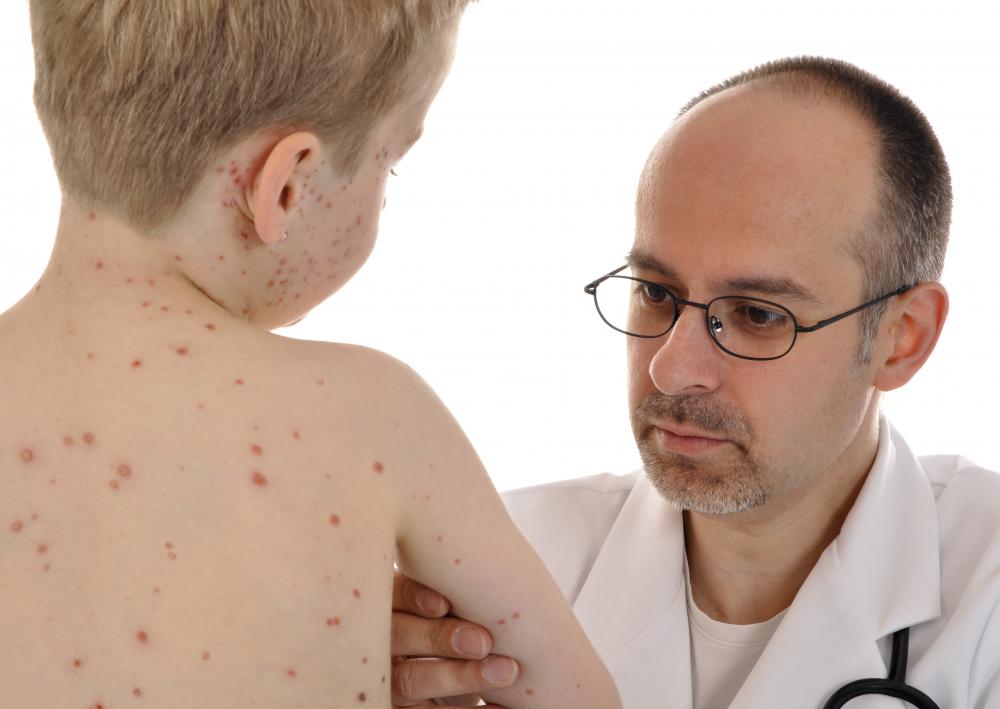
Viruses and bacteria can cause a wide range of diseases. Chicken pox, for instance, is caused by a virus, and some types of the E. coli bacteria cause food poisoning. Many times, fungi that cause disease affect plants, but there are some that can affect humans, such as ringworm, athlete’s foot, and oral thrush.
Another interesting organism that acts as a pathogen is an amoeba called Naegleria fowleri, which can be found in many areas, including fresh water supplies. It can travel up the nose of a person swimming in contaminated water and eventually make its way to the brain. There, it starts to destroy brain cells and causes primary amoebic meningoencephalitis (PAM). It is fatal to most victims, but infections are very rare.
AS FEATURED ON:
AS FEATURED ON:


-
![A virus is a pathogen.]() By: psdesign1A virus is a pathogen.
By: psdesign1A virus is a pathogen. -
![A fungus is a pathogen.]() By: photocrewA fungus is a pathogen.
By: photocrewA fungus is a pathogen. -
![A bacterium is a pathogen.]() By: fotoliaxrenderA bacterium is a pathogen.
By: fotoliaxrenderA bacterium is a pathogen. -
![Chicken pox is caused by a virus.]() By: Dan RaceChicken pox is caused by a virus.
By: Dan RaceChicken pox is caused by a virus. -
![The bacteria causing meningitis can survive and be transported through saliva, nasal secretions or bowel excrement.]() By: rob3000The bacteria causing meningitis can survive and be transported through saliva, nasal secretions or bowel excrement.
By: rob3000The bacteria causing meningitis can survive and be transported through saliva, nasal secretions or bowel excrement.



Discussion Comments
Recently I heard opinions that pathogenic viruses do not actually exist. That would leave bacteria and malnutrition as major causes of illness.
When investigating these opinions further, I searched for the scientific proof of existence of pathogenic viruses and found - nothing. Not only that, but the proponents of official theory of pathog. viruses refuse ANY discussion of this topic.
When taking into consideration the chaotic state of contemporary medicine related to corona virus, diametrically opposite announcements about Covid-19 and healing protocols and measures, false statistics with bribes planted both to doctors and patients to acknowledge covid diagnosis of any death, I definitely see the medical officials have departed from the medical science and misuse the medicine as a shield for their corruption, immorality and inhumanity.
Antibiotics are much overused in the medical world today. I think we should go back and look at nature for our cures.
Can waste companies such as biowise cause any health problems (pathogens) to people who reside near the facility? Bad odors come from this company and I would like to know if this may be a health risk.
Pathogens run rampant in schools. Kids have not yet learned proper hygiene, so they are always wiping their noses on their hands or coughing into them and not washing them afterward.
Teachers are at risk of getting sick, but the kids are more at risk. They haven't totally built up their immunity yet, so they will likely get sick from many pathogens before they grow up.
I was glad to hear that many schools are keeping containers of antibacterial hand sanitizer in the classrooms now. Maybe this will cut down on some outbreaks. I know that using actual soap and water is best, but since kids aren't allowed to go to the bathroom very often during class, hand sanitizer is a good substitute.
My cousin works in microbiology, and pathogens surround her every day. She works in the lab at a hospital.
When doctors take samples from patients to see what type of pathogen is making them sick, my cousin gets the samples and analyzes them. She does all kinds of test to identify the pathogen, and her job is essential to the diagnosis.
She is brave, in my opinion. There's no way I would let myself be surrounded all day by things that could potentially infect and kill me, no matter how good the pay might be.
I've heard about that scary amoeba that swims into your brain! I recall hearing that a guy got it from using a nasal rinse that contained tap water.
I'm not sure how the amoeba got into the tap water, but it did, and it went up his nose and killed him. That is so tragic, and it frightens me to know that these pathogens could be lurking in my own water system.
I will never squirt any water up my nose, and I also insist on holding my nose while going underwater in a lake or pool of any kind. I remember hearing that a few other people died from swimming in a lake during a really hot summer, because pathogens were flourishing that year, and when the people dove underwater, it forced the pathogens up their noses.
@ysmina – I agree with you. The pathogens that cause disease are learning to adapt to all these drugs that we are throwing at them because we aren't giving our own bodies the chance to learn how to fight them off now and in the future.
I've had doctors prescribe me antibiotics for colds. Now, colds are caused by viruses. What good are the antibiotics supposed to do?
I know that my doctor gave me the drugs on the off chance that the infection was bacterial instead of viral. Still, shouldn't he have tested me first to make sure? Wouldn't this be ideal to help prevent bacteria from mutating?
can you name some pathogens please?
There are so many pathogenic diseases, yet the nature of these organisms seems so mysterious even now. In fact, some scientists cannot even decide if viruses are alive or not, and if not, how they manage to do what they do. I hope that in this new century we can manage to learn more about this still greatly unknown part of science.
The fact that pathogens mutate is also why we see special pathogens, pathogens/viruses which under normal conditions exist in animals, for instance, bird flu and swine flu. How scary is that?
There are relatively few fungi that are pathogenic to humans. However, fungi pathogens are more difficult to treat than bacteria pathogens because treatments that kill the fungi also often harm human cells as both are eukaryotic cells.
It's so important to be careful in treating pathogens and disease, since it's easy to start breeding drug-resistant "superbugs." The abuse and overuse of antibiotics, used to treat many pathogenic diseases, causes pathogens to mutate and become drug-resistant.
Of course, I'm not advocating that we chuck antibiotics altogether -- but I think it is safe to say that they might be over-prescribed today.
There are so many pathogenic diseases, yet the nature of these organisms seems so mysterious even now. In fact, some scientists cannot even decide if viruses are alive or not, and if not, how they manage to do what they do. I hope that in this new century we can manage to learn more about this still greatly unknown part of science.
Post your comments