
At EasyTechJunkie, we're committed to delivering accurate, trustworthy information. Our expert-authored content is rigorously fact-checked and sourced from credible authorities. Discover how we uphold the highest standards in providing you with reliable knowledge.
What are Patch Panels?
Patch panels are switchboard look-alikes that house cable connections. In a typical setup, the connection consists of a shorter cable plugged into the front side of the patch panel and a longer cable plugged into the back. In this way, the panel can take the place of otherwise expensive switching equipment.
The telephone switchboards of old are the progenitors of today’s patch panels. Even today, these devices are used for telephone connections. They are also used for data transfers, however, and for audio and video applications.

In addition to having different lengths of cable connecting to the front and back, patch panels can have different types of electrical connectors as well. One example of this is a breakout box, which has individual connectors on the front leading to a compound connector on the back, into which all of the individual cables plug. Breakout boxes usually have an even number of individual connectors, but this is not always the case.
Patch panels are also used in computer networks. Local Area Networks (LANs) incorporate them by using them to connect the computers of a network to one another and to the Internet. They can also be used to connect a LAN to a Wide Area Network (WAN).

In all cases, these devices transmit signals from one cable to another without any loss of signal or data. Many users also like them because of the ability to change and interchange the individual cables on the front. Patch panels have compound connectors on the back side that don’t differentiate which signal is coming from which individual port.
Not surprisingly, software has been developed to help facilitate the data transfers taking place through patch panels. This software includes among its functionalities the ability to monitor data transfer signal strength, changes in temperature, and power fluctuations in the panels themselves. Most patch panels have redundant power supplies attached in order to ensure that power failures do not result in data transfer failures.
AS FEATURED ON:
AS FEATURED ON:









-
![Patch panels do the work of more expensive switching equipment.]() By: rilPatch panels do the work of more expensive switching equipment.
By: rilPatch panels do the work of more expensive switching equipment. -
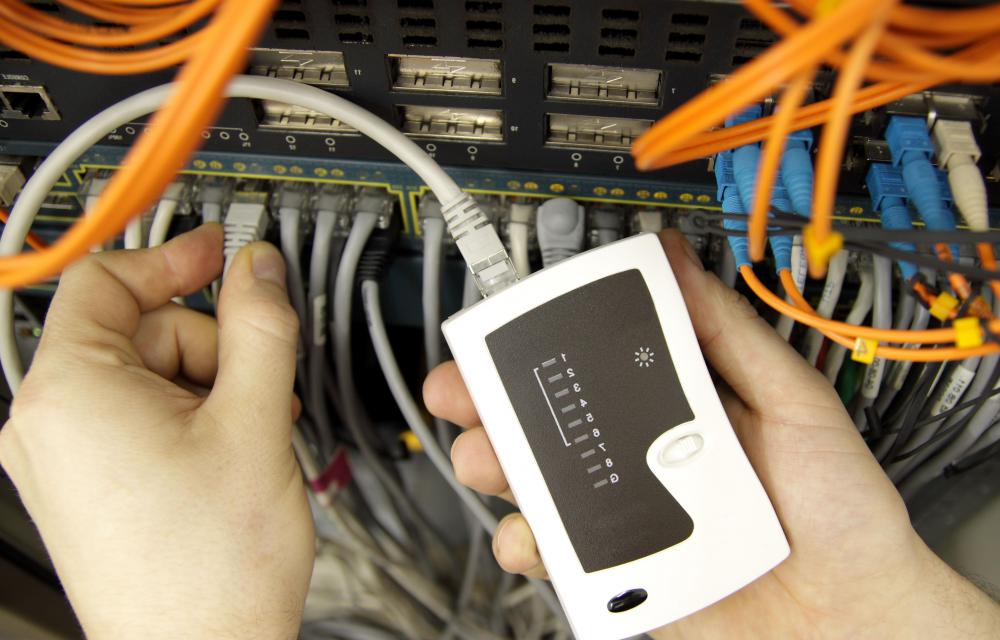
![Because there are a number of different wires on a patch panel, a network cable tester may be necessary to locate problematic wiring.]() By: ambrozinioBecause there are a number of different wires on a patch panel, a network cable tester may be necessary to locate problematic wiring.
By: ambrozinioBecause there are a number of different wires on a patch panel, a network cable tester may be necessary to locate problematic wiring.

Discussion Comments
Good article. I've been looking for an article on patch panels that isn't full to the brim with technical words. Good job!
Post your comments