
At EasyTechJunkie, we're committed to delivering accurate, trustworthy information. Our expert-authored content is rigorously fact-checked and sourced from credible authorities. Discover how we uphold the highest standards in providing you with reliable knowledge.
What are Patch Cords?
Patch cords are cables that connect electronic equipment for interoperability. Several different types of cable can be used for this purpose, depending on the equipment connected. They let the user "patch in," whether it be to stereo systems, audio/visual centers or computer networks.
Recording studios use patch cords to connect components like compressors, amplifiers, mixing boards, digital recorders and musical instruments. In this case, the term might refer to a midi cable, RCA audio cables, digital audio cables or a DIN-style microphone cable, to name a few examples. Video recording also uses patch cords.

Many people today use these cords to transfer their favorite record albums to CD ROM or hard disk. This can be done one of several ways, depending on the type of equipment. One way uses RCA cords to connect the turntable's outgoing left and right channels to the audio-in jack on the computer's sound card. This involves a special "Y" cord that accepts two male 1/4-inch (6.35 mm) RCA cables, and runs the two signals into a single tail with a stereo male 1/8-inch (3.175 mm) plug.

To see a veritable jungle of patch cords, glance behind any home theater system. Most of these cords are composite audio/video cables, component video cables or digital, optical or HDMI cables. Some are actually three or more cables ribboned or wrapped into a single cord. This style cuts down the tangle.
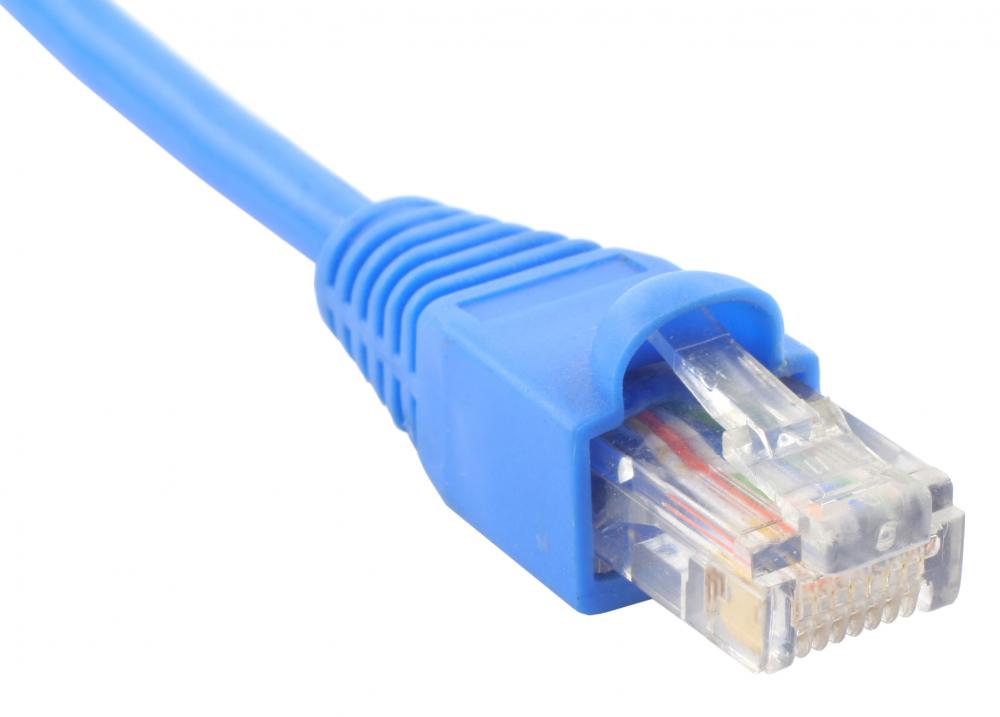
Wired computer networks use coaxial twisted pair Ethernet patch cords. Ethernet cables feature RJ-45 connectors and often come in blue, yellow or other colors. In a wired network, these cables run from the network switch or hub to each computer on the network.

As a general rule, electronic signals degrade with distance, so regardless of the application, shorter cables are the better option when possible. When longer patch cords are necessary, quality wiring and good shielding becomes even more relevant. These factors are important in standard-length cables as well, however. Shielding protects the signal from surrounding electronic interference that could otherwise degrade output, while quality wiring is of the correct gauge and free of physical and structural problems.
Quality connectors can also make a difference when it comes to performance, but hype can outweigh real-world difference and overpriced cables are not uncommon. If a good cable is needed, people should buy the cable and not the packaging. Often the "extras" on expensive cords amount to multicolored plastic hardware that does nothing for performance, while a humbler-looking cable with the same specs at half the price will perform equally well. Patch cords are available everywhere electronics are sold, and they can also be found at music stores, home improvement centers, discount department stores, and from a variety of online vendors.
AS FEATURED ON:
AS FEATURED ON:









-
![A HDMI® cable.]()
A HDMI® cable. -
![Cat 5 cable with RJ45 plug.]()
Cat 5 cable with RJ45 plug. -
![XLR cords are commonly used for microphones.]() By: Tiler84XLR cords are commonly used for microphones.
By: Tiler84XLR cords are commonly used for microphones.


Discussion Comments
I am installing a home network with one wired Mac G5 and 2 Windows based pcs (these will be connected wirelessly). I have seen various types of ethernet cable but i am not sure what kind i should use.
the length of the ethernet cable will be about 75 feet and it will be installed in-wall. what type of cable should i use? is there any advantage to using a 'crossover' cable? because the wire will be in-wall do i need a certain rating of wire?
thank you in advance for any advice you can give me.
Post your comments