
At DelightedCooking, we're committed to delivering accurate, trustworthy information. Our expert-authored content is rigorously fact-checked and sourced from credible authorities. Discover how we uphold the highest standards in providing you with reliable knowledge.
What are Pastured Eggs?
 Mary McMahon
Mary McMahon
Mary McMahon
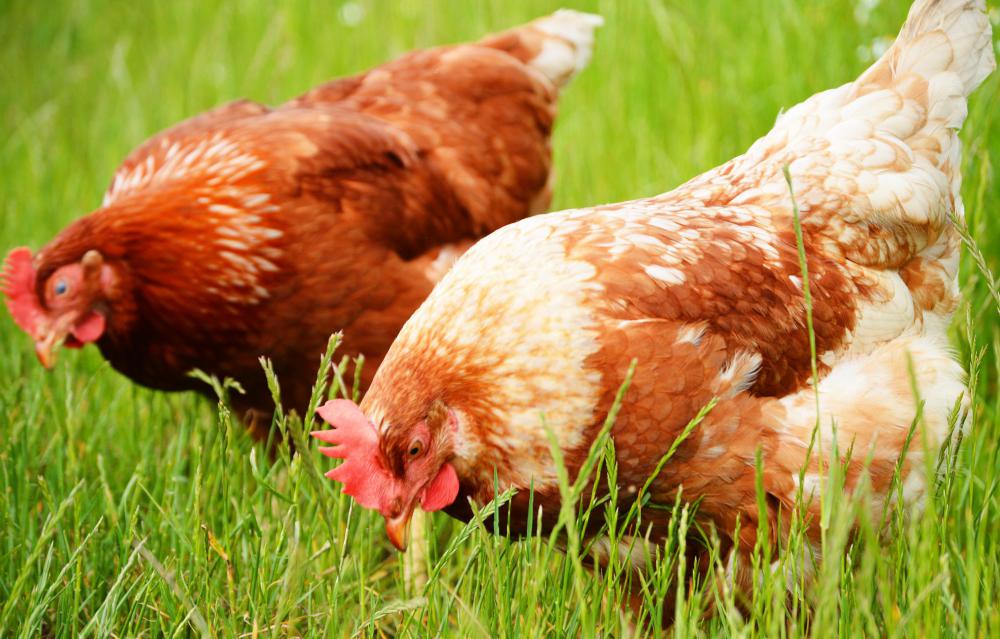
Pastured eggs and meat are chicken products that have been harvested from chickens allowed to roam in open pastures. Advocates believe that the chickens are happier and healthier, and nutritional analysis has shown that the eggs are also richer in useful nutritious elements like omega 3 acids and vitamin C. As a result of more labor intensive production techniques, these eggs are more expensive than conventional ones, and they are rarely available in conventional supermarkets, which order eggs in such high volume that small farmers cannot meet the demand.
Some consumers confuse the concept of free-range eggs with pastured eggs. Many conventional egg supply companies encourage this confusion, because consumers are sometimes willing to pay a premium price for products that they believe were harvested in humane and sustainable ways. The two terms are not synonymous, however, and "free range" eggs, according to the United States Department of Agriculture, must come from chickens that are offered access to the outside. Many commercial production companies provide this access in the form of a small door that is opened a few times a day; used to being confined indoors, the chickens make no move to explore the outdoors. Pastured chickens are raised in a pasture, with mobile coops to roost in at night.

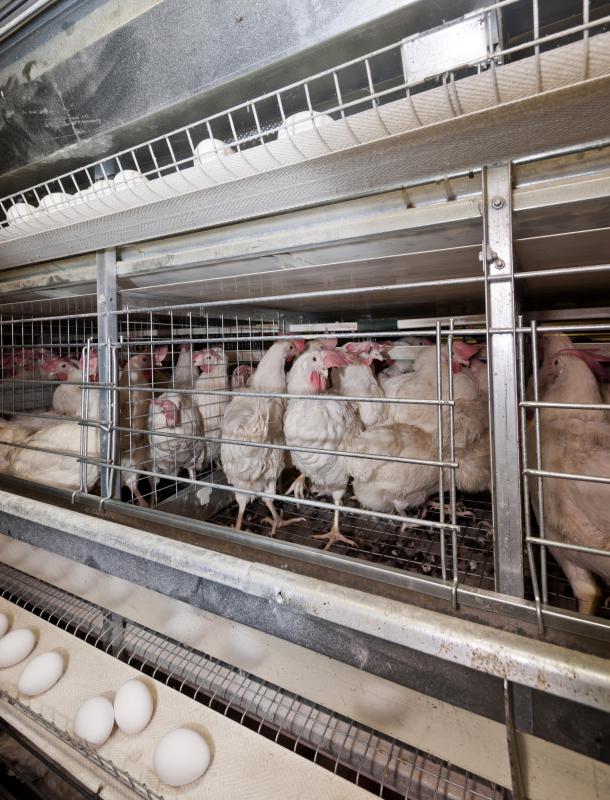
Conventionally produced eggs come from large warehouses full of hens. The hens are kept in confined cages where they often cannot stretch and move around, and they may be debeaked to prevent them from attacking each other. The floors of the cages are slanted, so that as the hens lay eggs, they roll onto a conveyor belt to be collected. The end result is cheap eggs in large volume, but the eggs tend to be less nutritious, and more subject to contamination with bacteria. The chickens are often fed prophylactic medications, which in turns leads to more virulent, drug resistant forms of bacteria like Salmonella and Escheria coli. When animal advocacy organizations raised public awareness about conventional egg production, “free range” labeling, and pastured eggs, some consumers started to seek out more information about where their food comes from.

Because pastured hens eat a varied diet, their eggs are more nutritious. The hens eat grasses, grubs, worms, insects, and an assortment of edibles, which alter the texture, taste, and consistency of their eggs. They also tend to be thicker, with stronger, darker yolks and a more complex flavor. These eggs are often organic, though not always, and are found at farmers' markets and through Community Supported Agriculture (CSA) cooperatives. Although there is no scientific basis for it, some people also believe that pastured hens are happier, and seek out pastured eggs because they are concerned about the treatment of food animals.
Mary McMahon
Ever since she began contributing to the site several years ago, Mary has embraced the exciting challenge of being a DelightedCooking researcher and writer. Mary has a liberal arts degree from Goddard College and spends her free time reading, cooking, and exploring the great outdoors.
Learn more...
Mary McMahon
Ever since she began contributing to the site several years ago, Mary has embraced the exciting challenge of being a DelightedCooking researcher and writer. Mary has a liberal arts degree from Goddard College and spends her free time reading, cooking, and exploring the great outdoors.
Learn more...AS FEATURED ON:
AS FEATURED ON:


-
![Brown and white pastured chicken eggs.]() By: aoatesBrown and white pastured chicken eggs.
By: aoatesBrown and white pastured chicken eggs. -
![Conventionally produced eggs are made from chickens that are kept in cages and cannot stretch or move freely.]() By: emirkooConventionally produced eggs are made from chickens that are kept in cages and cannot stretch or move freely.
By: emirkooConventionally produced eggs are made from chickens that are kept in cages and cannot stretch or move freely. -
![It's believed that free range hens produce eggs that are healthier.]() By: monticelllloIt's believed that free range hens produce eggs that are healthier.
By: monticelllloIt's believed that free range hens produce eggs that are healthier. -
![Pastured eggs have been shown to be richer in useful nutritious elements.]() By: IngaePastured eggs have been shown to be richer in useful nutritious elements.
By: IngaePastured eggs have been shown to be richer in useful nutritious elements.


Discussion Comments
We raise chickens for eggs. Our chickens are free range but not pastured as we have too many raccoons, foxes and chicken hawks that love to feast on chickens. Our eggs are also organic, as their feed does not contain antibiotics or GMO products.
I have bought eggs from a local farmer now for years. I even know what the chickens are eating, and what they are supplemented with. This year we are raising our first batch of chickens ourselves. We are very excited!
Here's a next step to consider: don't eat eggs at all. It is still a form of animal exploitation. No judgment -- just something to consider.
Government and megafarm agri-business don't want the public to know the difference between pasture-raised and free range and will defend ways to keep you in the dark to the nth degree, as sadly, they don't give one iota about either the welfare of the chickens or of the consumer buying chicken products. Both only care about the bottom line: profit margin and high yield with as little damage to the profit margin as possible.
I would like to know more about the devastating health effects of GM soy and corn in eggs. Can that be explained?
Pastured chickens are happier because the humans that get to hang out with them and move the chickens are happier outdoors. The chickens resonate with the energy of their keepers.
The only way to know for sure is to get your eggs from a local farm and see if the chickens are roaming freely, which is usually not the case. Also ask if the chickens are fed feed containing GMO ingredients, which is vitally important, as residues of GM soy and corn in eggs and meat have devastating health effects.
The only way to know for sure how the chickens that laid your eggs were treated is to know your farmer or raise them yourself. I guarantee you that no matter where you live, there is a farmer nearby producing quality eggs. You just have to seek them out.
You can hardly ever find "pastured eggs" in the grocery store because large farms that produce enough eggs to supply a store do not use pasture for their animals.
Also, "farm fresh" is a meaningless claim. Every egg comes from a farm. Commercial confinement farms are still farms. Producers use this label because the words "farm fresh" evoke a peaceful image of animals roaming free in big open grassy fields in the consumers mind. The reality is never as nice as the words "farm fresh" make it sound.
"Organic" is an entirely different matter. It refers to what the hens were fed, not where they lived. You can have an organic egg from a sick hen that spent its entire life in a tiny metal cage.
Have you guys noticed that eggs from caged chickens smell bad? I bought pastured eggs for the first time last week and I was surprised because my eggs didn't have any smell. I mean it smelled and tasted good. Regular eggs have an odd smell to them that's off-putting.
I think the same is true for pastured poultry. It smells and tastes much better than caged poultry.
Clearly, whether chickens are roaming in open pastures or not, makes a huge difference in flavor and quality.
And as if there wasn't enough confusion about the type of eggs, there is also something called "organic eggs," whatever that means.
Oh my God! I also thought that pastured eggs and free-range eggs were the same. I always pay extra and buy free-range eggs thinking that these chickens are roaming free the whole time. That's so unfair! I think the term "free-range" should be changed, it's clearly misleading. And "pastured eggs" is not used much either. I don't remember seeing many pastured egg brands at the grocery store.
We need to clarify these terms because I'm sure there are many people like me buying free-range eggs by mistake. I think free-range is still a notch better than regular eggs. But I want to eat eggs from completely free chickens. I can't's stand how inhumane most manufacturers treat those chickens. It's appalling.
I wonder if pastured eggs are the same as farm fresh eggs.
Post your comments