
At WiseGEEK, we're committed to delivering accurate, trustworthy information. Our expert-authored content is rigorously fact-checked and sourced from credible authorities. Discover how we uphold the highest standards in providing you with reliable knowledge.
What are Oyster Mushrooms?
 Mary McMahon
Mary McMahon
Mary McMahon
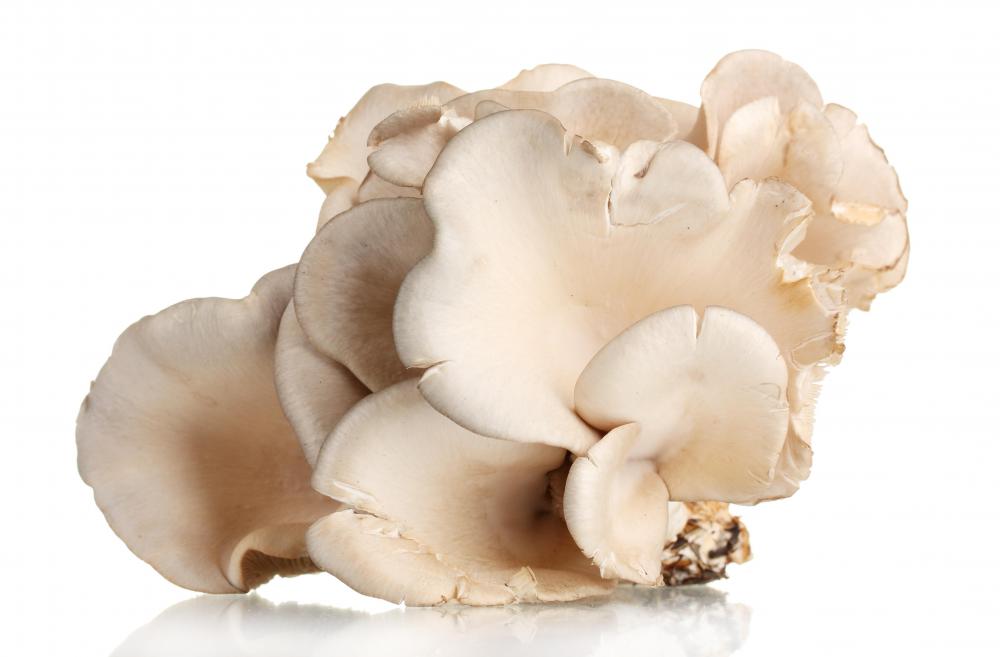
Oyster mushrooms, known scientifically as pleurotus ostreatus, are popularly consumed all over the world. In addition to being wild harvested, they are also heavily cultivated, which results in their ready availability at most grocery stores in both fresh and dried form. These fungi complement a wide range of foods with their slightly sweet, woodsy flavor and distinct aroma. Many people who are learning mushroom identification seek out this type because they are relatively easy to identify.
In the wild, oyster mushrooms are found growing on the trunks of dead hardwood trees. They prefer slightly damp temperate zones and are abundantly distributed in many parts of the United States, Asia, and Europe. The mushrooms are white with very short stalks, well defined gills, and a white spore print. Usually found growing in clusters, the mushrooms bear a resemblance to the shellfish for which they are named. They are also very easily to cultivate and can be grown on wood chips, logs, and any growth medium that contains enough cellulose.

These mushrooms are very delicate. If picking them, individuals should store them in a paper bag in a very cold area of the refrigerator and use them within one week. Ones that are purchased at the store should be firm and not have any traces of slime or sponginess, and they need to be stored with care. Those that grow in the fall tend to have a more complex, chewy texture, while spring varieties are more tender.

As is the case with any edible fungus, inexperienced mushroom hunters should always travel with people who are familiar with the different species of mushrooms. Several other types strongly resemble oyster mushrooms but could cause intestinal discomfort if picked and eaten. Mushroom hunter who are unsure about identification and who cannot get a sample verified should throw it out and try again some other time.

Fresh oyster mushrooms are often added tosoups, sauces, and stir fries. They stand up reasonably well to frying, especially if added towards the end, and will impart a delicate flavor that can add a new dimension to a dish. Dried ones can be used in stews, stuffings, and other dishes that have longer cooking times. Cooks can rehydrate the mushrooms in boiling water for five to ten minutes, and the leftover liquid can be added to sauces and other dishes that might benefit from a mushroom-flavored liquid.
Mary McMahon
Ever since she began contributing to the site several years ago, Mary has embraced the exciting challenge of being a WiseGEEK researcher and writer. Mary has a liberal arts degree from Goddard College and spends her free time reading, cooking, and exploring the great outdoors.
Learn more...
Mary McMahon
Ever since she began contributing to the site several years ago, Mary has embraced the exciting challenge of being a WiseGEEK researcher and writer. Mary has a liberal arts degree from Goddard College and spends her free time reading, cooking, and exploring the great outdoors.
Learn more...AS FEATURED ON:
AS FEATURED ON:









-
![Oyster mushrooms should be stored in a paper bag in the refrigerator.]()
Oyster mushrooms should be stored in a paper bag in the refrigerator. -
![Oyster mushrooms.]() By: Africa StudioOyster mushrooms.
By: Africa StudioOyster mushrooms. -
![Oyster mushrooms can be sauteed in a vegetable stir-fry, then served over nutritious brown rice.]() By: Stepan PopovOyster mushrooms can be sauteed in a vegetable stir-fry, then served over nutritious brown rice.
By: Stepan PopovOyster mushrooms can be sauteed in a vegetable stir-fry, then served over nutritious brown rice. -
![Several types of mushrooms resemble oyster mushrooms but could cause intestinal discomfort if eaten.]() By: cristovao31Several types of mushrooms resemble oyster mushrooms but could cause intestinal discomfort if eaten.
By: cristovao31Several types of mushrooms resemble oyster mushrooms but could cause intestinal discomfort if eaten.



Discussion Comments
I have always used pearl oyster mushrooms as my secret ingredient for stir-frys. It's kind of odd to think of making that seafood flavor pairing with a regular chicken or beef stir-fry, but let me tell you, it really enhances the flavor.
And the cool thing is, it's not like you really get a very heavy seafood taste -- it's more like the oysters just enhance the taste of the beef and chicken. Like MSG, but natural and not dangerous to ingest.
So the next time you make a stir-fry, throw a few pearl oyster mushrooms in. It's really easy, and nobody will know why, but your stir-fry will have taken on epic flavor proportions.
How would you say that growing oyster mushrooms compares to growing other kinds of mushrooms?
I try to grow all my own produce, and I have a little bit of experience with those growing morel mushrooms and using those shiitake mushroom logs.
I know that oyster mushrooms grow on logs or trees, much like the shiitakes, but how do they compare as far as growing time and ease of cultivation?
Does anybody reading this grow oyster mushrooms, and can you give me some information about this?
Thanks!
Oyster mushrooms have always kind of freaked me out. I mean, I'm not big into gourmet mushrooms in the beginning, whether they're shiitake mushrooms or pearl oyster mushrooms or whichever other type, but something about the shape and smell of oyster mushrooms just makes me cringe.
Good thing I don't make my living growing mushrooms -- you can really make a lot of money off of oyster mushrooms, but I don't think I could get over the smell, especially. Fungal oyster just isn't my bag.
which mushroom is a highly effective medicinal mushroom?
Post your comments