
At AllTheScience, we're committed to delivering accurate, trustworthy information. Our expert-authored content is rigorously fact-checked and sourced from credible authorities. Discover how we uphold the highest standards in providing you with reliable knowledge.
What are Organelles?
 Mary McMahon
Mary McMahon
Mary McMahon
Organelles are tiny structures that perform very specific functions within cells. The term is a reference to organs, likening the way these structures operate in cells to the way organs function in the body. A number of different organelles can be found inside various types of plant, animal, and bacteria cells. Each has its own important task, such as producing energy or manufacturing proteins.
Types

These structures have a wide range of functions, most of which are tasks that are critical to the life of the cell. The most important structures are the nucleus, the endoplasmic reticulum (ER), the Golgi apparatus, mitochondria, and chloroplasts. Each of these tends to be located in specific areas of cells. Typically, the nucleus is located near the center, with the ER and Golgi located nearby, and the remaining organelles spread within the cell.
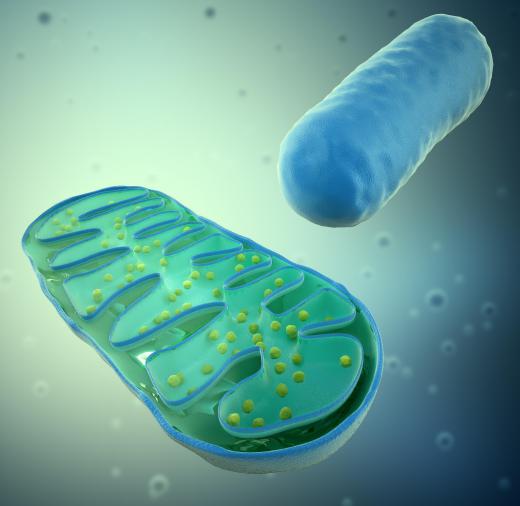
The type and number of organelles present within a cell varies, depending on the cell's purpose. For example, almost all plant and animal cells contain a nucleus, with the notable exception of mature red blood cells, which do not contain any organelles or genetic material. Another example is that muscle cells typically have many more mitochondria than other cell types, because more energy is required to keep muscle cells working effectively.
Structure

Researchers believe that the overall reason that organelles evolved is that cells benefit from isolating the many complex chemical reactions that occur within them. Within plant and animal cells, each one is encased in its own membrane, which helps the unit function. One of the main benefits of this protection is that, within a membrane-enclosed unit, chemical conditions such as pH can be modified without affecting the entire cell. Similarly, the contents of each is isolated from what is occurring within the cell at large.

Certain organelles are so big that their shape and surface can be seen under a light microscope. These include mitochondria and the Golgi, as well as the cell nucleus. An electron microscope is required to view them more closely, however. It was not until these structures could be examined via electron microscopy that researchers began to understand how they functioned.
Energy Production

Mitochondria are responsible for providing cells with usable energy. They are found in most complex organisms, including fungi and plants as well as animals. The main function of these structures is to produce a molecule called adenosine triphosphate, or ATP, which is the main source of energy in animal and fungi cells, and a secondary source for plants. Mitochondria have additional functions as well, including cell metabolism regulation and calcium storage.
Certain organelles are found only within a specific type of organism. The most well-known example is chloroplasts, which are found only in the cells of plants and algae. Chloroplasts use sunlight to produce glucose through the process known as photosynthesis. Another example is the carboxysome, which is found only in certain bacterial species. Carboxysomes allow the bacteria to turn carbon into organic molecules that they can use for energy.
Protein Production and DNA Interactions
Many organelles are able to communicate with one another, either due to their proximity, or via chemical signaling. For instance, the endoplasmic reticulum connects to the Golgi apparatus, and both of these units are involved in the production of new proteins. New proteins are manufactured in the endoplasmic reticulum, and from there, move to the Golgi, where they are modified and packaged for transport to other locations in the cell.
Another example of this communication is that which occurs between the nucleus of a cell and the other organelles within it. Although the nucleus and the DNA it contains do not physically connect with other cell structures, it communicates with the rest of the cell through protein signaling molecules. The membrane that envelops the nucleus controls what can enter and leave the structure, by limiting traffic to special proteins that are able to interact with DNA strands.
Diseases
Just as the larger organs can be affected by health problems, individual organelles can also be subject to medical conditions and congenital disorders. These structures are so essential for cell function that diseases that affect them often cause severe symptoms and, in some cases, are fatal. Dysfunction can have wide-ranging and unexpected results.
Endoplasmic reticulum dysfunction has been implicated in conditions such as cystic fibrosis, and in Alzheimer’s, Huntington’s, and Parkinson’s diseases. In each case, cellular dysfunction that puts stress on the ER is thought to contribute to the symptoms that develop. Diseases that affect the Golgi include congenital disorders that cause liver disease, mental disability, and seizures, and they typically cause death before a child reaches two years old.
A large family of conditions known as mitochondrial disorders can cause everything from digestive problems to blindness, depending on the specific nature of the disorder that a person is affected by. These conditions can be difficult to treat, as they usually involve congenital defects which cause damage to all of the organelles involved across a given cell type.
Mary McMahon
Ever since she began contributing to the site several years ago, Mary has embraced the exciting challenge of being a AllTheScience researcher and writer. Mary has a liberal arts degree from Goddard College and spends her free time reading, cooking, and exploring the great outdoors.
Learn more...
Mary McMahon
Ever since she began contributing to the site several years ago, Mary has embraced the exciting challenge of being a AllTheScience researcher and writer. Mary has a liberal arts degree from Goddard College and spends her free time reading, cooking, and exploring the great outdoors.
Learn more...AS FEATURED ON:
AS FEATURED ON:









-
![The rough endoplasmic reticulum is an organelle.]() By: Matthew ColeThe rough endoplasmic reticulum is an organelle.
By: Matthew ColeThe rough endoplasmic reticulum is an organelle. -
![Mitochondria are often called the power plant of the cell.]() By: MopicMitochondria are often called the power plant of the cell.
By: MopicMitochondria are often called the power plant of the cell. -
![Organelles are the tiny structures that perform specific functions within a cell.]() By: snapgalleriaOrganelles are the tiny structures that perform specific functions within a cell.
By: snapgalleriaOrganelles are the tiny structures that perform specific functions within a cell. -
![Organelles may be viewed under a microscope.]() By: kastoOrganelles may be viewed under a microscope.
By: kastoOrganelles may be viewed under a microscope. -
![Mitochondrial disorders can cause digestive problems.]() By: HalfpointMitochondrial disorders can cause digestive problems.
By: HalfpointMitochondrial disorders can cause digestive problems.


Discussion Comments
Between prokaryote and eukaryote have three things in common: they both have cell membranes, ribosomes, cell walls (eukaryote plants have cell walls), and chromosomes.
Cells are more complex than a motor vehicle.
Your motorcycle isn't a living thing, so it can't evolve. People created your motorcycle and may adapt the design to improve its functioning, just as a living thing may adapt to its environment. That doesn't make the information about adaptations religion.
Scientific research proves that living organisms adapt to different climates, food supplies and other conditions and those adaptations may involve changes/evolution at the cellular level.
"These structures have evolved over time to serve specific functions which will further the life of the host organism." My motorcycle doesn't evolve over time, on the contrary, is not a cell more complex than my stuff? How does science prove that organelles have evolved over time? I don't like religion in science teaching.
I was wondering what the relationship was between organelles and the nucleus. And, I found out that the nucleus is an organelle. And, eukaryotic cells (defined by having a nucleus) have organelles, one of which is the nucleus. Just thought I'd share!
@purple shark - thanks for the extra info!
I didn't know what a "unit membrane" was -- I thought you might have meant unified membrane -- so I looked it up and in case others wanted to know it's just the name of the membrane. It's also called a cell membrane or a plasma membrane or a plasmalemma.
My son had to do a science report on organelles and I helped him with his research. These are some of the things that we learned:
Most organelles are membrane bound, meaning that they have a unit membrane around them.
Some cells will have more of a particular organelle because they enable it to carry its function.
The prokaryotic cells don’t have membrane bound organelles.
Some of the organelles are visible with a strong light microscope.
Post your comments