
At TheHealthBoard, we're committed to delivering accurate, trustworthy information. Our expert-authored content is rigorously fact-checked and sourced from credible authorities. Discover how we uphold the highest standards in providing you with reliable knowledge.
What are Nerve Fibers?
Nerve fibers are very thin, thread-like transmission lines that carry signals between nerves and receptors in the skin, muscles, and internal organs. Their official job is to conduct nerve impulses, which basically means that they are responsible for delivering signals and sensations from the nerves to various parts of the body. Fibers come in three varieties called “classes” based on their primary role. Class A relates to muscle and tendon movement; Class B covers involuntary impulses, like digestion and lung movement; and Class C is responsible for pain and temperature sensations. The speed of transmission varies between the classes, and there can also be slight differences in fiber length and thickness depending on location and precise role. All fibers have the same overarching role, though, and they tend to all work in about the same way.
Basic Concept

The human nervous system is a complex web of signals that impacts everything from muscle movement to feelings of touch, warmth, and pain. There are two primary systems at play, and fibers are present in both. The central nervous system is generally understood to be the spine and brain; the peripheral nervous system, on the other hand, is the network of signals that runs through all parts of the body, stretching out to the fingers and toes and covering all points in between. Nerves in both systems are deep within the body, though, and sit well beneath the skin. Fibers are how signals from the nerves actually turn into feelings and sensations, since they carry messages off of the nerves and into a transmission site where they can be translated, interpreted, and executed.
Class A

Fibers that transmit signals related to muscle, tendon, and articular movement are in what is known as “Class A,” and this is usually the biggest grouping. They are also the thickest, measuring in at about one-fifth the diameter of a strand of human hair. As a result, they are usually really fast when it comes to transmission times.
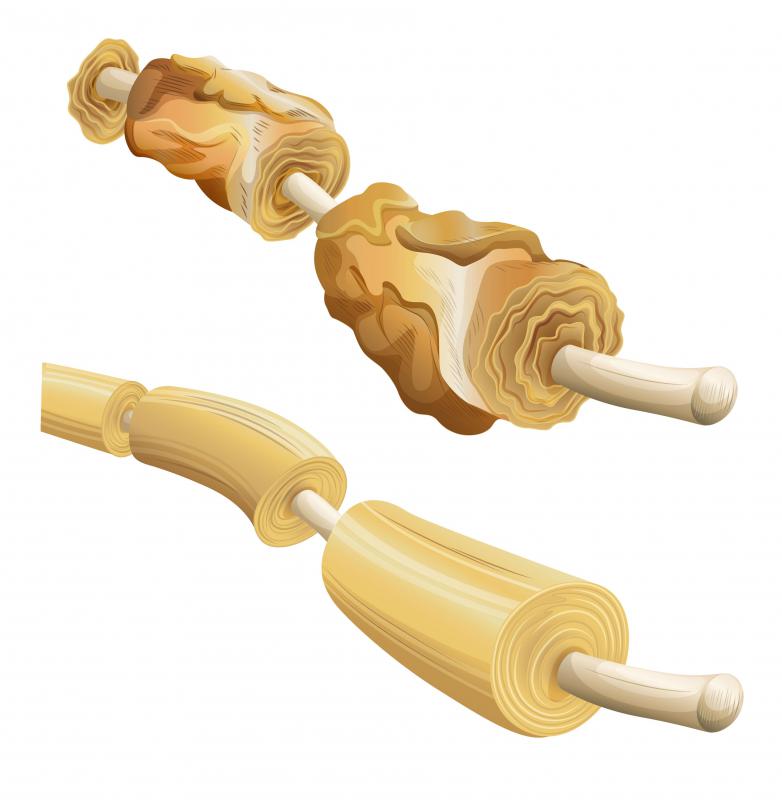
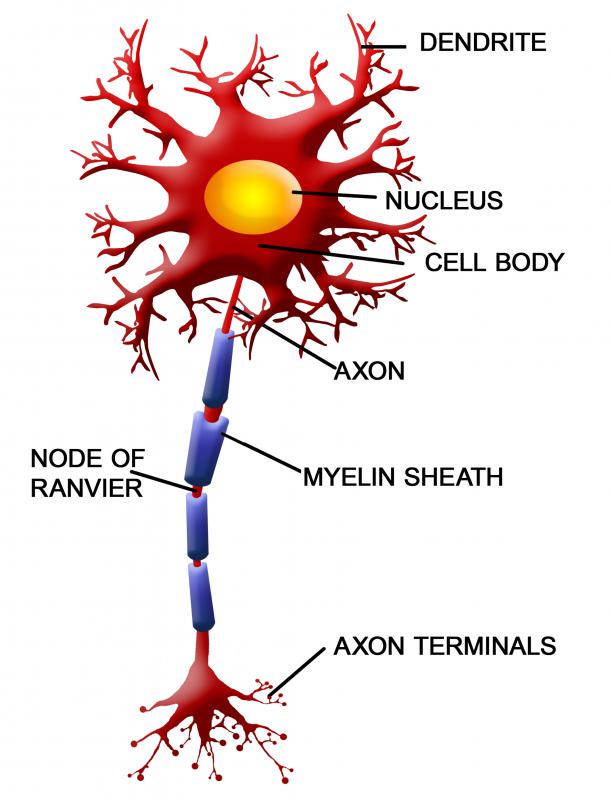
Most Class A nerve fibers are myelinated, which means that they are coated with a myelin sheath the same as many nerves are. This sheath helps signals move more quickly by enabling them to essentially “hop” along the surface of the fiber rather than course through it.

There are many different muscular functions that the nervous system impacts, and fibers in this category can be further broken down into four main sub-classes: A-alpha, A-beta, A-gamma, and A-delta. A-alpha can transmit information as fast as 299 to 394 feet (about 70 to 120 meters) per second, and usually have to do with muscle contractions. Class A-beta nerve fibers transmit information pertaining to touch and muscle movement at 131 to 299 feet (40 to 70 meters) per second, while information pertaining to touch and pressure is transmitted by Class A-gamma fibers at 49 to 131 feet (about 15 to 40 meters) per second. Pain, touch, pressure, and temperature impulses are handled by Class A-delta fibers, and travel approximately 16 to 49 feet (about 5 to 15 meters) per second.
Class B

Class B fibers carry messages related to automatic, involuntary functions from the central nervous system to ganglia, or bundles of nerve cells that act as relay points. Digestion, breathing, and basic organ functioning are just a few examples; pupil dilation and perspiration are included, too. These are things that people don’t do consciously, but that they depend on for good health. The vast majority of these fibers are myelinated, though they are usually a lot thinner than those in Class A. This means that they are a bit slower when it comes to actual transmission time.
Class C

Fibers in the C class carry signals about physical sensations like temperature and pain. These are generally unmyelinated and also quite thin in most cases. This enables them to reach all parts of the body equally, but it does mean that these signals tend to be some of the slowest. Fibers in this class travel approximately 7 inches (17.78 cm) per second.
Common Problems
People can suffer a variety of different health consequences when the fibers connecting the nerves to transmission sites break down or lose efficiency. Small fiber peripheral neuropathy, for example, is a condition where Class C fibers begin to degenerate and misfire. Sufferers frequently become either hypersensitive to pain, or else they have serious delays in how long it takes them to feel pain. Both can be serious and can impact a person’s quality of life, as well as his or her general health.
Sometimes the myelin sheath around Class A and B fibers begins to wear down, too. This may be due to poor diet, viral infection, or simple old age; it may also be a result of degenerative conditions like Multiple Sclerosis and Guillain-Barré syndrome. When these and other conditions are caught early enough they can often be effectively treated, but they can’t usually be cured or reversed.
AS FEATURED ON:
AS FEATURED ON:


-
![The myelin sheath that covers Class A and Class B nerve fibers can deteriorate due to heredity, poor nutrition, or viruses, leading to neurological disorders.]() By: blueringmediaThe myelin sheath that covers Class A and Class B nerve fibers can deteriorate due to heredity, poor nutrition, or viruses, leading to neurological disorders.
By: blueringmediaThe myelin sheath that covers Class A and Class B nerve fibers can deteriorate due to heredity, poor nutrition, or viruses, leading to neurological disorders. -
![Nerve fibers, or axons, are the main lines connecting the entire central nervous system.]() By: Balint RaduNerve fibers, or axons, are the main lines connecting the entire central nervous system.
By: Balint RaduNerve fibers, or axons, are the main lines connecting the entire central nervous system. -
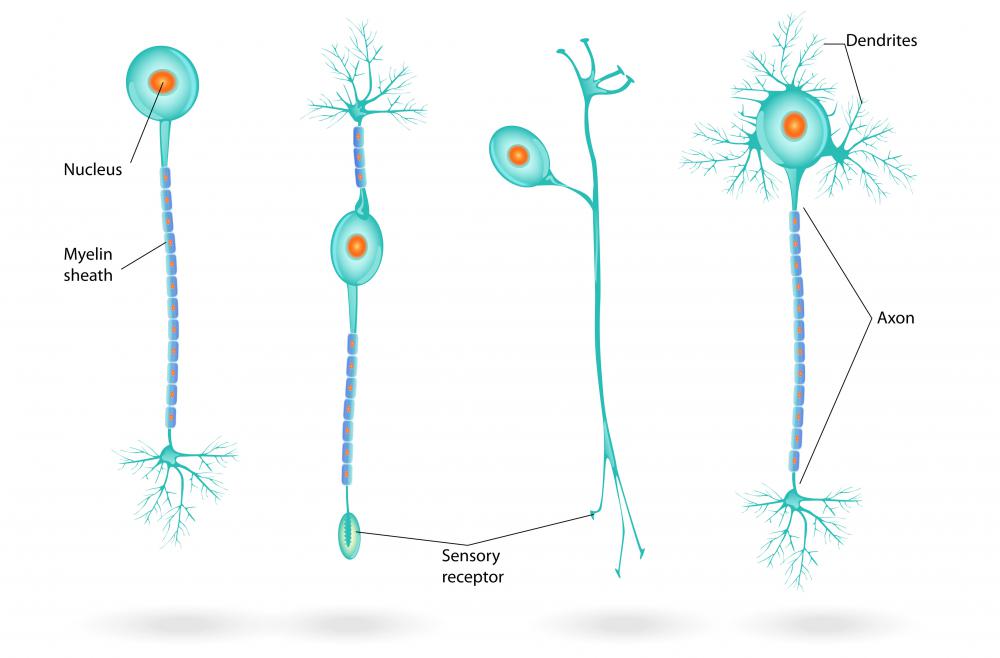
![Class A and Class B nerve fibers have a myelin sheath coating, while Class C nerve fibers do not.]() By: designuaClass A and Class B nerve fibers have a myelin sheath coating, while Class C nerve fibers do not.
By: designuaClass A and Class B nerve fibers have a myelin sheath coating, while Class C nerve fibers do not. -
![Multiple sclerosis is marked by the degredation of nerve cells' myelin sheath.]() By: joshyaMultiple sclerosis is marked by the degredation of nerve cells' myelin sheath.
By: joshyaMultiple sclerosis is marked by the degredation of nerve cells' myelin sheath. -
![Class B nerve fibers are responsible for involuntary functions, such as perspiration.]() By: DirimaClass B nerve fibers are responsible for involuntary functions, such as perspiration.
By: DirimaClass B nerve fibers are responsible for involuntary functions, such as perspiration.


Discussion Comments
@rallenwriter: Nerve "conduction" isn't stronger or weaker, just faster or slower. The different fiber types (A, B, C) carry different types of information, and to different places. C-fibers carry the slow-burning-pain sensation, among other things.
The sharp pain sensation is carried mostly by A-delta fibers - which are thicker and myelinated, and thus faster (fast is nice when you've just put your hand on a hot stove, or started to step on a thorny stick).
simple and clear. Thanks a lot.
I know that this might be too late, but the answers provided to you are wrong.
The correct answer is "tract." A collection of nerve fibers is called a "tract".
A ganglion is a collection of cell bodies of neurons. it is not a collection of nerve fibers.
@earlyforest -- Use your textbook, not the internet! But the answers to your questions are as follows.
A bundle of nerve fibers is called a ganglia or ganglion.
Nerves that contain afferent fibers are called sensory nerves.
Glad to help out, but seriously, your bio textbook should have these answers.
OK, I have this biology assignment on the nervous system and it's killing me.
So what is a bundle of nerve fibers called? The exact phrasing of the question is:
"Another name for a bundle of nerve fibers is..."
And one more question:
"Nerves that contain afferent fibers are called..."
Can somebody help me out?!
Very informative article -- I had no idea that there were different classifications of nerve fibers. I thought they were all just kind of the same thing -- you know, just nerves with a myelin sheath.
Maybe that explains why the nerve conduction feels so much stronger to us with nerves that fall under class C nerve fiber classification rather than those in the class A or B classification.
Really interesting, thanks!
Post your comments