
At TheHealthBoard, we're committed to delivering accurate, trustworthy information. Our expert-authored content is rigorously fact-checked and sourced from credible authorities. Discover how we uphold the highest standards in providing you with reliable knowledge.
What are Ligaments?
 Jeff Petersen
Jeff Petersen
Jeff Petersen
Ligaments are stretchy bands of tissue that, in most cases, hold one bone to another. They are a key part of what allows most joints to move, help control their range of motion, and stabilize them so that the bones move in proper alignment. Some parts of the peritoneum, the membrane that surrounds the abdominal cavity, are also called ligaments although they perform a different function.
Structure

Proteins known as collagen make up the tissue in most ligaments. Groups of these proteins form long, flexible, thread-like strands, or fibers. Collagen fibers are found throughout the bodies of humans and other warm-blooded animals, as they help the skin stay elastic and also make up most types of connective tissue. The composition of these fibers allows them to stretch significantly when they move, such as when the elbow is bent or straightened. Collagen fibers are often arranged in crossing patterns, which helps prevent the joint from moving past its normal range of motion despite the ligament's flexibility.
Types and Function

Connective tissues generally serve to protect organs, store energy, support body structures, or connect other tissues. Most ligaments fulfill the last function and help flex or extend a body part; these are called joint or articular ligaments. In the elbow, for example, the ulnar collateral, radial collateral, and annular ligaments work together to allow the joint to move. They are found in the head and neck, pelvis, wrist, and knee, among other places. Each joint typically contains at least three, with the knee having eight.
Other ligaments, such as those found in the back, mainly provide stability to bone or cartilage. If the structure primarily strengthens or supports other ligaments, it is called an accessory ligament.

There are additional structures that are called ligaments even though they do not connect bones. Most individuals, for example, have portions of a tubular structure left over from fetal development known as the fetal remnant ligament. Parts of the peritoneum that are folded together and are found around or between certain organs are called peritoneal ligaments. They surround a number of blood vessels, including the hepatic portal vein to the liver, and support significant parts of the reproductive system in women.
Injuries and Treatments

Sprains are perhaps the most common ligament injury, and occur when this connective tissue is unexpectedly stretched past its normal capacity. This is often mixed up with a strain, which is when a muscle has been stretched too far. Sprains are often caused by sudden and violent movement or by improper stretching techniques. When a ligament is damaged more severely, it can be torn or ruptured, a more serious injury.

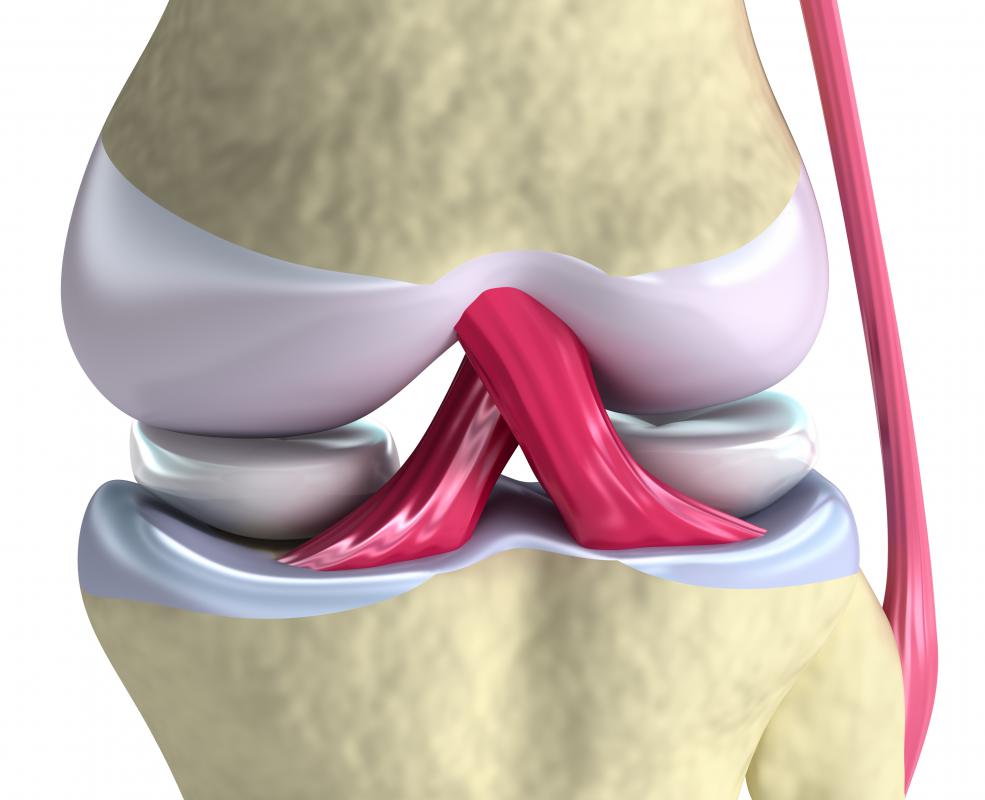
Because ligaments play an important role in stabilizing the joints, they are very susceptible to injury due to overuse or sudden movement. Many professional athletes injure the knees, elbows, and shoulders especially as actions taken while running, jumping, and throwing can all damage the joints. The anterior cruciate ligament (ACL), for example, is located behind the knee and often sustains damage through contact-heavy or running sports.

If a ligament is stretched too far too often, the joint will become weaker and less flexible, which can lead to long-term health concerns. Connective tissue also has a relatively low blood supply, so it may take longer to heal. Patients should be careful when engaging in any activities that can put excessive pressure on an injured ligament, as this may cause additional damage.

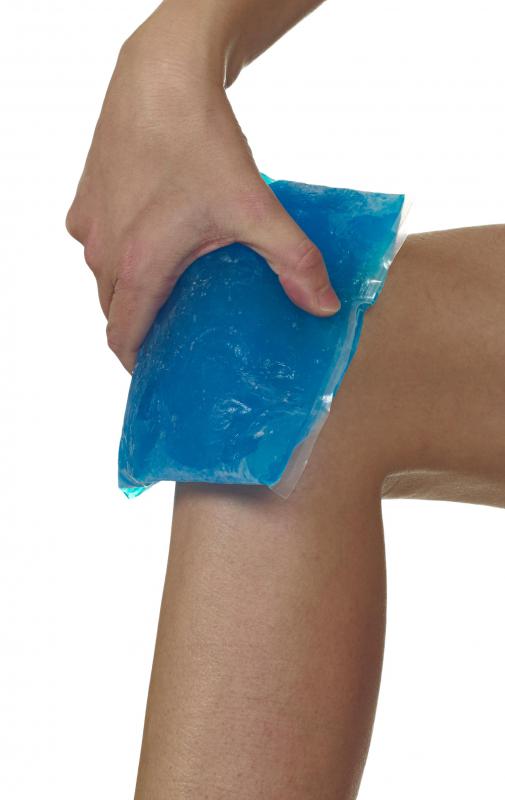
Injuries may benefit from at-home remedies like icing and rest, which can help relieve swelling and inflammation. Braces can be used to keep the injured body part stable, which can quicken recovery as well. More severe injuries may require physical therapy, where the ligament will be worked through light exercise. Generally, only major issues, such as a tear or rupture, will need surgery.
Stretching Benefits

Regular stretching can increase the length and flexibility of the muscles and by extension the ligaments. This strengthens the joints, helping to prevent injury and allowing them to move farther and support more activity. In extreme cases, this can even allow people to perform seemingly impossible body movements, such as the contortions of an acrobat or the kicks of a martial artist. Some individuals are naturally gifted at extraordinary movement, like so-called double-jointed individuals who have extra-long ligaments that allow their joints to stretch beyond the normal range.
Similar Tissues
Jeff Petersen
Jeff is a freelance writer, short story author, and novelist who earned his B.A. in English/Creative Writing from Creighton University. Based in Berkeley, California, Jeff loves putting his esoteric knowledge to good use as a TheHealthBoard contributor.
Learn more...
Jeff Petersen
Jeff is a freelance writer, short story author, and novelist who earned his B.A. in English/Creative Writing from Creighton University. Based in Berkeley, California, Jeff loves putting his esoteric knowledge to good use as a TheHealthBoard contributor.
Learn more...AS FEATURED ON:
AS FEATURED ON:


-
![A knee joint with the ligaments shown in pink.]() By: Alexandr MitiucA knee joint with the ligaments shown in pink.
By: Alexandr MitiucA knee joint with the ligaments shown in pink. -
![A medical professional wrapping an elastic bandage around a person's knee because of ligament problems.]() By: Gennadiy PoznyakovA medical professional wrapping an elastic bandage around a person's knee because of ligament problems.
By: Gennadiy PoznyakovA medical professional wrapping an elastic bandage around a person's knee because of ligament problems. -
![Elbow braces are among the most common ligament support items in use.]() By: Julián RovagnatiElbow braces are among the most common ligament support items in use.
By: Julián RovagnatiElbow braces are among the most common ligament support items in use. -
![Double-jointed people have unusually flexible joints, tendons, and ligaments.]() By: kekiDouble-jointed people have unusually flexible joints, tendons, and ligaments.
By: kekiDouble-jointed people have unusually flexible joints, tendons, and ligaments. -
![Torn ligaments in the knees can seriously impair walking.]() By: DirimaTorn ligaments in the knees can seriously impair walking.
By: DirimaTorn ligaments in the knees can seriously impair walking. -
![Many types of knee ligament injuries will improve with home-care treatment, such as applying ice and resting.]() By: LovrencgMany types of knee ligament injuries will improve with home-care treatment, such as applying ice and resting.
By: LovrencgMany types of knee ligament injuries will improve with home-care treatment, such as applying ice and resting. -
![Sprains are the most common ligament injury.]() By: Monkey BusinessSprains are the most common ligament injury.
By: Monkey BusinessSprains are the most common ligament injury. -
![Ligaments are very susceptible to injury due to overuse or sudden movement.]() By: .shockLigaments are very susceptible to injury due to overuse or sudden movement.
By: .shockLigaments are very susceptible to injury due to overuse or sudden movement.




Discussion Comments
i fell off my stair two days ago. I feel sharp pain. what do I do?
One of my friends is suffering from a ligament problem in the ankle. What is the solution to recover from this problem.
@MrsFuller5: I know you said you couldn't afford it, but if you decide to go out of state, look online for sports medicine clinics and find the one nearest you. Look on the clinic's site for the name of their chief of orthopedic surgery. Get an email or address and tell your doctor you want a referral to this clinic. Then, have your doctor send the surgeon your records.
If you look around online, you may find a sports clinic has a branch in a town in your state, or even a local orthopedist who works with such a clinic. Good luck.
I found out the other day that I have an LCL tear in my knee. Don't know how it happened and it has been this way for years. My doctor says that surgery won't be able to repair it, it's that bad. It makes me wonder how he can come to that conclusion without doing any scans.
I am 23 and have a child. This injury makes life and being a parent, rather difficult as my mobility is limited. I cannot find anything online that says this injury can't be repaired beyond a certain point, not even with athletes. I am so frustrated. I live in a smallish town where decent doctors are hard to come by. Heck, our hospital scored as the worst hospital in my state. What am I supposed to do? I can't afford trips out of town to see a better doctor, and don't even know how to go about it all. Any advice?
My 4 year old daughter's knee gives out sometimes when she jumps down, then she collapses. And then she tries to get up and walk because she is tough, but then she can't walk for about five minutes. It also happens when she is running, like last night when she was running backward. It is still sore today but she is still running around. Should I be concerned and what is it?
I injured my right ankle. I originally was told it was a third degree sprain on the outside ankle, a second degree separation on the inside ankle, with mild knee sprain.
I did elevation and ice, then a month later had physical therapy. It hurt so much and was still swelling after two months, so they did an MRI. It showed a bone bruise or fracture with marrow edema, torn ligament, tendinitis and pockets of fluid.
Can you tell me what options for treatments are out there so I can be more informed when I go to the orthopedic specialist doctor's appointment? Thank you for any information and help.
I find myself standing up and without any notice or warning, my knees seem to collapse. There is no pain; I just feel like I am losing my balance. Any suggestions as to what is causing it?
fix your patella ligament. It stops your leg getting hurt if you fall over because it will keep your patella in place so it doesn't move out of place. A ligament keeps your joints together.
Age of ligaments in conjunction with determining illness in the body. please help me to understand this. Thanks.
I had a car accident two weeks ago. It hit my knee. What should I do?
I have just found out about your site and you seem to be very informative. Thanks to all who work and give their time and helpful knowledge to this site.
I was involved in an auto accident and t-boned which was a hit and run, and now my doctor tells me that i have two torn ligaments in my lower back.
He gave me pain pills and a muscle relaxer that does nothing for me, and I've been on bed rest for three weeks now.
Plus i have a therapist who wants to give me a steroid shot. Will this help the problem or is this just a temporary fix. Do you have any suggestions? Signed, please help.
I dropped a computer modem on my left big toe a month and two weeks ago. The pain was still bad, and the toe was still swollen, so I went to the ER the next night.
They x-rayed me and said it was a contusion, not a break. The pain is still with me. When I do leg stretches, it feels like there is a knife going into the right side of my toe.
Is there ligament damage and will a steroid shot get me over the healing hump? What is going on? I have an appointment with the orthopedist next Monday.
I have some pain around the waist which turns to be a sharp pain around waist back and front and the lower side of the shoulders. who can assist?
I had menisectomy operation in May (Ligaments/cartilage). I still feel moderate pain on the site where the camera or scope went in. Is this normal?
I had a torn ligament in the knee. I had surgery and it was fine for about three months and now periodically it gets very painful and I can hardly walk. The doctor said there is nothing he can do. Also the knee gives out sometimes and I am scared I will fall. Does anyone have a similar problem and if so what have you found that helps?
My doctors say I have inflamed ligaments in my thumb between the finger bone and the connecting bone. He said to rest it (which is almost impossible) take ibuprofen and ice three times a day for 20 minutes. If this does not work we can give you a cortisone shot. Guess I will be getting a shot because two weeks have passed and my thumb is still inflamed. Anyone know a better solution for my problem?
Hey will you be able to put up information about synovial joints and synovial fluid up please?
Here is an exercise that can strengthen ankle ligaments. Sit in a chair and place a towel under your bare feet. Starting with the small toe try to grab the towel and work toward the big toe, all the while keeping your heel on the ground. Do several repetitions and switch to the other foot.
Hi, My son is 17 and has torn his Ulnar ligament in elbow. I am wondering if anyone knows how long this takes to heal or if with a good hinged brace it offers enough protection that he can play football? Should he not play until completely healed. Thank you, Worried Mom
this site is very helpful. it's got clear information which is easy to understand!
I tore my some ligaments or muscles in my growing area and above that between my stomach and my left growing i guess. what do i need to do about it. I also have a bone spur in my right hip. could that be causing me to tear stuf in that area of the growing. i keep tearing stuff and i don't why. i am a bullrider so i know that that puts strain on it but it wasn't till just in the last couple of years that i have been tearing them. could back problems with the spine cause me to tear ligaments in that area.
I've just came to know about your site. Its very informative. Thanks to those who worked for it.
In fact, I was looking for a remedy to my problem. When I go for jogging, I feel a severe pain on outer side of the knee. It almost makes me limping. Someone told me its because my ligaments have become weaker. The same thing happens when I strongly throw a ball. I feel pain at lower part of the shoulder. A few years earlier, I could do so without such pain and could throw the ball even farther. In both the cases, pain disappear in a couple of days.
I wonder if there's a way to reinforce ligaments (exercice, movements, precautions). If you know anything about it, please share it with me.
How come you always hear about ACL and meniscus injuries? What is the other ligament called? The one behind the ACL? Isn't it the PCL? Posterior Cruciate Ligament? Is that less susceptible to injury? Why?
Post your comments